What Is VVV? The Privacy-Obsessed AI Token That’s Up 3,000% in 2026
In brief
- Venice (VVV) hit a fresh all-time high of $34.51 on September 21.
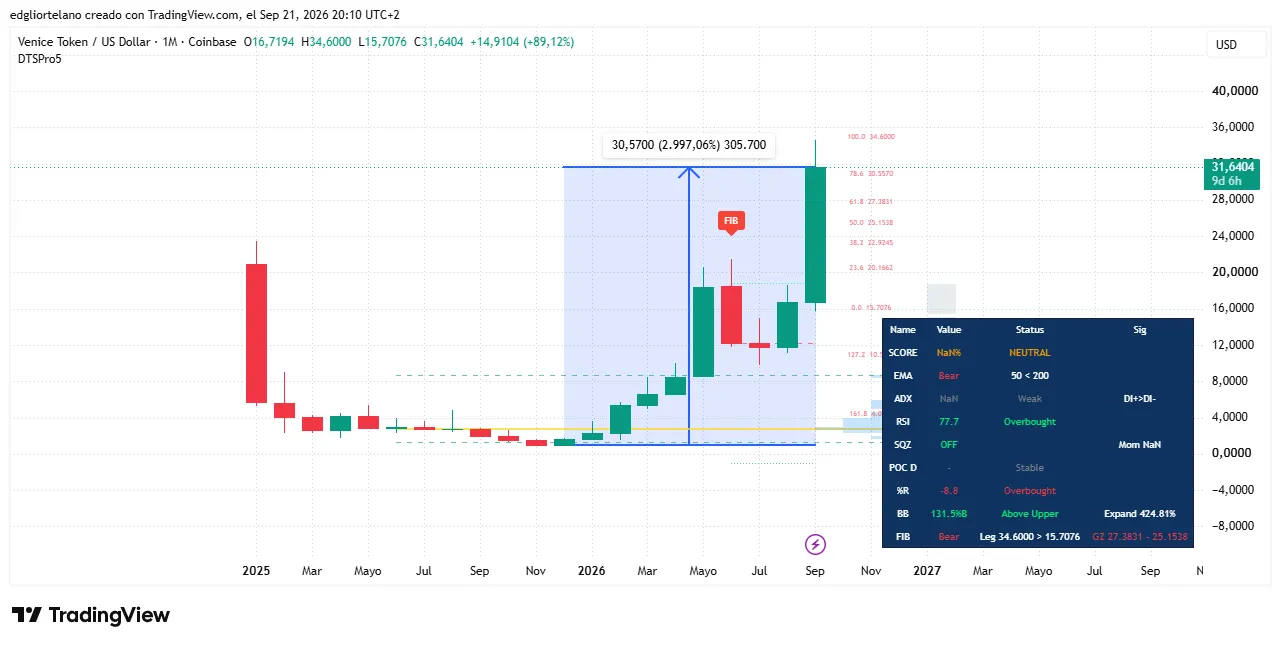
- The token is up roughly 17% in a day and more than 3,500% since bottoming out at $0.92 last December.
- VVV is the access key to Venice AI, a privacy-focused chatbot founded by ShapeShift's Erik Voorhees, and the token now ranks as the third-largest AI cryptocurrency by market cap.
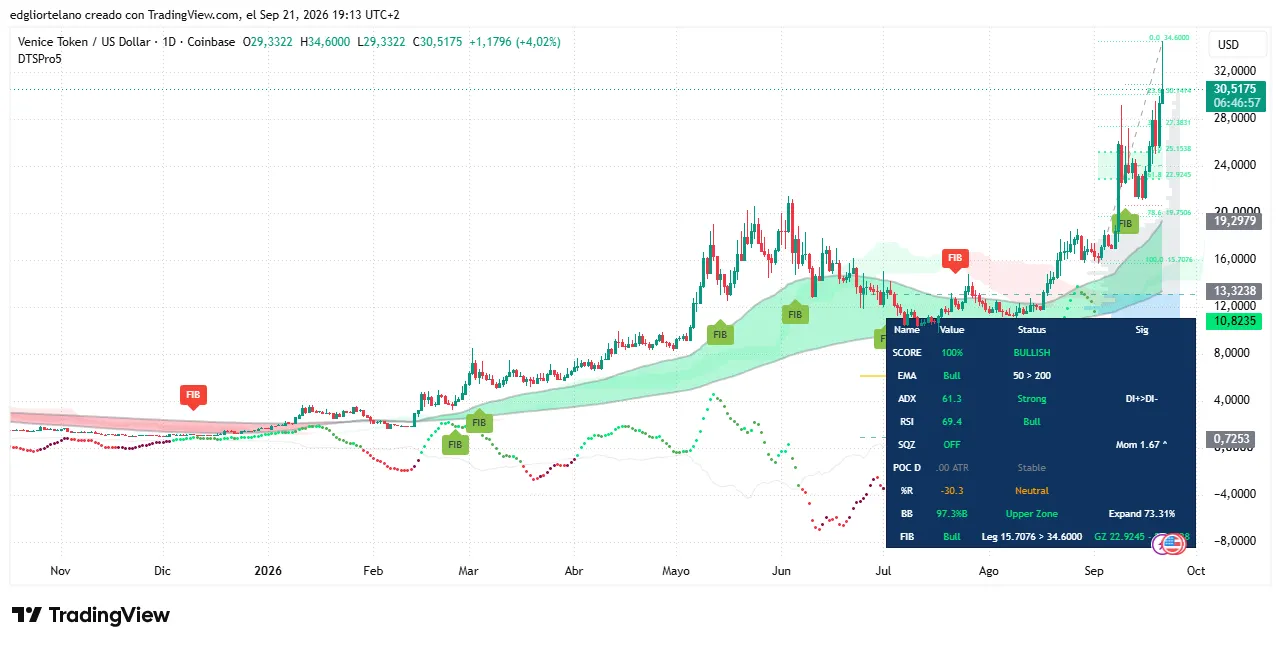
The native token of the Venice AI platform just hit a fresh all-time high of $34.51 on Sunday, and it doesn’t look to be slowing down.
The token, which trades under the ticker VVV, is up roughly 17% in the past 24 hours and has climbed around 3,000% since bottoming out at $0.92 last December. Its market cap now sits near $1.6 billion, making it the third-largest AI-focused cryptocurrency, trailing only Near and Tao.
VVV isn't a coin you spend on coffee. It's an access key for Venice AI, a chatbot and image generator built by Erik Voorhees, the early Bitcoin and crypto entrepreneur who founded ShapeShift.
Instead of billing users per prompt the way ChatGPT does, Venice lets people stake VVV—lock it in a smart contract—to claim a daily share of the platform's inference, which is simply the computing work an AI model does to turn a prompt into an answer.
Of course, you can also pay with fiat for your private inference plan, but where’s the fun in that?
How VVV staking replaces the subscription
There's a second token in the mix called DIEM. Lock up staked VVV, and Venice mints DIEM, which hands the holder a dollar's worth of API credit every day, forever. It's an odd piece of financial engineering—part subscription, part perpetuity—but it ties the token's value to actual platform usage rather than pure speculation.
A portion of Venice's revenue also buys VVV on the open market and burns it permanently, shrinking supply over time.
So it’s an utility token with an actual, relevant application right now. Most mainstream chatbots keep a copy of what users type, at least temporarily, to improve their models and screen for abuse. Venice says it does neither: no logs, no account required, and none of the content filters that block certain requests elsewhere. That's either a privacy win or a red flag depending on who's asking, but it's the entire reason Venice and its token VVV exist as a business.
The Venice rally, and the catch
Earlier in September, a public dispute broke out between an NYU mathematician and OpenAI over who deserved credit for a fluid-dynamics proof. Neither side accused the other of misusing private chats, but the argument raised an uncomfortable question that spread fast on X and Hacker News: Could a company that reads your prompts eventually fold your ideas into a competitor's research?
Venice’s pitch is that its platform makes this impossible, putting users’ minds at ease when it comes to their ideas leaking out after they enter a Venice chat.
VVV jumped 34% in a single day on the speculation alone and skyrocketed since then.
Beyond the speculation and cypherpunk talk, Venice said in August it had crossed a $100 million annualized revenue run rate, up from $70 million a month earlier, and in July it raised $65 million in a Series A led by crypto fund Dragonfly at a $1 billion valuation, its first outside capital since launching in 2024.
Annual token issuance, meanwhile, has been cut repeatedly, from 14 million VVV a year at launch down to 2.5 million as of September 1, with a further cut to 2 million scheduled for October.
None of this makes Venice the best AI provider on the market. It doesn't train its own frontier model; it routes prompts to open-source systems like Llama and DeepSeek, which trail OpenAI's and Google's top models on most public evaluations.
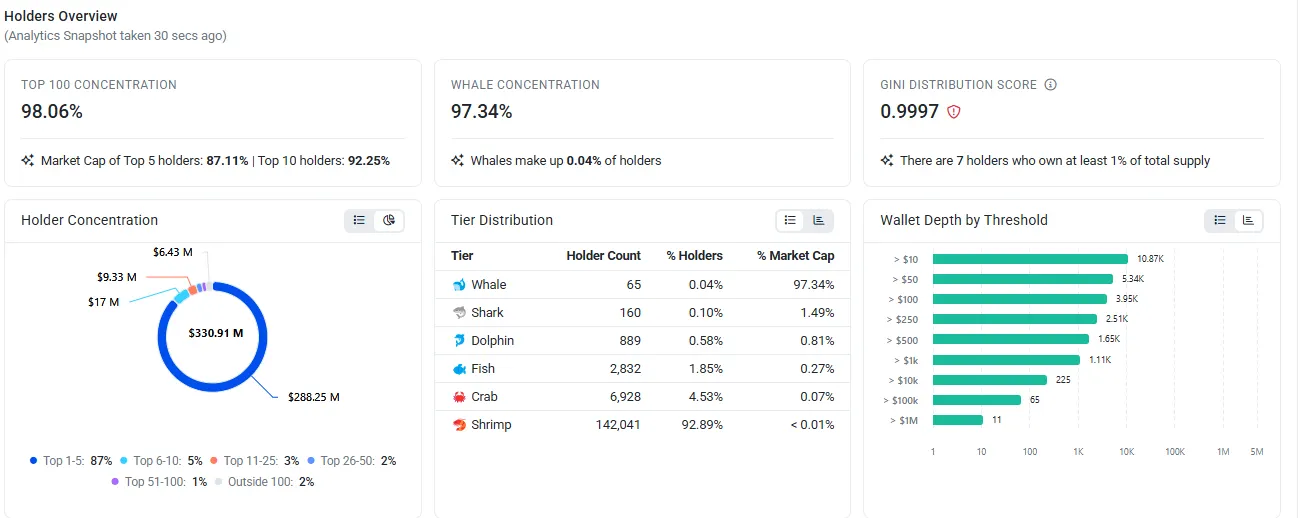
What Venice sells is discretion. The token carries its own warning sign, too: market data shows the 100 largest VVV wallets control roughly 98% of the supply, meaning a handful of holders can swing the price far more than any wave of retail buying.
Venice's annual emissions are scheduled to fall again on October 1, from 2.5 million to 2 million VVV a year, the next milestone in a supply squeeze traders are watching closely.