US courts target $1.2B in stolen Binance funds, yet victims face a new hurdle
Quick Take
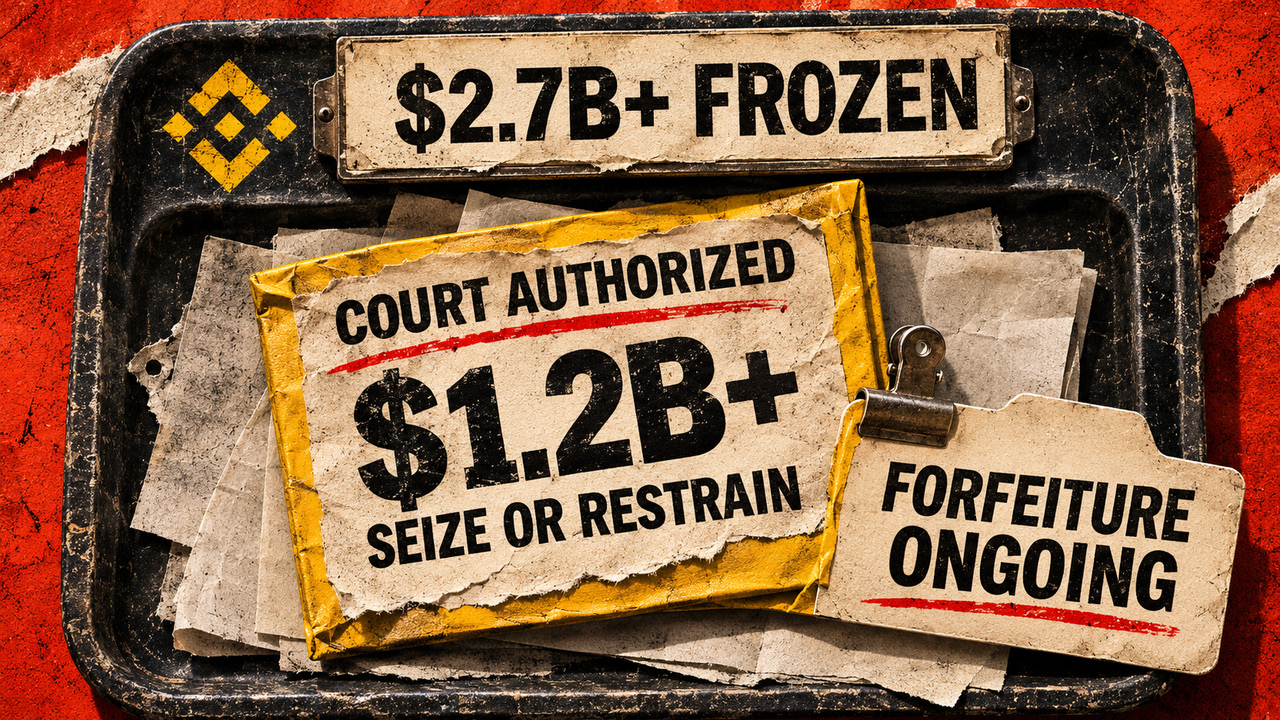
- DOJ disclosed court authority to seize or restrain more than $1.2 billion stolen from Binance in its Nov. 12 announcement.
- The release leaves forfeiture completion and return timing unresolved.
- Binance's Nov. 3 promise to absorb the loss concerns company funding, separate from recovering the stolen assets.

US authorities have secured court authorization to seize or restrain more than $1.2 billion stolen from Binance funds, advancing the legal effort to recover assets from the October theft.
The Department of Justice (DOJ) disclosed the authorization on Nov. 12 but did not announce completed forfeiture or a timetable for returning the money.
The court-covered assets sit within more than $2.7 billion frozen through combined US government and private-sector efforts, according to the department.
The larger figure measures the combined freezing effort, while the smaller one identifies the portion for which DOJ reports seizure or restraint authority.
Binance had already committed to covering its losses in its Nov. 3 incident report. The exchange promised to absorb the financial impact of the stolen funds and said it had set aside more than 100% of what it would need to cover the loss.
DOJ attributes the theft of more than $6 billion on or about Oct. 29 to North Korean military actors known as TraderTraitor. Its announcement said efforts to trace, freeze, seize and forfeit the stolen assets remained ongoing as the attackers continued laundering them through cryptocurrency bridges, mixers and exchanges.
Court authority covers part of Binance's frozen haul
The DOJ's Nov. 12 figures describe nested amounts. Binance's dated loss-coverage promise concerns a separate company undertaking.
More than $1.2bn is within the frozen pool; the release leaves return timing open.
Figures are lower bounds, not exact totals or a common valuation series. Areas are not proportional. No seized/restrained split or asset-return timetable is provided. Binance's promise is company-reported, not independently audited reserves.
Sources
Supporting facts
- The Justice Department said on November 12, 2026 that it had obtained court authorization to seize or restrain more than $1.2 billion of cryptocurrency stolen from Binance. [1]
- According to the Justice Department's November 12 announcement, the more than $1.2 billion covered by seizure or restraint authority is part of more than $2.7 billion frozen through combined US government and private-sector efforts. [1]
- The November 12 Justice Department announcement does not announce completed forfeiture of the Binance assets, specify how much of the court-covered pool is seized versus restrained, or provide a timetable for returning it. [1]
- In its November 3 incident report, Binance promised to absorb the financial impact of the stolen funds and said it had set aside more than 100% of the funds required to cover the loss. [2]
Method
Conceptual containment using DOJ's reported lower bounds. The court-covered pool is part of the frozen pool. An undirected dotted connector links that pool to the unanswered return question, not to a documented distribution route. Binance's dated promise remains separate.
Scope
Figures are lower bounds, not exact totals or a common valuation series. Areas are not proportional. No seized/restrained split or asset-return timetable is provided. Binance's promise is company-reported, not independently audited reserves.
 CryptoSlate
Court authority leaves further recovery steps for Binance funds
The department's detailed account uses the wording “seize or restrain” and does not break down how much of the covered pool falls into each category.
The authorization establishes the scope of court-backed action over part of the frozen assets, without establishing that the entire amount is already seized.
The release describes forfeiture efforts as ongoing, and leaves the eventual recipients and distribution route unspecified.
DOJ's general guidance on compensation from forfeited assets helps explain the distinction between securing assets and paying victims.
Before remission can occur, the government must identify, seize, and forfeit assets.
The court authorization marks progress in recovering the stolen haul. The Nov. 12 announcement leaves unanswered how much is ultimately forfeited, who receives the assets, and when any return occurs.
Mentioned in this article

Editorial credits

Also known as "Akiba," Liam Wright is a reporter, podcast producer, and Editor-in-Chief at CryptoSlate. He believes that decentralized technology has the potential to make…

Gino Matos is a law school graduate and a seasoned journalist with six years of experience in the crypto industry. His expertise primarily focuses on the Brazilian blockchain…