Palmer Luckey Says He’s Building an Offshore Haven for Industry—And 'Illegal' Medicine
In brief
- Palmer Luckey revealed SLAB, a proposed ocean platform designed to last 1,000 years and allow American industries to operate outside certain state and local regulations.
- Luckey says the project received funding at a $1 billion valuation in 2017, but has not disclosed its location, construction status or operating timeline.
- In an exchange on X, Luckey said he wants people to access medicine currently illegal in the United States, raising questions about the limits of offshore regulation.
Palmer Luckey, the billionaire founder of Oculus and defense technology company Anduril, is spending over a billion dollars to have a private island where he can do things without worrying about U.S. laws.
He wants to build a massive industrial platform in the ocean where American businesses can operate without some of the regulations they face on land. And he has apparently been working on the idea for nearly a decade.
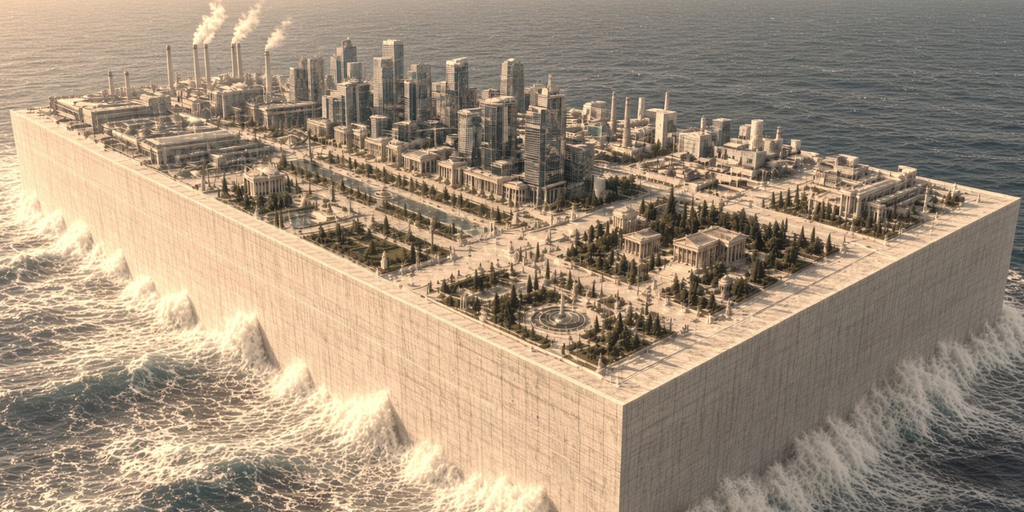
In an X post published Wednesday, Luckey revealed a project called SLAB, a proposed seastead with a 1,000-year design life that he says could support industries ranging from metal processing and oil refining to medical research and treatment.
Selling Oculus to Facebook in 2014 gave me money for helicopter flight lessons and developing a seastead called SLAB with a 1,000 year design life.
The goal was to be cheaper than land and absent state/local laws that cripple critical American industries like metal processing,… pic.twitter.com/aJkd0eOgLF
— Palmer Luckey (@PalmerLuckey) November 18, 2026
His goal, he wrote, is to create an industrial base cheaper than land and free from state and local laws that he believes are crippling critical American industries. Luckey described the project as a way to strengthen the United States rather than escape it, calling it a "relief valve" for outdated regulations.
“Me and a few close friends cashed it up at a $1B valuation back in 2017, and while it still has a long way to go, there has been significant progress towards my goal of reviving manifest destiny and westward expansion,” he wrote.
Luckey said he used proceeds from Facebook's 2014 acquisition of Oculus to finance the project.
The announcement included an AI-generated illustration of a gigantic offshore platform, rather than photographs of an operating facility so it’s hard to know which type of endeavor he’s dedicating his time and money to.



Luckey said he decided to disclose SLAB after learning that journalists were preparing to describe it as a floating AI data center. He rejected that characterization as incomplete, saying the project was considerably older and "way cooler than that."
Medical treatments outside US regulations
Luckey provided a more specific indication of his ambitions in a heated exchange with journalist Joshua Topolsky, who questioned whether creating an offshore community was a sensible way to modernize medical research.
Topolsky argued that regulatory reform could happen without constructing an island in the ocean and challenged Luckey to identify which existing rules had prevented him from pursuing medical advances.
Luckey responded that he would rather build a place where people could save their families with "safe but currently illegal medicine ASAP" than wait for lawmakers to reform the system.
He accused political interests and large pharmaceutical companies of obstructing change, arguing that conventional reform would require legislation capable of securing support from 60 senators.
Does moving offshore actually escape American law?
Luckey's plan also faces a significant legal complication: moving an operation into the ocean does not automatically place it outside American jurisdiction.
When another X user asked how close SLAB could operate to San Francisco without falling under its jurisdiction, Luckey answered, "Three miles."
That generally corresponds to the boundary of California's state-controlled coastal waters, according to the U.S. Bureau of Ocean Energy Management.
That said, federal jurisdiction extends considerably farther. The United States has a 12-nautical-mile territorial sea and a 200-nautical-mile exclusive economic zone, where it retains authority over certain economic activities and the construction and use of artificial islands, according to NOAA guidance.
The applicable rules would depend on SLAB's location, whether it floats or is attached to the seabed, and how it is registered. Even vessels operating on the high seas remain subject to applicable maritime laws and the jurisdiction of their flag states, so it’s not as if he’d be living in an anarchist fairy tale.
Medical research presents its own complications, if that’s what he’s actually doing. The FDA requires foreign clinical studies submitted in support of U.S. drug approvals to meet good clinical practice standards, including independent ethical review and informed consent. Conducting treatment offshore would not, by itself, make an unapproved drug legal for sale in the United States.
Previous seasteading experiments have encountered similar jurisdictional disputes. A floating community off Thailand triggered a confrontation with authorities in 2019, while a subsequent project in Panama adopted boat registration to operate within an existing legal framework.
This is all, of course, speculation. Luckey has not publicly identified SLAB's proposed location, the specific regulations it would avoid, or the medical treatments he hopes to make available. He has also not announced a construction deadline or provided independently verifiable details of the project's current physical development.
Daily Debrief Newsletter
Start every day with the top news stories right now, plus original features, a podcast, videos and more.