Ethena is targeting the $120 trillion Wall Street stock market to hunt yields 5x higher than Bitcoin
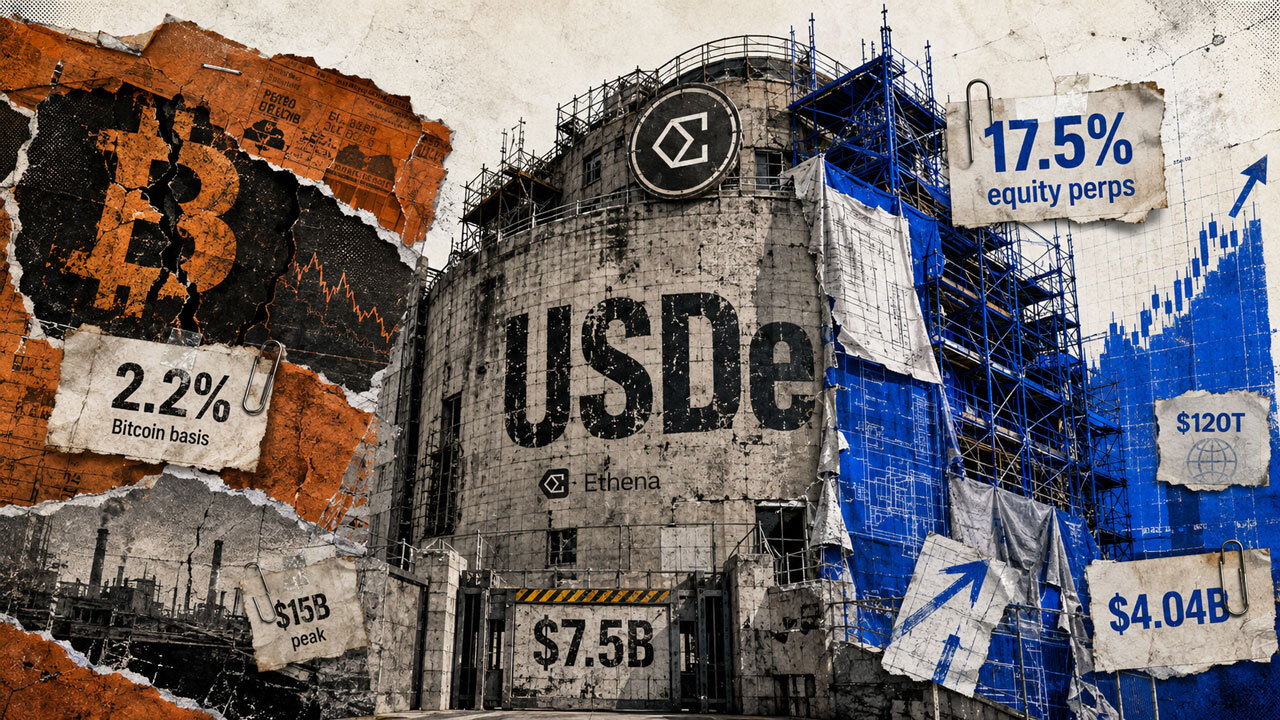
Ethena is expanding USDe into equity perpetual-basis trades, targeting funding yields more than five times higher than Bitcoin’s as the synthetic dollar looks to recover from its 2026 contraction.
On Aug. 28, Ethena revealed plans to extend the basis strategy behind USDe into equity perpetual futures, where open interest has surged to about $6.2 billion from less than $1 billion in March. Funding rates in this market have averaged about 14% on Hyperliquid and 17.5% on Binance in recent months.
By comparison, Bitcoin perpetual funding averaged 2.2% this year through Aug. 11, down from 4.9% in 2025 and 11% in 2024.
Ethena founder Guy Young said equity and commodity-linked perpetuals have become one of the protocol’s biggest potential growth markets.
According to him, real-world asset perpetual volume exceeded half of crypto volume on Hyperliquid last month, while aggregate RWA perpetual volume on Binance reached roughly twice the volume of BTC-USDT, he said.
Young expects open interest and trading volume in the sector to surpass crypto perpetuals across major venues within roughly two years. For Ethena, the expansion increases the pool of underlying assets available to its basis strategy from a crypto market worth about $2.5 trillion to more than $120 trillion of equities.
The protocol plans to start deploying into equity-basis positions over the coming weeks through venues where it already executes crypto trades, using the same infrastructure developed for USDe.
Young said Ethena had delayed entering the market at scale until equity perpetuals developed deeper liquidity and enough trading history to assess their behavior.
The expansion comes as USDe remains near $4.04 billion, less than one-third of its roughly $15 billion peak last year.
Falling crypto yields are forcing Ethena to find a new engine
Ethena’s push toward equities follows a sharp deterioration in the trade that originally helped USDe scale, as falling crypto funding rates have made traditional basis positions increasingly unattractive.
USDe was launched around a delta-neutral structure that paired crypto collateral with short derivatives positions. When traders paid positive funding to maintain leveraged long positions, Ethena could collect those payments while the opposing exposures limited sensitivity to swings in Bitcoin and Ethereum prices.
That strategy performed best when demand for crypto leverage was high.
However, the economics behind that trade have weakened considerably this year because of poor market conditions.
Data from the Ethena Transparency Board shows that crypto basis positions had declined to around 13% of USDe's backing as of press time.
Ethena has filled the gap by moving more of USDe’s backing into other markets.
DeFi lending accounted for about $1.26 billion, or 30.8% of reserves, while liquid stablecoins represented another 32%. Real-world assets made up 12.3%, and institutional lending accounted for 11.8%.
Those allocations were generating yields ranging from about 3.1% for DeFi lending to as much as 7% for institutional credit.
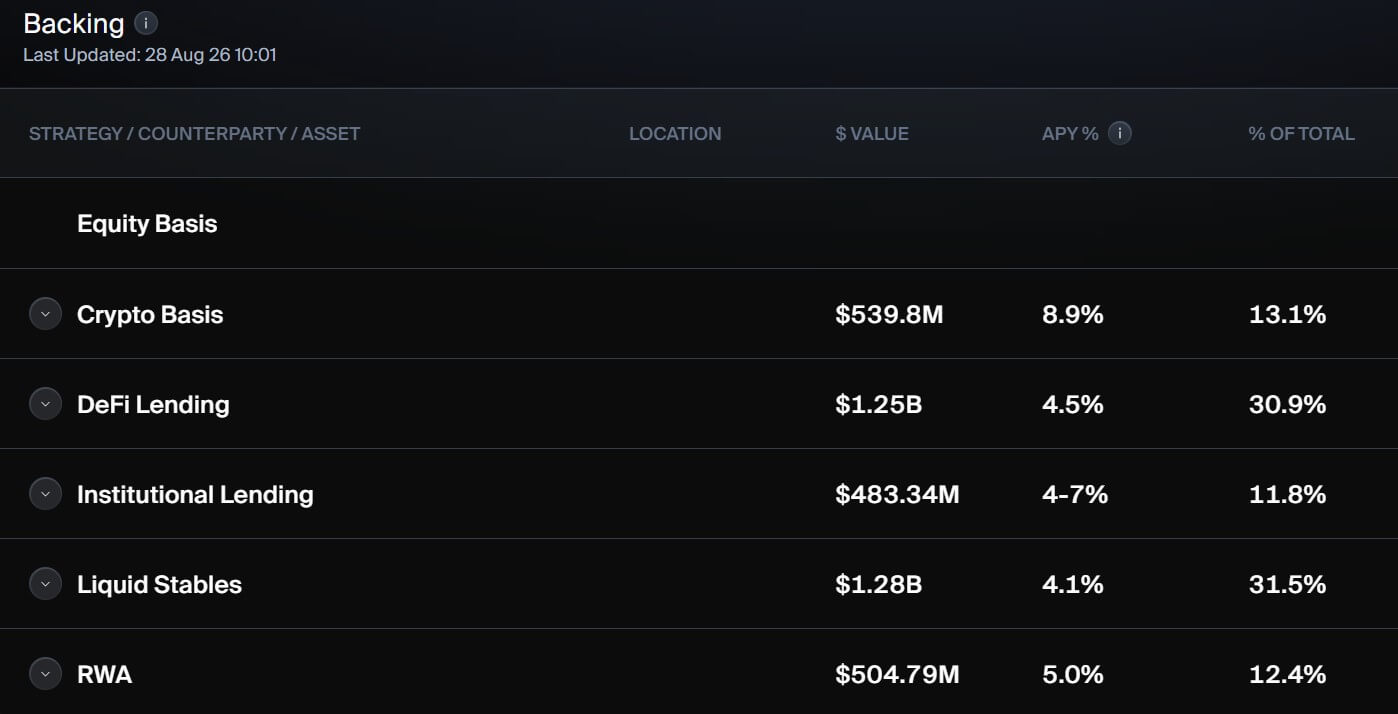
The changes mean the crypto basis book that defined USDe at launch now contributes only a small part of its returns.
Equity perpetuals offer Ethena a way to restore basis trading without depending on another surge in Bitcoin and Ethereum leverage.
They could also make returns less synchronized with crypto cycles. Funding on equity contracts has shown limited correlation with crypto funding, allowing one market to potentially remain attractive when conditions weaken in the other.
However, the opportunity remains exposed to the same forces that can erode any basis trade. Funding rates can compress as more capital enters the short side, while liquidity may prove thinner during periods of market stress.
Equity perpetuals also trade continuously on crypto venues even when the underlying stock markets are closed, creating additional questions around pricing and liquidity outside traditional trading hours.
Ethena is nonetheless betting that the market is growing quickly enough to accommodate larger positions.
Rebuilding USDe is now the gate to ENA buybacks
Finding stronger returns has become more urgent because Ethena is tying future ENA purchases directly to whether USDe can recover the billions of dollars in supply it lost this year.
USDe entered March with roughly $5.92 billion in circulation before falling to $3.90 billion by the end of April, a decline of about one-third in two months. Supply recovered 15.6% to $4.51 billion in May and remained near $4.46 billion through June before slipping again.
August has brought a modest improvement.
USDe climbed from about $3.92 billion on Aug. 10 to more than $4.08 billion on Aug. 23 before easing to around $4.06 billion on Aug. 28. The increase has halted some of the earlier decline but leaves supply far below its 2025 high.
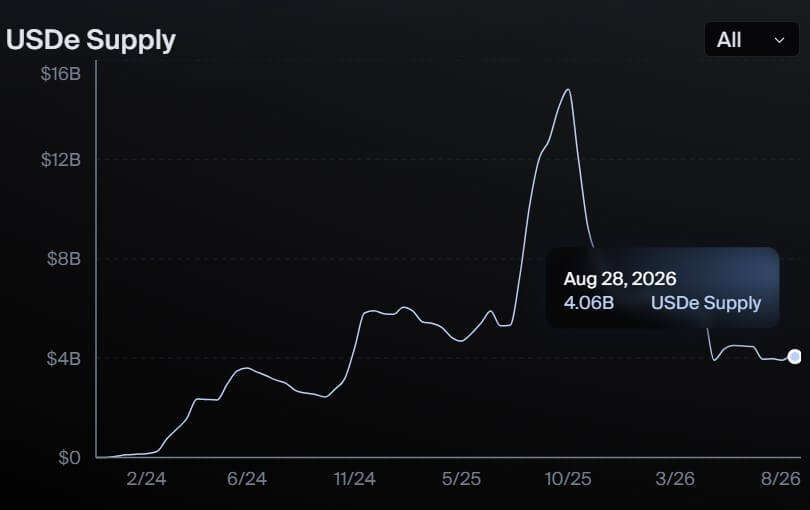
That gap now determines when ENA holders begin benefiting from Ethena’s proposed fee switch.
A governance proposal unveiled Aug. 27 would start directing revenue toward ENA buybacks once USDe reaches $7.5 billion. The share of protocol revenue allocated to the program would then increase as supply crosses $10 billion, $15 billion and $20 billion.
Once the first milestone is reached, Ethena proposes directing 95% of the net revenue paid to its Foundation from its three core business lines toward ENA purchases. Those businesses include USDe savings, white-label stablecoins, and a third operation called Ethena X, expected to launch next week.
At current supply, USDe still needs to add about $3.46 billion, which is an increase of roughly 86%, before the first threshold is reached.
The structure deliberately leaves the buyback inactive while Ethena focuses on rebuilding its core product. The proposal targets a return to roughly $15 billion in USDe, which it reached last year, before eventually pushing supply above $100 billion over the next five years.
The Risk Committee has recommended using a 14-day trailing supply average to determine whether the thresholds have been met, reducing the chance that a single large mint temporarily activates the program. Its backtest estimated buybacks could run about $52.7 million annually under historical conditions, though the amount would depend on future protocol revenue and yields.
ENA traders have already moved ahead of that recovery.
Data from CryptoSlate shows that the token was trading around $0.163 on Aug. 28, up about 11.6% over 24 hours and nearly 99% over the past 30 days. Trading volume exceeded $2 billion as investors responded to the proposed buybacks, changes to investor unlocks, and Ethena’s broader expansion.
The contrast leaves Ethena with a clear test.
ENA has nearly doubled in a month, while USDe remains roughly $3.5 billion short of the level required to turn Ethena’s growing revenue streams into recurring token purchases.
Equity perpetuals are the latest attempt to close that gap. Their current funding rates give Ethena considerably more yield than Bitcoin basis trades, but rebuilding USDe will depend on whether those returns remain attractive as more capital moves into the market.
For Ethena, the next phase of growth is increasingly tied to markets far beyond the crypto derivatives trade that first took USDe to almost $15 billion.