Bitcoin Rally Stalls, But Long-Term Sentiment Remains Bullish

In brief
- Bitcoin dropped as low as $76,877 on Friday after Fed Chair Kevin Warsh's hawkish Jackson Hole keynote, confirming the resistance zone flagged earlier this week.
- September rate-hike odds jumped to roughly 56% from about 35% a day earlier after Warsh said the Fed still has "work to do" on inflation.
- Myriad traders are still pricing Bitcoin's next major move at 77% for $84,000 versus 23% for $55,000, largely unmoved by Friday's selloff.
Bitcoin fell as low as $76,877 on Friday, giving up most of a double-digit weekly gain after Fed Chair Kevin Warsh's first Jackson Hole keynote warned that inflation isn't cooling fast enough.
The drop came from an overnight high of $81,455, inside the resistance zone that had already capped several prior breakout attempts this year. That zone held once again.
Warsh marked his 100th day in the job by declining to give markets any fresh guidance, but the tone was enough to move prices. In his keynote, Warsh set a standard for himself: the Fed needs to see inflation moving toward its target clearly and at sufficient speed before declaring the job done. Short of that, he said, the central bank still has "work to do."
Traders read that as hawkish. September rate-hike odds jumped to 55.7% from 35.4% a day earlier, according to the CME Group's FedWatch tool.
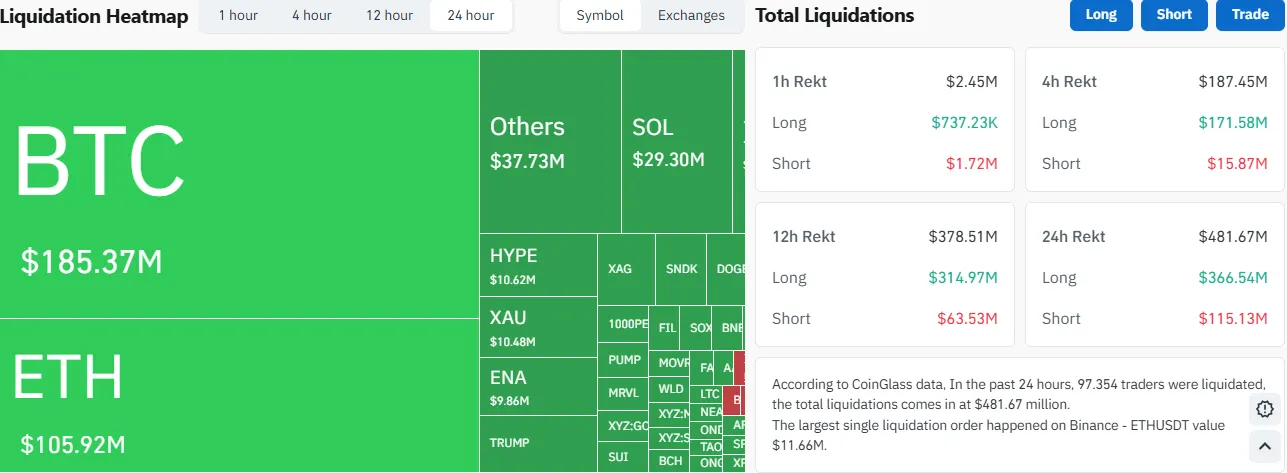
The reaction rippled through leveraged positioning. CoinGlass data showed roughly $481 million in liquidations across the crypto market in the 24 hours around the speech, with more than $360 million of that coming from long positions caught wrong-footed by the drop. Bitcoin closed the day at $77,557, down 3.39%.
Bitcoin price: What the charts say
Technically, the pullback looks more like digestion than reversal. The Relative Strength Index sits at 69.7, well off the overbought reading above 80 that preceded Tuesday's rejection, while the Average Directional Index near 39.5 still points to a strong trend rather than a broken one. Price remains inside the bullish leg that runs from the June low near $68,858 to this week's high near $81,455.
The $73,670 to $75,157 band marks the golden zone traders will watch first if the selloff extends. A close back below that range would put the 50-week moving average and the June breakout structure both in question. Above the market, the $81,000 to $82,500 shelf remains the level bulls need to reclaim for new highs.
The long view: What Myriad bettors are pricing
This is where the long-term bullish case actually lives. Myriad's "BTC next move" market has been running since late February, with $231,000 traded and no fixed resolution date. The two outcomes, a push to $84,000 or a drop to $55,000, have traded the lead back and forth repeatedly since spring as price action whipsawed through the year.
That back-and-forth ended this month. The $84,000 outcome has surged 31.7 percentage points to 77%, against 23% for the $55,000 scenario, and Friday's rejection at resistance hasn't moved that split.
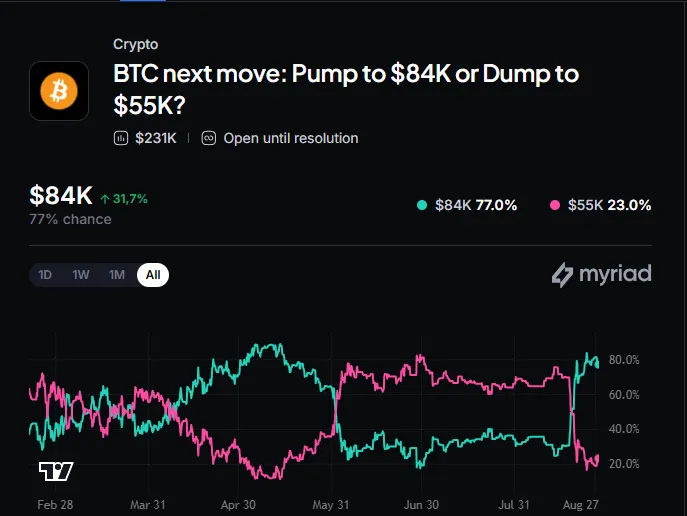
The last time predictors were this bullish was near April.
The fundamental case for higher prices hasn't gone anywhere. U.S. spot Bitcoin ETFs pulled in $2.8 billion over eight straight days of inflows through Wednesday, the longest streak since April.
That demand traces back to a Treasury Department announcement that it would at least double its long-dated bond buybacks starting September 9, supporting a part of the bond market that has seen weak demand since June. Lower long-end yields and a softer dollar revived the "debasement trade" that fueled Bitcoin's climb from roughly $62,000 to $80,000 this month.
Warsh's remarks left that backdrop unchanged, since he set no explicit rate path and merely flagged a condition the Fed hasn't yet met.
Pay attention to the bears
Short-term, the setup still favors caution. Warsh's insistence on ditching forward guidance means traders get no clean signal until the Fed's next rate decision, leaving Bitcoin exposed to headline-driven swings on every inflation print between now and then.
The PCE price index is running at 3.7% annually, nearly double the Fed's 2% target, and Warsh gave no timeline for when that changes.
Resistance has now rejected different attempts on previous months, and Warsh gave bulls no reason to expect the Fed will make the next bull test easier.
Disclaimer
The views and opinions expressed by the author are for informational purposes only and do not constitute financial, investment, or other advice.