Coinbase AI trading tool pauses bots, but leaves orders open
Quick Take
- Coinbase announced server-enforced per-trade and 24-hour volume limits, plus a portfolio-loss trigger that pauses new agent trades.
- Auto-stop does not promise cancellation of open orders or closure of positions, so it is not a guaranteed loss ceiling.
- Isolated agent portfolios support spot crypto only, while US futures require the default portfolio and product-category permissions remain forthcoming.

Coinbase is rolling out Agent Controls for Agents, its service that connects users' AI tools to their trading accounts.
The Nov. 11 announcement adds limits enforced on Coinbase's servers, while leaving users responsible for the trades their agents make.
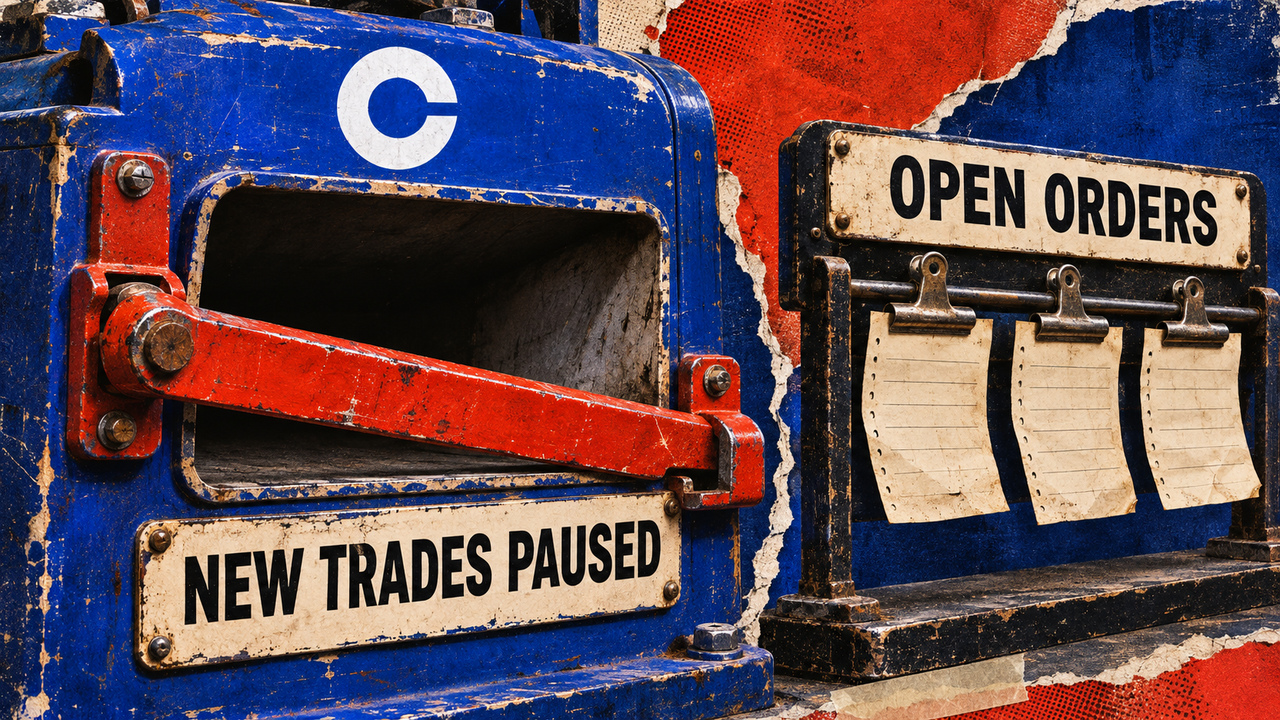
On Nov. 13, CEO Brian Armstrong promoted the controls as a way to make AI use in financial accounts safe. A pause on new trades does not mean existing orders have been canceled, positions closed, or losses ended.
In its Agent Controls announcement, Coinbase describes a maximum dollar amount for each trade and a cap on total trading over 24 hours, and trades exceeding the volume limit will not go through.
Auto-stop adds a portfolio percentage-loss trigger, and the agent stops placing trades until the user turns trading back on in the Coinbase app.
Coinbase says enforcement runs on its servers, where the agent cannot bypass the limits or change them itself, while users manage the settings through their authenticated Coinbase account. That separates the rules governing execution from instructions given to an AI model.
Product-category permissions remain forthcoming. Coinbase labels the choice of whether an agent may trade crypto, equities, or derivatives as coming soon.
The announcement does not say auto-stop cancels outstanding orders or closes existing positions, and also gives no loss-calculation baseline or valuation frequency, and does not define how the 24-hour volume window is counted.
Coinbase's agent guide treats order management as a set of distinct operations, while its equity guidance warns that receiving an order ID is not proof of a fill and says individual cancellation results must be checked.
The command reference lists canceling an order and closing a position separately, with availability depending on the product.
The practical implication is that a user cannot treat an agent's stopped status as confirmation that exposure has ended. A pause, a successful cancellation, and a closed position answer different questions. The published auto-stop description supports the first of those, without promising the other two.
Where Coinbase’s trading controls end
Auto-stop governs new agent trades. Existing orders, positions and portfolio scope require separate attention.
Which portfolio boundary applies?
Users can fund and scope a dedicated portfolio for spot crypto.
A stopped agent is not confirmation that existing exposure has ended.
Vendor-described behavior, not a tested guarantee. Announcement does not specify automatic cancellation or position closure, loss baseline or valuation frequency. Eligibility and product support vary.
Sources
Supporting facts
- Coinbase's November 11 announcement describes Agent Controls rolling out for Coinbase for Agents, with per-trade USD limits, 24-hour trading-volume limits and a portfolio percentage-loss auto-stop. [1]
- Coinbase says Agent Controls run on its servers and cannot be bypassed or changed by the agent; users manage them from their authenticated Coinbase account. [1]
- Coinbase says a trade exceeding the configured 24-hour volume limit will not go through, and auto-stop prevents an agent placing trades until the user turns trading back on in the Coinbase app. [1]
- The announcement does not state that auto-stop cancels open orders or closes existing positions. A pause on new trades therefore cannot be treated as a documented guarantee that losses end at the chosen threshold. [1] [3]
- Coinbase's setup documentation limits isolated agent portfolios to spot crypto and requires US derivatives/futures to use the default portfolio. [2]
- Coinbase recommends creating a dedicated portfolio, funding it with only what the user is willing to risk, and scoping agent access to that portfolio. [2]
- In its equity lifecycle guidance, Coinbase distinguishes an accepted order from a fill and says individual cancellation results must be checked; its command reference lists cancellation and closing an open position as separate operations. [3]
Method
Qualitative mechanism diagram using current source-backed claims. Selectable spot and US-futures views compare documented portfolio scope. No numerical model, prediction or scale is implied.
Scope
Vendor-described behavior, not a tested guarantee. Announcement does not specify automatic cancellation or position closure, loss baseline or valuation frequency. Eligibility and product support vary.
 CryptoSlate
Portfolio isolation has a futures exception
Coinbase's setup documentation recommends a dedicated portfolio funded with only what the user is willing to risk, with agent access restricted to it. That makes the user's initial allocation and permission choices part of the protection.
US derivatives, including futures, require the default portfolio. A user considering futures cannot assume the same dedicated spot-portfolio boundary applies across every supported asset class.
Supported AI apps connect through remote MCP using Coinbase OAuth, where users approve portfolios. The local command-line interface instead uses a CDP API key scoped to selected accounts, with Trade and Transfer permissions.
The documented Transfer permission allows internal portfolio moves, and Coinbase also maintains a client allowlist, so compatibility alone doesn't grant access.
The product page says crypto, stocks, and futures availability depends on region and account eligibility. Approval before each trade and unattended scheduling also depend on the agent app.
Coinbase's guide points users to Account Security Connections to revoke access, but deleting a local skill or clearing a chat does not revoke it.
Coinbase also warns that AI agents can fail, trading can lose the entire investment, and users assume responsibility for agent transactions and third-party data use. Users still have to decide what exposure they accept, check what has executed, and manage the resulting positions.
Mentioned in this article

Editorial credits

Also known as "Akiba," Liam Wright is a reporter, podcast producer, and Editor-in-Chief at CryptoSlate. He believes that decentralized technology has the potential to make…

Gino Matos is a law school graduate and a seasoned journalist with six years of experience in the crypto industry. His expertise primarily focuses on the Brazilian blockchain…