Zcash turns 10 as Grayscale credits developer funding for innovation
Grayscale has credited Zcash’s allocation of 20% of block rewards to development funding for supporting a decade of privacy and security upgrades as the cryptocurrency approaches its tenth anniversary on October 28.
- Grayscale credits Zcash’s 20% developer allocation with supporting continued protocol upgrades.
- Miners receive 80% of block rewards, while development programs receive the remaining 20%.
- Ironwood introduced formally verified supply protections and quantum-recoverable notes in July 2026.
- Zcash’s current funding arrangement divides block rewards between two grant programs.
According to an October 26 research report, Zach Pandl, Grayscale’s head of research, said the funding arrangement has helped Zcash (ZEC) continue improving its technology through prolonged bear markets and periods of weak token performance.
The asset manager pointed to the network’s successive shielded transaction systems, including the Ironwood upgrade introduced in July 2026, as evidence of sustained investment in protocol development.
Grayscale points to Zcash’s 20% developer funding model
Unlike Bitcoin, where miners receive the full block subsidy, Zcash reserves one-fifth of newly issued block rewards for ecosystem development.
Grayscale said the allocation has provided continuing financial support for research, software development and network improvements without depending entirely on venture capital or private investment. The remaining 80% goes to miners responsible for validating transactions and securing the blockchain.
Under the current arrangement, 8% of block rewards support Zcash Community Grants, while 12% fund the Coinholder-Directed Retroactive Grants Program.
The latter structure allows eligible ZEC holders to participate in decisions about funding previously completed work, while community grants support eligible development and ecosystem initiatives.
Grayscale’s research traces the arrangement to the network’s original Founders Reward, which supported development during its first four years before subsequent governance changes introduced different funding recipients.
Pandl argued that consistent access to development resources helped the network continue technical work despite extended periods when ZEC struggled against other cryptocurrencies.
Zcash privacy upgrades span four shielded pools
Grayscale identified successive privacy systems as examples of the network’s development record since its launch on October 28, 2016.
Zcash initially introduced Sprout, using zero-knowledge proofs to support transactions that could conceal information normally visible on public blockchains.
The Sapling upgrade followed in 2018, improving the practicality of shielded transactions. Orchard arrived in 2022 with a newer proving system.
Each generation introduced technical changes to the way shielded funds are handled, with protocol funding contributing to the work, according to Grayscale.
In July 2026, developers activated Ironwood after identifying a vulnerability in Orchard’s zero-knowledge proof circuit that could potentially have enabled undetectable counterfeit ZEC.
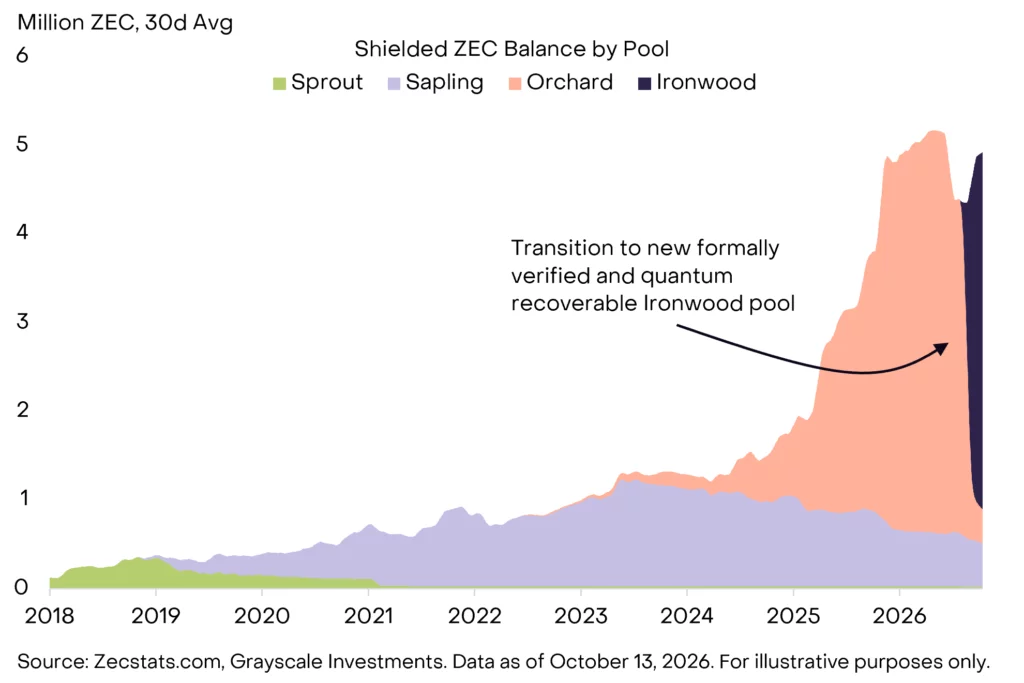
As crypto.news previously reported on Ironwood, the upgrade activated at block height 3,428,143 on July 28, introducing a replacement shielded pool with separate accounting protections.
Developers had already deployed emergency safeguards following the vulnerability’s discovery in May, with project researchers reporting no evidence that attackers had exploited the flaw.
Ironwood introduced formal verification of supply-integrity properties, using mathematical proofs to examine whether the new system could create unauthorized value under its stated assumptions.
The upgrade incorporated quantum-recoverable notes intended to support future recovery procedures if advances in quantum computing threaten existing cryptography.
However, the feature does not independently make Zcash quantum-resistant today, since additional recovery mechanisms would still need to be developed.
Zcash holders approve millions in security grants
Recent community funding decisions provide another example of how the development arrangement operates.
In October, Zcash holders approved $8.39 million in grants covering 17 of 37 proposals in the third-quarter retroactive funding round.
The approvals included $1.5 million connected to researcher Taylor Hornby’s discovery of the Orchard vulnerability, comprising an original bug bounty and a separate community nomination.
Other funded work included $1.95 million for Zcash Open Development Lab’s protocol development and approximately $1.2 million for ValarGroup’s Ironwood contributions.
A further $738,942 was approved for formal verification of Ironwood’s cryptographic circuit, alongside $599,000 for external security audits.
The figures describe approved funding, not necessarily completed distributions, as some payments require administrative and compliance reviews.
Grayscale sees further work on quantum and AI security
Looking ahead, Pandl identified transaction capacity, quantum computing and AI-powered cybersecurity threats as areas requiring continued research.
The analyst said future improvements would depend on financial support from multiple sources and careful allocation of development resources.
Zcash developers are already working on quantum protections beyond Ironwood’s recovery provisions, including planned changes to transaction signatures and proposals addressing privacy risks from future cryptographic attacks.
The network’s current retroactive grants program is scheduled to accept its next round of proposals from October 30 through November 13, with voting planned for December 17–29.