XRP volume surges 99% to $62M, yet small sellers lose out
Quick Take
- XRP-paired native DEX turnover rose 99.9% across two completed UTC weeks, reaching $62.6 million during Nov. 9-15.
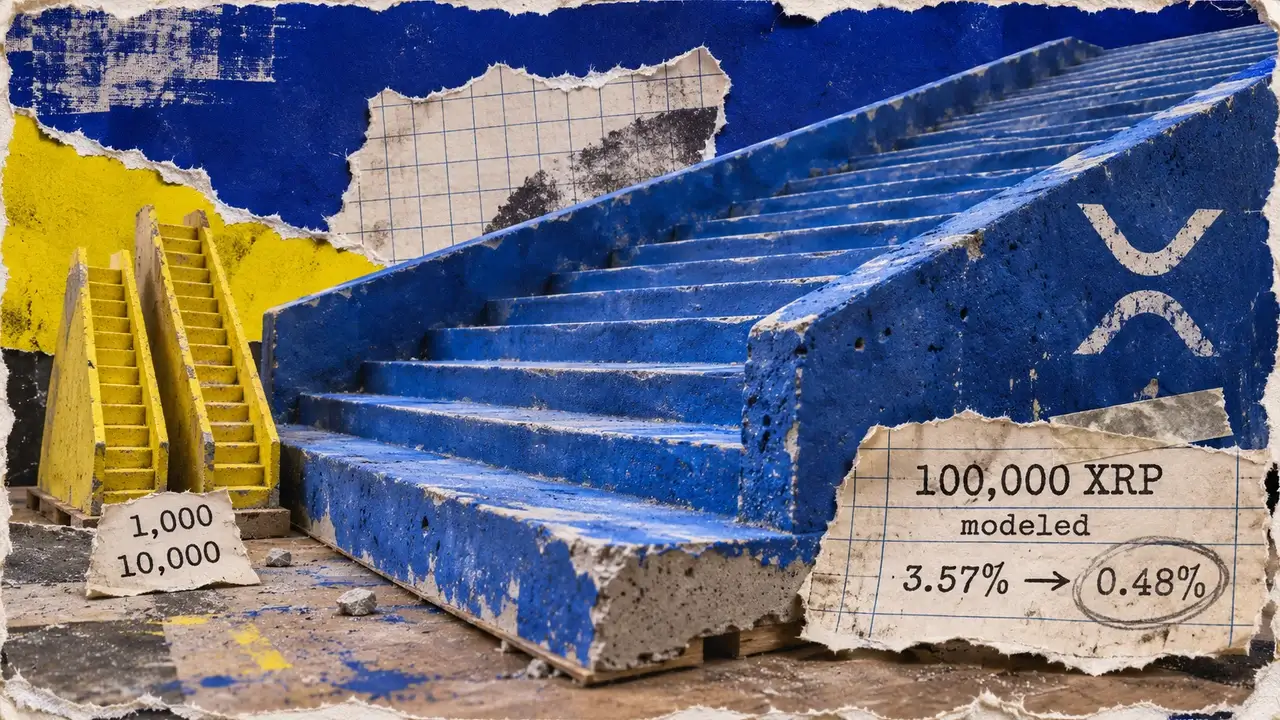
- Matched-ledger modeling narrowed the 100,000-XRP shortfall from 3.57% to 0.48%, while smaller modeled sales fared slightly worse.
- Larger funded RLUSD offers accompanied a smaller pool reserve, but the snapshots cannot establish migration or bank-dollar cash-out capacity.

XRP-paired trading on its native ledger nearly doubled over Nov. 9-15, but a separate comparison of the direct market for Ripple USD (RLUSD) at two dated ledgers showed a smaller execution penalty for a 100,000-XRP sale.
DefiLlama's daily data put completed Nov. 9-15 trading at $62.6 million, up 99.9% from $31.3 million during Nov. 2-8.
The measure combines XRP-paired automated market maker swaps and order-book trades. Native XRP participates directly, but repeated turnover can recycle existing inventory without establishing fresh net buying.
NOSHASHI's ledger data showed the XRP/RLUSD automated market maker holding 2.165 million RLUSD at Nov. 9's close and 1.861 million on Nov. 16, a 14% decline. Native XRP in the same pool slipped from 1.972 million to 1.959 million.
Over that interval, sampled funded RLUSD offers available to token sellers increased from about 19,392 to 111,951 RLUSD, roughly 5.77 times the earlier amount. Funded amounts measure what the offer owners could deliver and may be below the advertised size.
NOSHASHI's measurement requests at most 100 offers per side and counts funded depth within 10% of each snapshot's reference midpoint. Its ask side is the RLUSD inventory an XRP seller receives, and the figures exclude AMM reserves, do not measure all XRP liquidity, and do not imply that every sampled offer sits near the best price.
What different XRP sale sizes could return
An idealized static model combined the Nov. 9 raw offers and pool state with their Nov. 16 equivalents. For each snapshot, it allocated XRP between funded offers and the constant-product pool according to which supplied more RLUSD for the next XRP sold.
The pool calculation includes its ordinary trading fee, 0.308% at the earlier ledger and 0.315% at the later one. XRPL can combine offers and AMMs in an actual transaction, but this calculation is not account-specific pathfinding or a completed fill.
The benchmark is the midpoint of the sampled book's tightest uncrossed bid and ask quotes, equivalent to about 1.098 RLUSD per XRP on Nov. 9 and 0.951 on Nov. 16.
| XRP sold | Nov. 9 modeled RLUSD | Nov. 16 modeled RLUSD |
|---|---|---|
| 1,000 | 1,097 | 950 |
| 10,000 | 10,973 | 9,488 |
| 100,000 | 105,867 | 94,600 |
In CryptoSlate's calculations, the shortfall for 100,000 XRP narrowed from 3.57% to 0.48% against each snapshot's own reference midpoint.
This compares modeled proceeds with the token amount implied by that reference price and includes spread, modeled AMM fees, and price impact. The lower absolute proceeds on Nov. 16 reflect XRP's lower price in RLUSD, despite the smaller relative penalty.
The smaller trades did not share that improvement: the 1,000-XRP shortfall widened from 0.05% to 0.11%, while at 10,000 XRP, it widened from 0.05% to 0.19%.
In the later snapshot, the larger modeled sale relied more heavily on funded offers. On Nov. 9, only about 17,701 XRP went to the sampled book, leaving 82,299 XRP for the pool. On Nov. 16, about 88,471 XRP went to offers and 11,529 XRP to the pool.
The larger modeled sale paid a smaller penalty
XRP-to-RLUSD execution shortfalls at two 2026 snapshots: November 9 close and November 16 at 13:07 UTC. The improvement depended on sale size.
Where the modeled 100,000-XRP sale went
The later model relied mainly on funded offers. The lower XRP price still meant fewer RLUSD received.
The modeled 100,000-XRP shortfall narrowed, but the same sale returned fewer RLUSD after XRP repriced.
Capped sample: 100 offers per side, within 10% of the reference mid. Assumes static liquidity and an eligible receiving trust line. Excludes deeper offers, other assets and additional transfer, network or redemption costs. Estimates are not pathfinding or completed fills; RLUSD is not bank cash.
Sources
Supporting facts
- A CryptoSlate idealized static model combining only the sampled funded RLUSD offers and XRP/RLUSD AMM at matching ledgers estimates 1,097, 10,973 and 105,867 RLUSD for sales of 1,000, 10,000 and 100,000 XRP on November 9, versus 950, 9,488 and 94,600 RLUSD on November 16; these are modeled proceeds, not completed fills or live quotes. [1] [2] [3] [4] [5]
- Relative to each snapshot's own reference mid, the model's execution shortfall for 100,000 XRP narrowed from 3.57% to 0.48%, while the 1,000-XRP shortfall widened from 0.05% to 0.11% and the 10,000-XRP shortfall from 0.05% to 0.19%. These estimates describe only the sampled direct XRP/RLUSD routes, not market-wide execution. The shortfall includes spread, modeled AMM fees and price impact relative to the snapshot's reference mid. [6] [7] [1] [2] [3] [4] [5]
- For the idealized 100,000-XRP sale at the two dated snapshots, the November 9 model assigns about 17,701 XRP to the sampled RLUSD offers and 82,299 XRP to the pool; the November 16 model assigns about 88,471 XRP to funded offers and 11,529 XRP to the pool, rather than measuring actual trade routing. [1] [2] [3] [4] [5]
- The idealized direct-route estimates use static funded offers and a constant-product pool with the ordinary AMM fee, assume an eligible receiving trust line, and exclude deeper offers, other assets, additional issuer-transfer, network and redemption costs, and changing liquidity; they are not account-specific pathfinding or guarantees of execution. [1] [2] [3] [4] [5]
Method
CryptoSlate static model combines funded offers and one constant-product AMM at ledgers 108227899 and 108367932. Shortfall = 100 × (1 − proceeds / (XRP sold / reference mid)); ordinary pool fees 0.308% and 0.315%. Bars share a zero-to-4% scale. Input-allocation strips total 100,000 XRP; values are rounded to whole XRP or RLUSD. Percentage labels and bar lengths use two decimal places.
Scope
Capped sample: 100 offers per side, within 10% of the reference mid. Assumes static liquidity and an eligible receiving trust line. Excludes deeper offers, other assets and additional transfer, network or redemption costs. Estimates are not pathfinding or completed fills; RLUSD is not bank cash.
 CryptoSlate
These estimates exclude deeper offers, routes through other assets, additional issuer-transfer, network and redemption costs, and other account restrictions.
Swaps and liquidity-provider deposits or withdrawals can all change pool balances. A dollar-valued total value locked decline can also reflect repricing: DefiLlama's pool methodology excludes order-book offers and can double a pool's sole priced side, so its valuation buckets cannot establish literal token holdings or net deposits.
RLUSD proceeds also differ from dollars in a bank account. Ripple's user terms require Customer status under its customer agreement for direct issuer redemption, subject to applicable conditions.
The next useful evidence is whether funded offers persist and repeatable estimates remain favorable at the intended sale size.
This sample supports the conclusion that the larger direct RLUSD exit became less costly in the model even as the pool's RLUSD reserve shrank.
Mentioned in this article

Editorial credits

Also known as "Akiba," Liam Wright is a reporter, podcast producer, and Editor-in-Chief at CryptoSlate. He believes that decentralized technology has the potential to make…

Gino Matos is a law school graduate and a seasoned journalist with six years of experience in the crypto industry. His expertise primarily focuses on the Brazilian blockchain…