Why Pronostyx Is Building Prediction Markets for Questions the Big Platforms Ignore
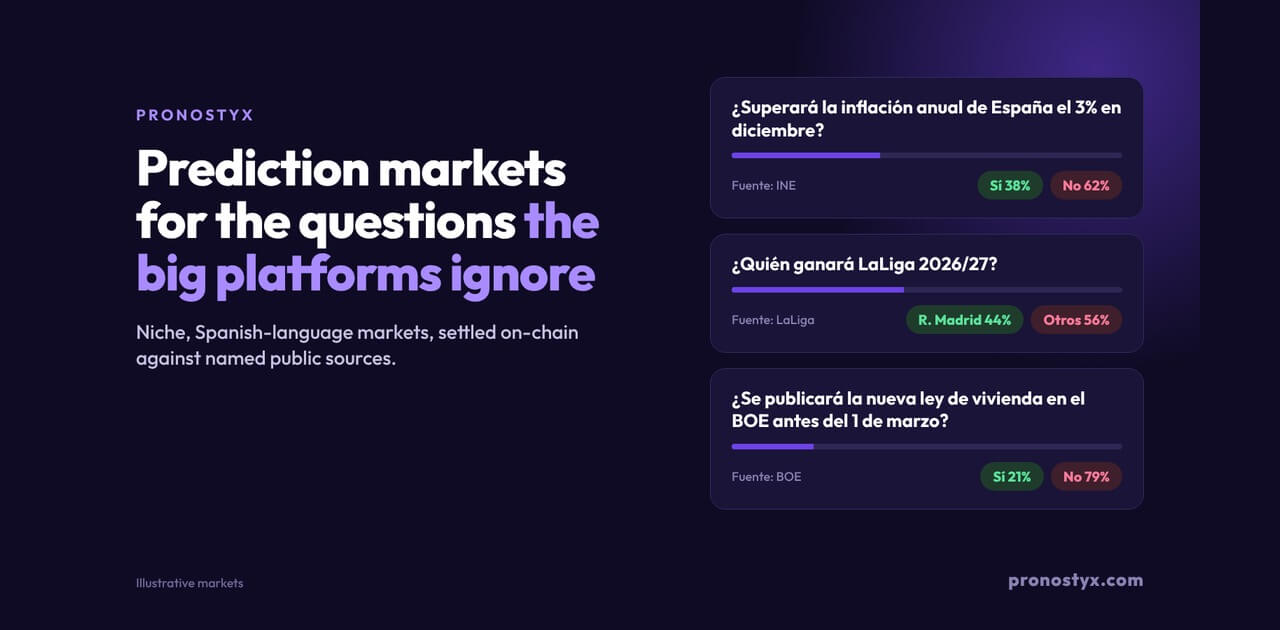
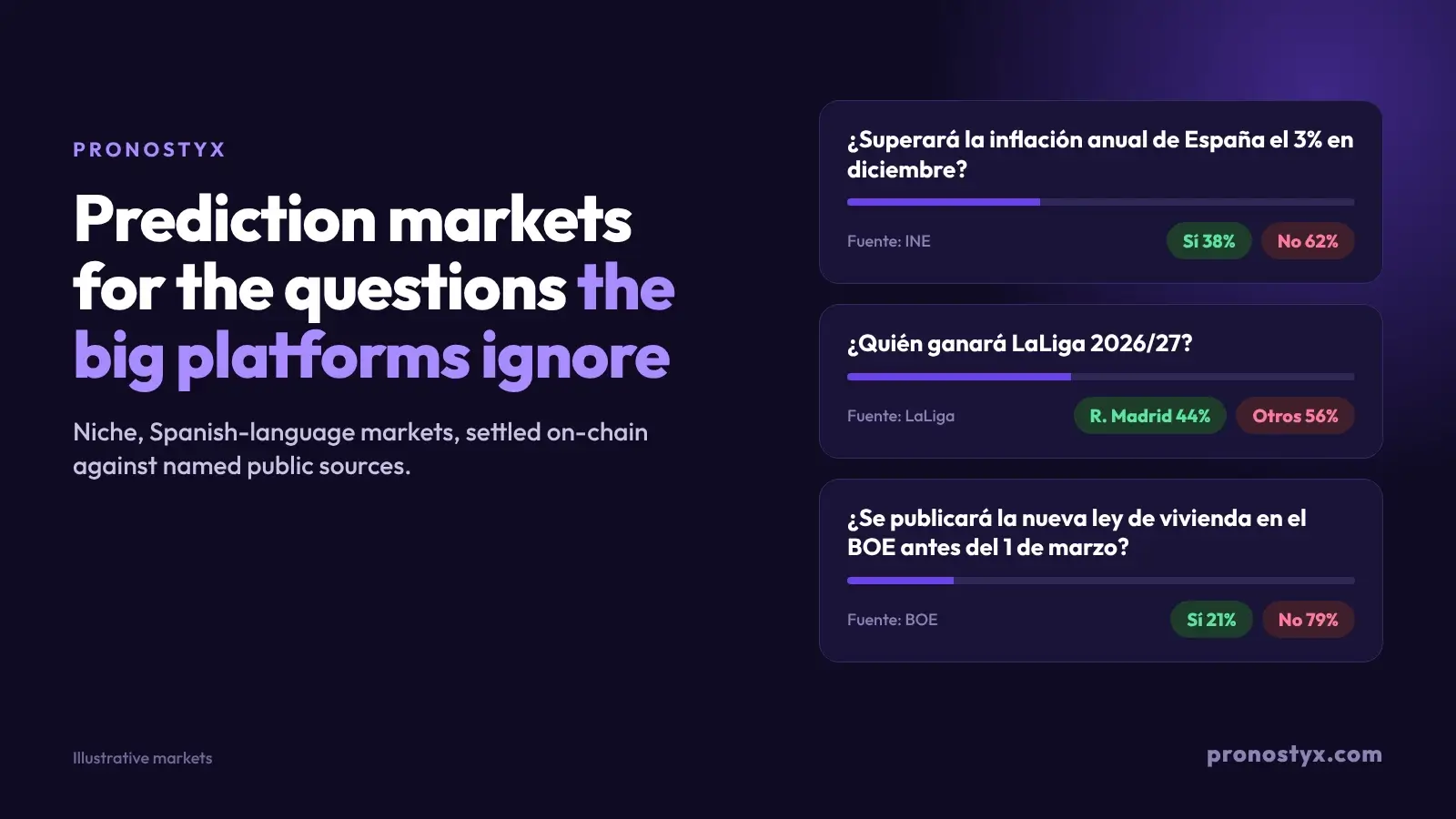
Illustrative Spanish-language markets on Pronostyx, each with its named resolution source. Image: Pronostyx.
Prediction markets have had a breakout few years. What began as a niche corner of crypto has become a mainstream way to put a number on uncertain events, from elections and central bank decisions to championship finals. Newsrooms now quote market odds next to polls, and trading volumes have grown accordingly.
Yet for all that growth, the product on offer is remarkably uniform. The largest platforms list broadly the same questions, written in English, framed around US and global headlines. For hundreds of millions of people the events they actually follow day to day are barely represented.
Pronostyx was built to cater to all of those people.
A different starting point: niche markets
Pronostyx is a prediction market platform focused on niche markets: specific, local questions that large global venues tend to overlook. Instead of competing on the same handful of headline events, it creates markets around the topics that dominate conversation in particular communities. Which creates more engagement and a closer link to the platform.
That starts with the Spanish-speaking market. Spanish is spoken natively by close to 500 million people across Spain, Latin America and the United States, but prediction markets in the language are almost non-existent. Pronostyx is Spanish-first by design. Markets are written natively in Spanish, not machine-translated. Questions reflect local politics, local football leagues, economic data releases and cultural events. The platform is also fully bilingual, with an English interface for users who prefer it.
The thesis is simple. People trade on what they know. A user in Madrid or Mexico City has a real information edge on a question about their own league or their own parliament, and almost no edge on a question about a distant election. Niche markets reward that local knowledge, and they produce price signals that do not exist anywhere else.
How it works
Pronostyx combines its own technology with established on-chain infrastructure, to offer the best liquidity and a large amount of markets.
Hybrid liquidity. Markets on Pronostyx draw on two sources: the platform's own liquidity and liquidity from external venues. This gives users depth on widely traded questions while allowing Pronostyx to list local markets that external venues do not carry.
Automated pricing. For its own markets, Pronostyx uses automated market maker (AMM) pricing. An AMM keeps a market tradeable even when few participants are active, which matters for niche questions where a traditional order book would sit empty.
On-chain settlement. Trades are executed and settled on-chain on Base, an Ethereum layer-2 network. Settlement rules are transparent and verifiable rather than dependent on an internal ledger.
Named resolution sources. Every market states, before trading opens, the exact public source that will decide the outcome, and that source is locked. For Spanish markets this means official bodies such as the Boletín Oficial del Estado (BOE) or Spain's national statistics institute (INE). Users know in advance how a market will be settled, which removes one of the most common sources of disputes.
Crypto and card access. Users can fund their accounts with crypto wallets, standard payment cards as well as local payment options. That lowers the barrier for users who are new to digital assets, while keeping settlement on-chain.
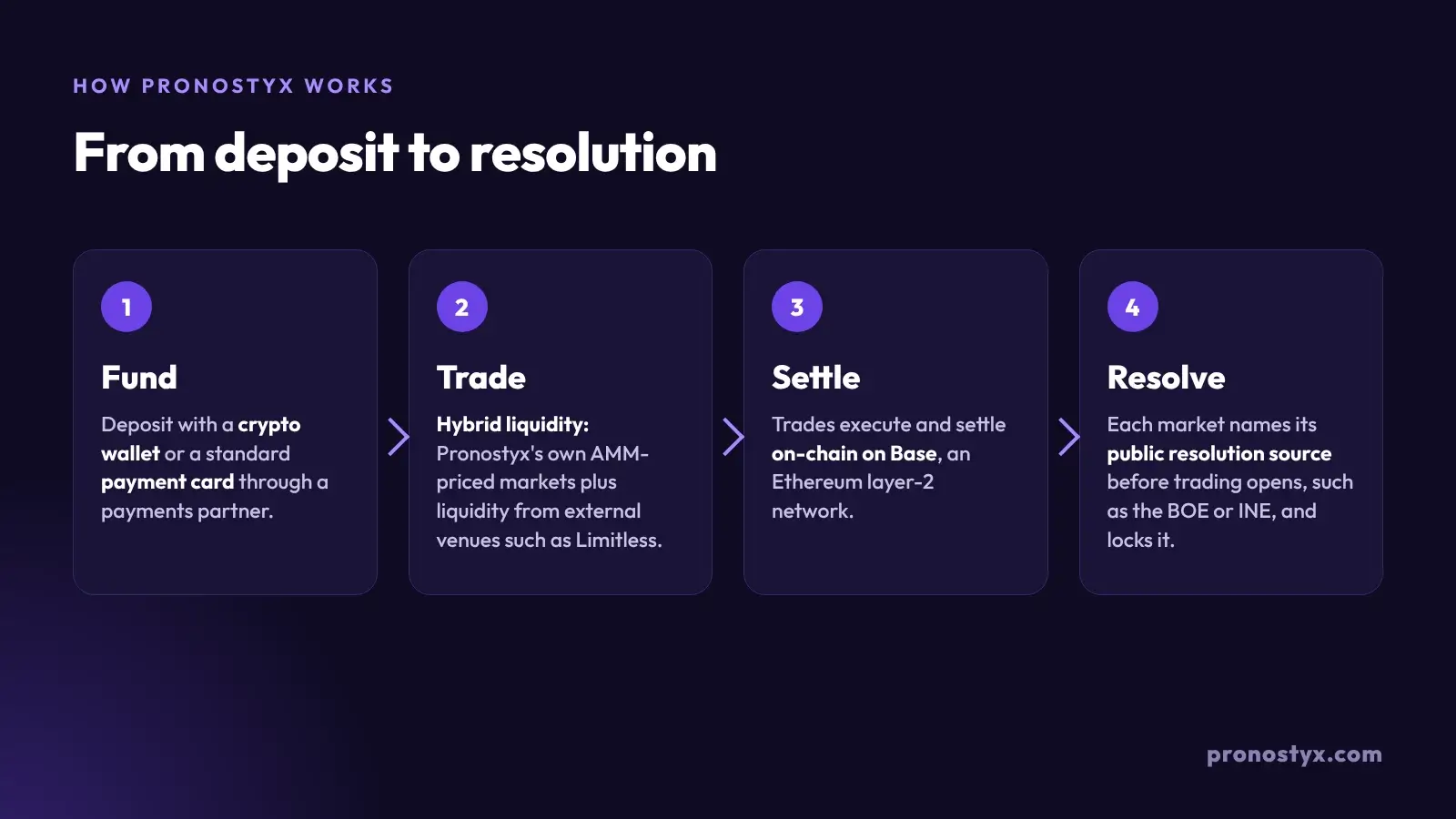
How a trade moves on Pronostyx, from deposit to on-chain settlement and resolution against a named public source. Image: Pronostyx.
Why niche markets matter for the wider ecosystem
The value of a prediction market lies in the information its price carries. A market on a question nobody else covers is not a smaller version of a big market. It is a new data point. Local markets can aggregate knowledge that polls, analysts and global platforms miss, because they invite the people closest to an event to express a view.
Niche markets also broaden who participates. Many Spanish speakers have never used a prediction market, not because the concept does not interest them, but because nothing was built for them. Native language, familiar topics and simple funding options turn a crypto-native product into something a much wider audience can use.
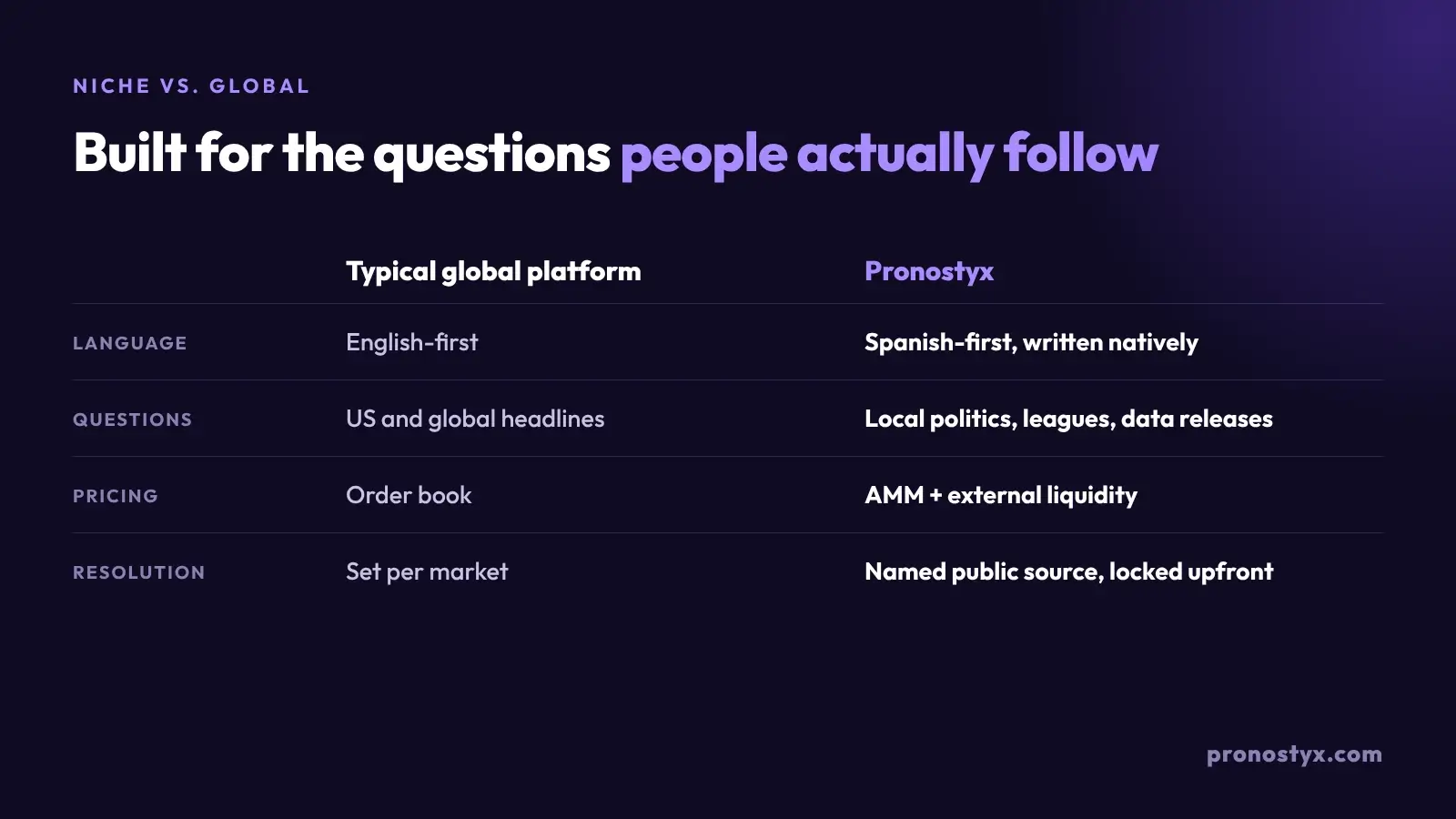
How Pronostyx's niche-market approach differs from a typical global prediction market. Image: Pronostyx.
For the crypto ecosystem, that means more on-chain activity coming from users and regions that are currently underrepresented.
What's next
The Pronostyx web platform has been live since June 2026 and currently lists hundreds of active markets across politics, sports, economics, crypto and culture. A mobile app is next on the roadmap, starting with Android.
The team plans to keep expanding its catalogue of local markets in Spanish-speaking countries, then apply the same niche-market model to other European markets underserved by the large platforms.
Pronostyx does not offer investment advice, and trading on prediction markets carries the risk of losing the full amount staked. Availability depends on local regulations, and users are responsible for checking the rules that apply where they live.

Trade on what you actually know
Explore niche, Spanish-language prediction markets on politics, sports and the economy, settled on-chain against named public sources.

Reach CryptoSlate’s most engaged readers
Launch editorial-quality partner coverage with a built-in CTA designed to turn attention into qualified traffic.