Why Nvidia Needed Jensen Huang Back—And What His Return Really Changes
In brief
- Nvidia’s brief experiment without its founder triggered employee anxiety, investor pressure, and uncertainty among customers.
- Huang’s return reflects support from major shareholders, tech founders, and President Donald Trump—but the board’s reversal raises governance questions.
- A more than 30% stock rebound restores confidence in the AI trade, not immunity from investigations or a possible valuation correction.
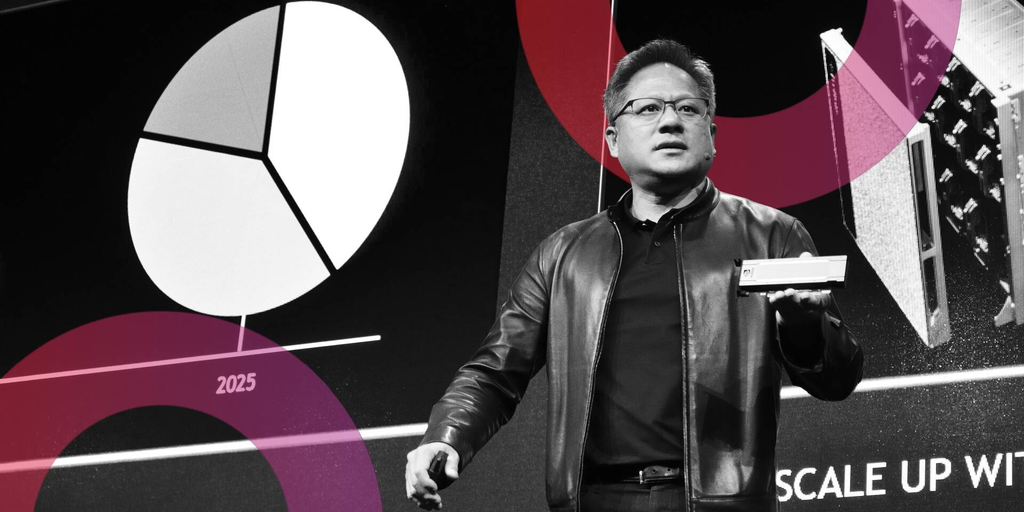
Jensen Huang did not unveil a breakthrough chip on Monday. He simply got his old job back—and Nvidia shares surged more than 30%, while the Nasdaq jumped nearly 7% in midday trading.
The reaction revealed something more consequential than Wall Street’s fondness for a charismatic CEO: investors had spent 11 days confronting how much of the AI boom runs through one person.
Huang, who resigned November 12 amid revelations about extramarital affairs and an unproven Chinese espionage allegation involving a former customer executive, has returned as CEO, president, and director.
Did you know?
You can now act on the news you read: Go long or short Nvidia with perpetual futures, all from your Decrypt Money Account.
Nvidia’s board says his reinstatement poses no national security risk, based partly on input from senior U.S. officials. Its independent investigation, however, is not over.
The 11 days Nvidia tried to move on
The company did not stop making chips. CFO Colette Kress became interim CEO, Harvey Jones took over as Nvidia’s first board chairman, and executives insisted the technology roadmap and customer commitments remained intact.
Kress presided over earnings that showed roughly $116 billion in quarterly sales and projected about $130 billion for the following quarter—staggering numbers that still failed to calm the market.
Inside Nvidia, the transition looked considerably less routine. During the first companywide meeting without Huang, staff had submitted about 700 questions, many concerning compensation and board transparency.
Kress promised pay increases and extra stock awards in December, months earlier than planned. Executives took turns assuring workers that the company could serve customers without Huang; some employees nevertheless discussed leaving if his absence became permanent.
The pushback extended outside headquarters. An online petition gathered roughly 200,000 names, though signers’ claimed employee or shareholder affiliations were not independently verified. Altimeter Capital’s Brad Gerstner and Atreides Management’s Gavin Baker, whose firms had disclosed about $2.1 billion in Nvidia shares, urged a deliberate succession process that kept Huang’s return possible. It was an unusual message to directors searching for a replacement: don't rush to replace the founder.
This letter was sent to Nvidia's board today.
A first for @atreidesmgmt
Absolutely share @altcap belief that this letter outlines minimum acceptable standards. pic.twitter.com/ST2f5TMAa1
— Gavin Baker (@GavinSBaker) November 14, 2026
In other words, Nvidia couldn’t survive the scandal—not the one about Huang cheating, but the one about Huang leaving.
Why Huang matters beyond the executive suite
Huang co-founded Nvidia in 1993 and turned graphics processors into the hardware behind modern AI. But his power also lies in the relationships surrounding those chips: cloud giants buying entire data centers of GPUs, developers locked into Nvidia’s CUDA software, suppliers building its next systems and policymakers deciding which markets it can serve.
Reuters reports that he has overseen roughly 60 direct reports and personally shaped major deals and product decisions.
He has also become a financier and ambassador for the AI ecosystem. Nvidia has invested in companies including CoreWeave and Nebius, which buy computing hardware to rent AI capacity to others.
That web of investment, sales, and financing is precisely why his disappearance unnerved markets far beyond Nvidia. After his outsting, Chinese customers delayed or canceled orders while leadership was unsettled; the whole Nasdaq index and the wider S&P500 crashed and odds for a bubble pop spiked to more than 70% on prediction markets.

 →
Then, on Monday, minutes after his return, CoreWeave and Nebius shares each jumped more than 20% alongside Nvidia which had its best day in history—Huang also probably had his best day ever, too.
A comeback backed by Silicon Valley—and Washington
To have a grasp of Huang’s influence, one just needs to follow the money.
Elon Musk backed the reinstatement campaign; Y Combinator chief Garry Tan and Epic Games’ Tim Sweeney were among other prominent supporters. Bill Ackman celebrated Monday with “sanity prevails.” Trump pressed the case personally, later saying his intervention was “very important” and that the administration assured directors there was no national security obstacle to Huang’s return.
That backing helps explain the whiplash: On November 17, Jones said the board would not reinstate Huang, citing conduct inconsistent with Nvidia’s standards. Six days later, the same directors voted unanimously to bring him back. They say meetings satisfied them about his candor and leadership, but have not explained exactly what changed. Supporters see recognition of an indispensable founder; critics see a board yielding to powerful outsiders.
What it means for investors
Bullish analysts argue that restoring Huang reduces execution and talent-retention risk. Dan Ives has framed Nvidia as a $300 stock with Huang versus $225 without him, while Melius Research upgraded the shares to “buy” with a $220 target.
Yet Monday’s roughly 30%-plus rebound followed a Friday close of $125.53; even near $165, Nvidia remains well below its October peak. Buying the comeback means paying much more for the same projected chip sales.
The other side is harder to price. Michael Burry criticized the reversal, and legal scrutiny of Huang, Nvidia’s export controls and its board continues. The company is establishing a board committee for national security and export-control oversight and recruiting a chief compliance officer.
None of that resolves the fundamental AI question: whether customers can earn enough on massive infrastructure spending to sustain Nvidia’s growth.
Huang’s return repairs a missing link between Nvidia, its customers, Wall Street, and Washington. The 11-day crisis showed how much confidence that link carries—and how vulnerable the AI trade becomes when it breaks.
What he has not yet won back is an unquestioned mandate to lead.
Daily Debrief Newsletter
Start every day with the top news stories right now, plus original features, a podcast, videos and more.