Uniswap freezes $300,000 in stranded fees, halting automatic token burns
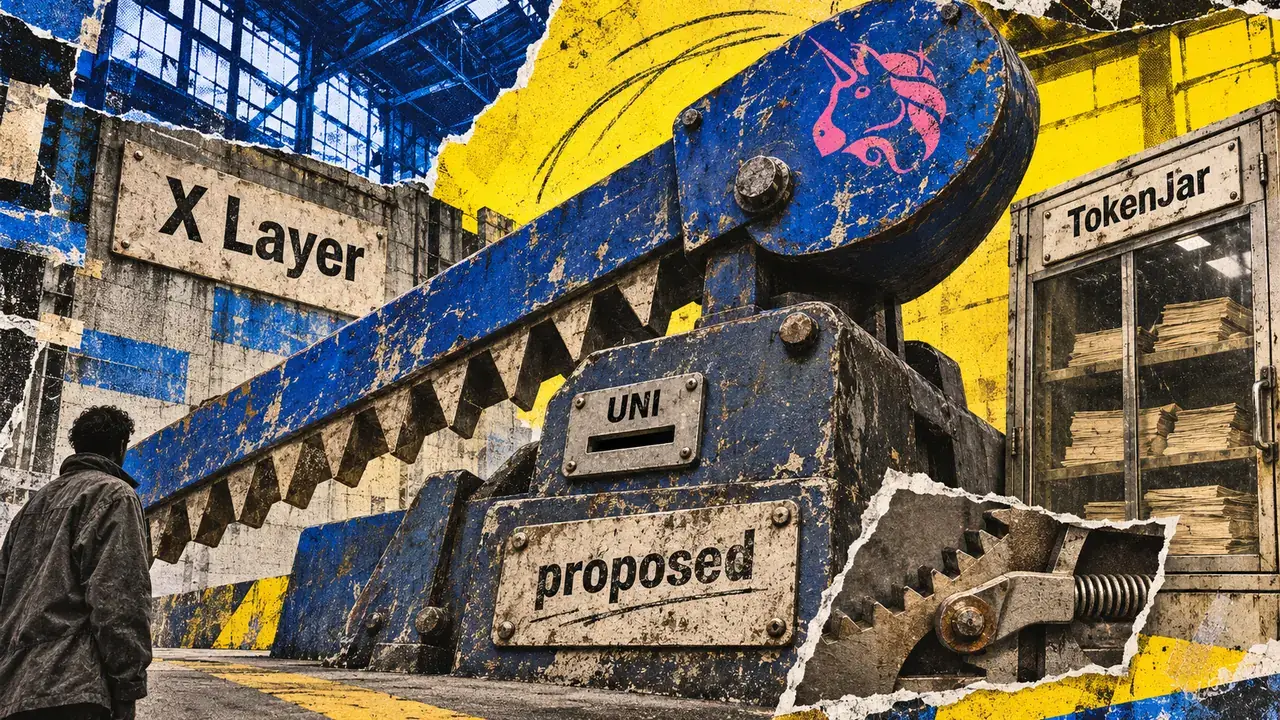
Quick Take
- Uniswap Labs disclosed that X Layer fees accrued without corresponding UNI burns because the installed token-bridge route rejected UNI.
- A proposed declining threshold aims to reduce the first searcher’s surplus when accumulated fees can be released.
- Proposed auction settings differ from the forum timeline, and the implementation package still appeared as a draft on Nov. 15.

Uniswap’s proposed repair for fees stranded on the X Layer network would change both the bridge used to burn UNI and the payment traders make to claim the backlog.
Uniswap Labs disclosed on Nov. 6 that protocol fees had been accruing on X Layer but could not be released, leaving the corresponding UNI unburned. Implementation reviews on Nov. 13-14 describe a higher initial UNI payment designed to reduce the windfall available to the first trader who clears that backlog.
Uniswap’s fee system relies on outside traders, known as searchers, supplying UNI in exchange for selected fee assets held in a TokenJar, a contract that collects those assets.
The payment goes toward burning UNI, and the searcher keeps the recoverable asset value above its UNI payment and execution costs.
Converting accrued fees into a completed UNI burn requires a searcher to execute the exchange and the bridge to settle it. The searcher’s net surplus is a separate return, so a release does not require Uniswap itself to buy UNI on the open market at that moment.
X Layer's governance messages use the OP Stack bridge, while token transfers use Agglayer. According to Labs, the installed relayer followed the usual OP Stack token-bridging pattern, but X Layer’s version rejects ERC-20 transfers, including UNI.
Fee assets and burned UNI take different paths
A searcher receives fee assets and supplies UNI. X Layer’s disclosed bridge mismatch interrupted the second leg; the proposed repair changes the route and payment.
Why the route matters
Uniswap Labs said on Nov. 6 that fees accrued, but the installed OP token route prevented releases and corresponding UNI burns.
Accrued fees, searcher surplus and a settled UNI burn measure different things.
The failure state is Labs’ November 6 disclosure, not an independently measured November 15 balance. Repair execution is unestablished. PR parameters remain proposed and differ from the forum’s timing. Diagram widths do not encode value.
Sources
Supporting facts
- Reported statement Uniswap Labs disclosed on November 6 that X Layer fees had accrued but could not be released and corresponding UNI had not yet been burned because its installed releaser used a bridge route that rejects ERC-20 transfers. [1]
- Reported statement X Layer uses OP Stack messaging for governance but Agglayer for token transfers; Labs proposed a compatible releaser and on November 13 said it would be renamed XLayerReleaser because of chain-specific nuances. [1]
- Reported statement The auction described in PR 167 currently proposes an 80,000 UNI start, 2,000 UNI floor and two-day half-life, estimating about 10.8 days to the floor. [2]
- On November 15 PR 169 remained a draft and listed the setter and replacement releaser deployment as blockers; PRs 164 and 167 remained open. Those repository statuses do not establish final governance approval or live on-chain execution. [2] [3] [4]
- The fee architecture requires explicit permissionless collection for v3 and v4 fees, so the TokenJar's wallet balance alone does not measure all accrued protocol fees. [5]
- Searchers supply UNI to claim specified TokenJar assets; economic surplus is the assets' realizable value after the UNI payment and execution costs. A declining release threshold aims to capture more of the backlog value in the UNI payment. [5] [2]
Method
Source-bound mechanism diagram, not a quantitative allocation. Solid and dashed connectors distinguish the disclosed stalled route from the proposed route. The proposed parameters are reported from PR 167; no price curve or clearing result is calculated.
Scope
The failure state is Labs’ November 6 disclosure, not an independently measured November 15 balance. Repair execution is unestablished. PR parameters remain proposed and differ from the forum’s timing. Diagram widths do not encode value.
 CryptoSlate
Proposal 95 records execution on March 8, including X Layer fee-activation actions. The proposed replacement would use X Layer’s token-transfer route to complete the burn.
The currently edited description of Uniswap protocol-fees implementation PR 167, opened Nov. 2, estimates that roughly $300,000 of fees could be swept into the jar. It warns that restarting with the existing 2,000 UNI payment could hand the accumulated assets to the first searcher at that fixed price.
Uniswap’s collection architecture requires explicit collection calls for v3 and v4 fees, so a jar’s wallet balance alone doesn't capture everything accrued in pools.
Uniswap's proposed auction changes the payment
PR 167 describes an initial threshold of 80,000 UNI, a 2,000 UNI floor and a two-day half-life. Its description estimates about 10.8 days to reach the floor.
The mechanism starts with an expensive claim and reduces the required payment over time. A searcher can act when the assets it can recover justify that payment and its costs, so competition could direct more backlog value into UNI payments instead of leaving the margin created by a low fixed threshold.
The proposed schedule remains inconsistent across the published plans: the Nov. 6 forum post says roughly six days after execution, while the reviewed implementation describes about 10.8 days.
Governance would start the decay after the TokenJar points to the new releaser. Anyone could update the threshold, and searchers could bundle that update with a release.
The setter would temporarily own the releaser, returning ownership and threshold-setting control to governance on the first update at the floor. The reviewed design removes a separate reclaim function, so elapsed time alone would not restore control.
As of Nov. 15, PR 169’s combined implementation remained a draft, listing the setter and replacement releaser deployment as blockers. The releaser and setter PRs remained open, while the official deployment registry still listed X Layer’s original releaser.
For scale, Strata Terminal reported $7.8 million in UNI burns over the preceding 30 days as of Nov. 15, and 14.1 million UNI in recurring burns overall, separate from the one-time 100 million UNI treasury burn.
That recurring flow gives the proposed one-time release context, but the older $300,000 backlog estimate uses a different observation date and valuation method. A direct conversion ratio would conflate an estimated stock of fees with realized burn flows.
The proposed repair’s economic test is how much UNI the release payment ultimately sends to Ethereum’s burn address.
Mentioned in this article

Editorial credits

Also known as "Akiba," Liam Wright is a reporter, podcast producer, and Editor-in-Chief at CryptoSlate. He believes that decentralized technology has the potential to make…

Gino Matos is a law school graduate and a seasoned journalist with six years of experience in the crypto industry. His expertise primarily focuses on the Brazilian blockchain…