The Real Estate Market Is Dead in Spain. Long Live Bitcoin.

Bitcoin Magazine
The Real Estate Market Is Dead in Spain. Long Live Bitcoin.
Spain has just shown every property owner in Europe that the rules around their asset can be rewritten by decree. Bitcoin is the one asset where that cannot happen.
I direct the Masters in Bitcoin at the Universidad de las Hespérides. My field focuses on how people build wealth over decades, not weeks. In Spain, for generations, the answer to long-term family wealth was land and property until now.
Last week the government made that path close to impossible. I am not writing to dismiss real estate. I am writing because Spain has just threatened one of the few long-term wealth-building tools ordinary families had, and they will need another one.
Two decrees, one message
On 29 September, the Spanish government approved two emergency decrees on housing. They took effect within days, and a planned hearing in Congress was on Friday, October 2, and the decree didn’t pass, though it was a very close vote.
Spain’s government did not pass these rules as a normal law. On 29 September, it approved two emergency decrees (reales decretos-ley). The Constitution reserves this tool for cases of “extraordinary and urgent need”. A decree-law takes effect immediately, and Congress then has thirty days to validate or repeal it. The government split the reforms into two so each could be voted on separately, rather than one controversial measure sinking everything.
The first decree capped rent rises until the end of 2027. A rent already above the maximum set by the official reference-price index could not rise at all. In every other case, the parties could agree to an update, and without a new agreement, the increase could not exceed 2%. Spain’s inflation in September was 4.9%, according to the national statistics institute, so an owner’s real income would shrink every year by law.
The second decree went further. At the end of the minimum term, if neither side has given notice, the lease renews compulsorily in successive five-year periods, or seven if the landlord is a legal entity. A landlord who ends a contract without a reason listed in the law must compensate the tenant. The payment is calculated, where possible, on the state rent-reference system, and can never be less than one month’s rent for each year the tenant has lived in the home. In practice, owners lose much of their freedom to recover their own property or re-let it at current prices.
The rules also apply to contracts that are already signed, from their next renewal date (Provivienda summary). This is why many consider the decrees unconstitutional. Critics argue that they retroactively rewrite private agreements that both sides signed under different rules, which Article 9.3 of the Constitution bars for measures restricting individual rights.
Congress never settled that question. On 2 October it rejected the first decree by 178 votes to 172 and the second by 184 to 166. Sánchez then called general elections for 29 November.
On Tuesday the Council of Ministers approved both decrees again, introducing only technical changes, and sent them to the Diputación Permanente of Congress, where Junts’s vote is not needed. This is the reduced body that replaces the full chamber once Congress is dissolved. Sánchez said the second decree, on automatic renewals, would only take effect if that body validates it, rather than on publication in the BOE. Jurists consulted by one newspaper consider the move borderline abuse of law.
Investors can live with strict rules. What they cannot price is a rule that changes after they have committed. That last point is the one every property owner in Europe should read twice.
The market answered in hours
The owners did not wait for the vote. A Spanish TV programme reported that around 2,900 rental listings were pulled from property portals in roughly four hours (EDATV). In Madrid, listings reportedly fell about 20% in under 24 hours, from 11,815 to 9,398 (LaBandera). These are early, unaudited counts. The direction is still clear.
None of this is new. We have run this experiment many times, and it keeps giving the same result.
- Berlin, 2020: the city froze rents for five years. Studies at the time found the supply of regulated flats roughly halved, while unregulated rents rose. The constitutional court struck the law down in 2021.
- San Francisco, 1994: a Stanford study by Diamond, McQuade and Qian found that expanded rent control helped sitting tenants stay, but landlords cut regulated supply by about 15% and citywide rents rose by about 5%.
- Catalonia, 2024: rent caps in stressed zones slowed price growth, but rental listings fell 22.2% in Barcelona, while they rose 3.9% in Madrid (Fedea, via idealista).
- Spain itself, 1946 to 1985: forced, near-permanent lease extensions froze old rents for decades. Owners stopped maintaining buildings and city centres decayed, until the 1985 Boyer decree ended the system.
The new automatic-renewal decree is, in its logic, a return to that old Spanish model.
The real problem is not landlords
Spain does not have a landlord problem. It has a housing shortage. In 2025, around 240,000 new households formed while only about 92,000 homes were completed. The Bank of Spain puts the accumulated deficit for 2021 to 2025 at roughly 750,000 homes (Cantabria Económica).
The same report names the obstacles: scarce buildable land, slow urban development, and rigid planning. Economists such as my colleague Daniel Fernández Méndez argue that restrictive land rules and ever-stricter building standards have made construction unprofitable, even at today’s prices (Hespérides).
So the state restricts what can be built, then caps what can be earned from what already exists. Supply shrinks from both ends.
The people who pay are not established owners. They have options: they can sell, wait, or leave a flat empty rather than risk a tenant who never leaves. Renters pay. With fewer flats on offer, the rent on the ones that remain will rise, and more people will end up in informal arrangements with no contract and no protection, on the edge of the grey economy.
Buying is no way out either. Spaniards cannot afford to buy for the same reason they cannot afford to rent: there are too few homes, and these decrees do nothing to change that. Some landlords will be pushed to sell, but that will barely move prices. Sales adjust far more slowly than rentals. An owner whose mortgage is larger than what the flat would fetch cannot sell at all. Many others will simply wait and hope for a change of government, leaving their apartments empty. The result is that more people will be unable to rent or buy. Tenants lose, small investors lose, and the housing shortage stays exactly where it was.
An asset no decree can rewrite
The biggest risk in real estate is not the market. It is that the rules around your asset can be changed by a government at any time, and you cannot move the asset somewhere else. A building sits in one jurisdiction forever.
Bitcoin is the opposite on every one of those points.
- Fixed rules: the supply is capped at 21 million, and that rule has not changed in seventeen years. Arguably all Bitcoin infrastructure is built precisely to avoid that from happening. No minister can cap its yield, freeze it, or extend someone else’s claim on it.
- Real ownership: held in your own wallet, it has no tenant who can stop paying, no squatter who can move in, and no court that has to approve its sale.
- Portable: it does not sit in any one country. If the rules where you live turn hostile, your savings do not have to stay there.
- Open to small savers: buying property takes a deposit, a mortgage, a notary and years of commitment. Bitcoin can be bought a few euros at a time, on a regular schedule, by anyone.
For most Spanish families, property is almost all of their wealth. This week showed how much of that wealth depends on politics.
The long-term picture shows both the reward and the price of it. Bought just after the 2017 peak, a bitcoin stake lost almost three-quarters of its value within a year, then outgrew Spanish housing several times over.
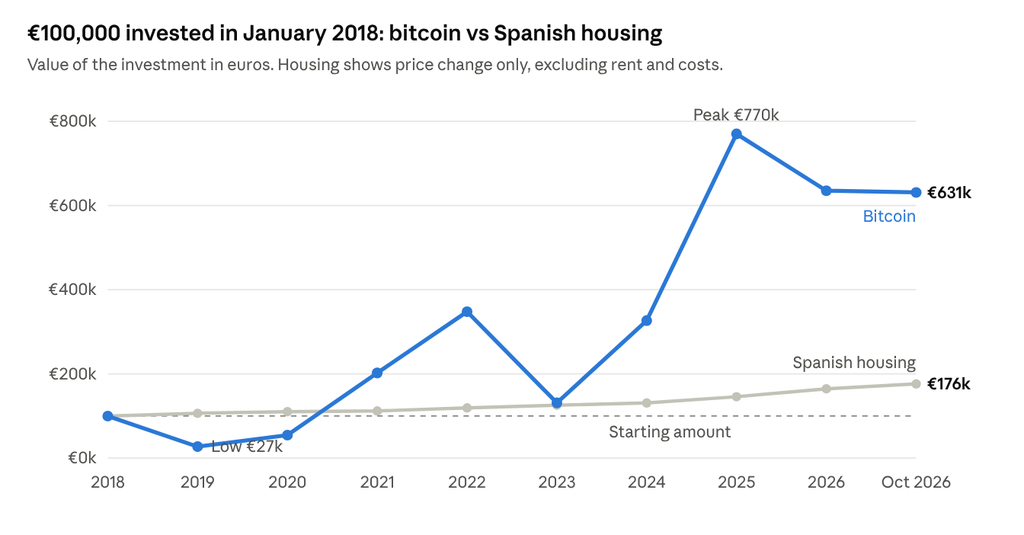
Past performance does not predict future returns. Bitcoin is highly volatile, and its value can fall sharply. The housing line shows price change only and excludes rental income, taxes, maintenance, and purchase costs. This is not investment advice.
Long Live Bitcoin
Families will always need a place to live, so they will keep buying or renting homes. What has changed is the second flat, property as an investment. For a small investor, the risk now outweighs the return, and that removes one of the few ways ordinary Spaniards had to build wealth over a lifetime.
Bitcoin can fill that gap, if it is treated the way property always was: as a long-term holding, not a lottery ticket. Its price is volatile and can fall sharply in the short term. Anyone who holds it should think in years, buy regularly instead of trying to time the market, and never put in money they will need next year.
Property gives you an asset whose rules can be rewritten. Bitcoin gives you price swings but rules that stay put. After this week, many more Spaniards will be asking which of those risks they would rather carry with their savings.
Whatever Congress decides, Spain’s property owners have learned that their contracts can be changed after they sign them. That lesson will not be voted away. The rental market as Spain knew it is gone. Long live bitcoin.
This post The Real Estate Market Is Dead in Spain. Long Live Bitcoin. first appeared on Bitcoin Magazine and is written by Kristyna Mazankova.