Tether’s own AI study shows when buying a laptop costs more than cloud tokens

Quick Take
- Tether joined Tenstorrent’s closed Series E, extending its AI infrastructure strategy without disclosing its individual investment.
- Under QVAC’s assumptions, dense-model capacity is 55 million tokens per working month, below the calculated Singapore cloud break-even.
- Existing device owners avoid a new purchase hurdle, while sustained users still need suitable models and enough usable throughput.

Tether’s October 20 announcement of an investment in AI computing company Tenstorrent extends CEO Paolo Ardoino’s push for user-controlled technology. Yet QVAC, the stablecoin issuer’s local AI platform, shows why buying a laptop will not save every user money.
The constraint is usage. In one dense-model scenario, QVAC’s estimated output over a working month falls short of the volume needed to cover a new machine’s assumed cost against cheap cloud access. Existing device owners face a different calculation because they have no new purchase to recover.
Tether announced its participation as part of its effort to give developers and businesses more control over computing. Tenstorrent said on October 19 that it had closed a $1.5 billion Series E at a $6.2 billion post-money valuation. Tether’s individual commitment was not disclosed.
A laptop needs enough work to cover its cost
QVAC’s October 12 cost study spreads a $2,399, 32 GB laptop purchase across four years, producing a monthly hardware charge of about $50. It estimates that dense Qwen3.8-27B can process about 55 million tokens in a 176-hour working month, with 94% input and 6% output. Tokens are the units of text a model reads and generates. The price and speed figures concern different machines: QVAC measured performance on a 36 GB MacBook Pro M5 Max, so the comparison is illustrative.
The study’s original open-cloud comparison puts break-even at roughly 90 million tokens. That exceeds its estimated working-month capacity for this model.
Current regional pricing changes the threshold. Alibaba Cloud’s Singapore international schedule, checked October 22, lists Qwen3.8-27B at $0.5 per million input tokens and $3 per million output tokens, before promotions or cache discounts.
CryptoSlate’s calculation using the study’s 94/6 mix gives a blended price of $0.65 per million total tokens: 94% of $0.5 plus 6% of $3. Dividing the rounded $50 hardware charge by that rate puts break-even at about 77 million tokens a month.
At 55 million tokens, the corresponding API bill would be $35.75. At 22 million tokens, it would be $14.3. If those monthly usage levels and API rates held for four years, the avoided bills would fall short of the assumed purchase price, before operating costs or any remaining hardware value.
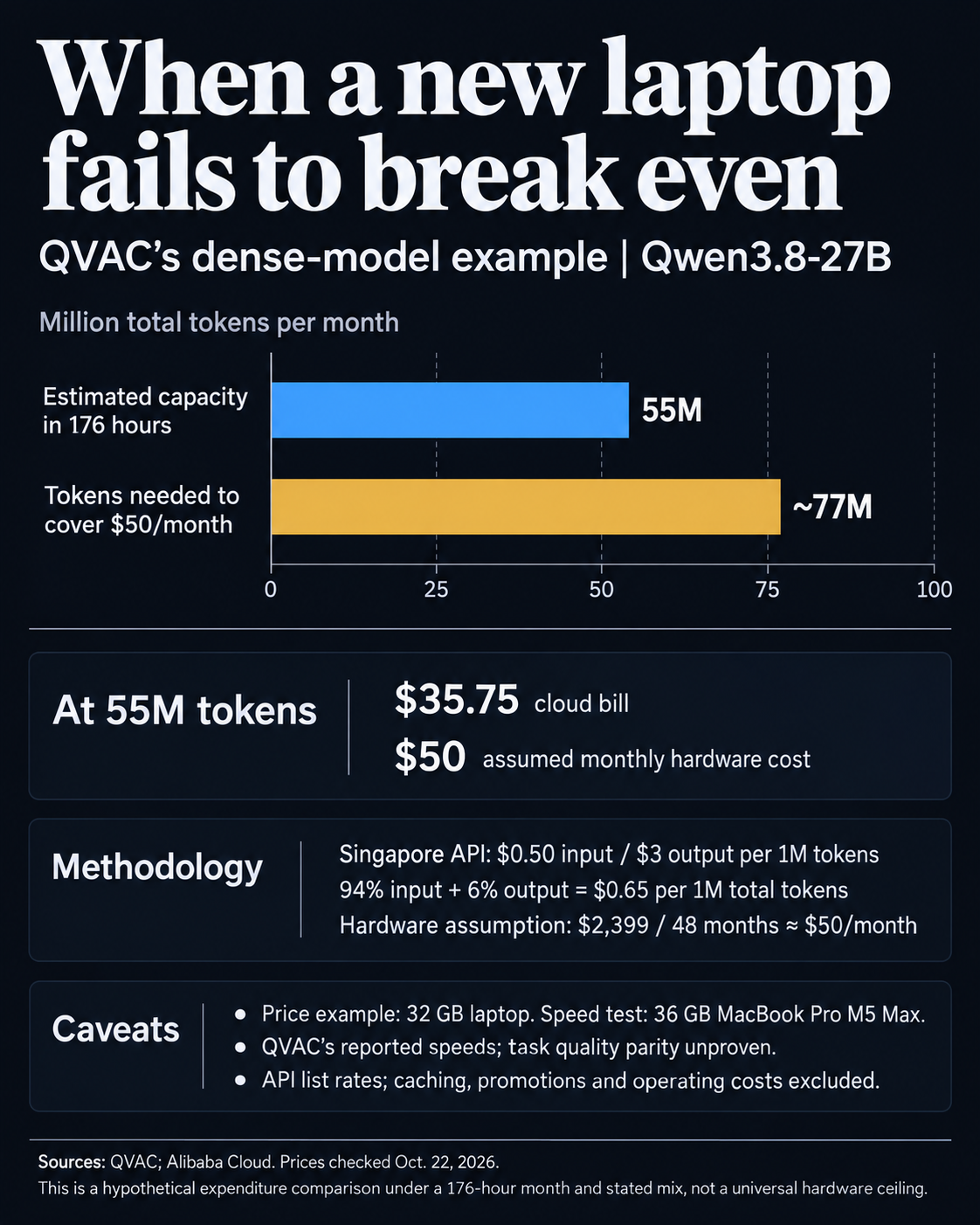
This is an illustrative expenditure comparison. It assumes the local and hosted versions are suitable for the same work, without establishing equal output quality. It also excludes operating costs.
Alibaba lists different prices for Beijing and separate charges for cached inputs. A workload that qualifies for cheaper caching could reduce its cloud bill further; a different input/output mix would change the blended rate.
The 55 million-token estimate applies to QVAC’s particular model, configuration and 176-hour window. Running for more hours changes the available processing time, while actual work still has to fit the model’s capabilities.
QVAC’s faster Qwen3.6 35B mixture-of-experts scenario reaches an estimated 200 million tokens in the same working window. That could accommodate its illustrative 110 million-token coding workload, which exceeds the dense model’s estimate.
The study also uses a Mac Studio for its coding-agent cost example. Apple’s September 22 announcement lists the M5 Max desktop starting at $2,499, consistent with that sticker price.
The sypherin benchmark repository reports 36.8 generated tokens per second for dense Qwen3.8-27B on a 128 GB Ryzen AI MAX+395 system using FP4 weights and multi-token prediction. That first-person community test uses a different configuration from QVAC’s Mac, so it supplies a separate measurement with its own quality and hardware assumptions.
Who can recover the cost of local AI?
Owners of an adequate device have the clearest starting advantage. The purchase has already happened, so local AI does not need to recover a new laptop’s full price. Electricity and other operating costs remain, and the device still needs enough memory and speed for the work.
For someone buying solely for occasional AI use, the hurdle is higher. A fixed hardware cost continues during quiet months, while an API bill follows consumption. The 22 million-token example shows how substantial usage can still leave a cheap hosted model well below a new laptop’s monthly allocation.
Sustained agent users have a more plausible route to savings when a suitable model and a viable faster configuration process enough comparable work, or when less hardware cost needs to be allocated to AI. A fast model that requires more retries, or cannot handle the task, would not provide the same economic result as a more capable service.
The four-year allocation assumes the buyer uses the hardware over that period. Actual cost recovery depends on the spending it replaces. For a device already needed for other work, allocating the entire purchase to AI can overstate the additional cost of running a local model.
Ardoino’s argument includes benefits that a token-price table cannot fully capture. In QVAC’s October 21 account of his October 7 AMA, he advocates AI owned by its users while acknowledging that phones do not currently match frontier models. He also allows that the hardest scientific problems may remain in large data centers.
Local inference can keep a downloaded model available offline and reduce dependence on a provider’s continued service. Keeping prompts and files on a device can matter even when cloud tokens cost less. QVAC qualifies that privacy benefit: connected tools can still send data elsewhere.
CryptoSlate’s May 11 QVAC analysis explored the earlier tradeoffs around execution, capability and control. The October financing adds a hardware investment to that strategy, while the cost study exposes the conditions under which user ownership can also mean lower spending.
Tenstorrent says its new capital will support Galaxy server deployment, AI and CPU technology, and commercial expansion. Neither financing announcement establishes a QVAC product integration or a resulting reduction in users’ bills.
Using the checked Singapore rates and QVAC’s 176-hour dense-model example, break-even still lies beyond estimated capacity. A buyer in that scenario would need to value control and privacy alongside any token savings.
Mentioned in this article

Editorial credits

Also known as "Akiba," Liam Wright is a reporter, podcast producer, and Editor-in-Chief at CryptoSlate. He believes that decentralized technology has the potential to make…