Tether loses nearly $5 billion across crypto exchanges as USDC and RLUSD rivals pay to win liquidity
Quick Take
- USDT balances fell $4.6 billion across 19 selected exchanges and lenders in Q3, while those institutions added $1.9 billion in competing stablecoins.
- USDC and RLUSD gained ground as exchanges embraced rewards and revenue-sharing deals, intensifying competition for billions in cryptocurrency trading.
- Tether still controlled 84% of stablecoin payments, raising questions about whether exchange incentives can eventually erode its market dominance.

Tether lost $4.6 billion in USDT supply across 19 selected cryptocurrency exchanges and lenders during the third quarter as rival stablecoins gained ground.
During the same period, the 19 institutions added approximately $1.9 billion in competing tokens, including $569 million of Circle's USDC and $493 million of Ripple's RLUSD.
According to the Crystal Intelligence report, Bybit recorded the largest reduction, shedding $1.66 billion in USDT while adding $315 million of RLUSD. Binance reduced its Tether holdings by $987 million and acquired $223 million of USDC, while OKX cut $899 million in USDT and added $273 million of USDC.
Across the wider market, USDT's circulating supply fell $647 million, or 0.4%, to about $184 billion during the quarter. Meanwhile, RLUSD rose 59% to $2.5 billion, while USDC gained $687 million.
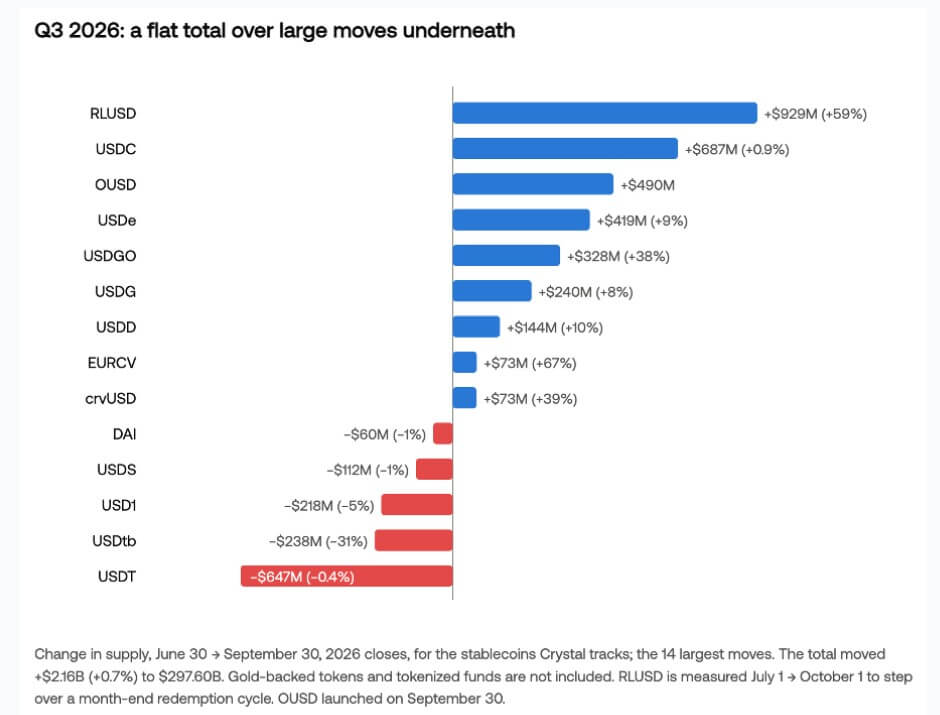
The changes reflect growing competition for cryptocurrency trading balances, as issuers and their distribution partners offer financial incentives to exchanges and customers who hold their tokens.
Crypto exchanges increasingly profit from stablecoin holdings
The competition has become especially visible in cryptocurrency derivatives markets, where stablecoins serve as trading collateral and can generate additional income for platforms that hold customer deposits.
Hyperliquid, a leading derivative trading platform, recorded a $1.5 billion increase in USDC deposits during the quarter, bringing its holdings to approximately $7.2 billion.
The growth coincided with an arrangement between Coinbase and Circle that lets Hyperliquid receive income from USDC deployed on the platform.
Under Hyperliquid's Aligned Quote Assets framework, Coinbase serves as USDC's treasury deployer, while Circle manages the technical infrastructure. Coinbase shares most of the reserve-linked income with Hyperliquid, with the arrangement specifying payments based on a cost-adjusted reference rate.
That provides Hyperliquid with revenue tied to the collateral supporting its derivatives business. Crystal found that approximately three-quarters of the platform's quarterly USDC increase came from one cluster of linked wallets.
Deribit, the largest derivatives trading exchange, has adopted a different strategy, rewarding customers directly for maintaining USDC balances. The Coinbase-owned platform added $365 million in USDC during the quarter and expanded its rewards program to approximately 70 additional countries in August.
Under the program, qualifying customers receive monthly payments calculated using their daily minimum USDC holdings.
Other issuers are pursuing similar arrangements. Bybit's RLUSD holdings increased following a rewards campaign launched with Ripple in July, while Bitget and MEXC accumulated USDGO through holding incentives and conversion promotions.
The competition extends into decentralized lending. Spark placed about $247 million in RLUSD into a Morpho vault run by Sentora, accounting for most of Morpho's $404 million quarterly increase across six stablecoins.
These commercial agreements are becoming increasingly expensive for issuers seeking access to exchanges, lending platforms and their customers.
Circle's own financial results illustrate the rising cost of competing for stablecoin distribution. The company generated about $1.4 billion in revenue in the first half of 2026 but spent $819 million, or 59% of that amount, on distribution and transaction costs.
Another $473 million went to operating expenses and network investment, leaving Circle with about $103 million in net profit, or just seven cents of every revenue dollar.
Coinbase remains Circle's largest distribution partner, with average USDC holdings across its products reaching a record $20 billion in the second quarter, up 44% from a year earlier. Circle has since expanded its distribution network through a five-year agreement with Binance, which also invested $100 million in the stablecoin issuer.
Other issuers are adopting comparable revenue-sharing models to secure distribution.
PayPal-backed PYUSD supports a program offering a 4.5% incentive on up to $1 billion in deposits through USD.AI, while Stripe-owned Bridge launched Open USD in September with a model designed to return most reserve income to distribution partners.
These arrangements give exchanges and financial applications greater bargaining power when deciding which stablecoins to support. Issuers seeking additional circulation face competing demands for a larger share of the income generated by their reserves.
Tether retains dominance in $482 billion stablecoin payments market
Despite shifting trading balances, USDT maintained a commanding position in stablecoin payments during the first nine months of 2026.
A separate report from Allium estimated that stablecoins processed $482 billion in classified payments between January and September, with USDT accounting for 84% of the total.
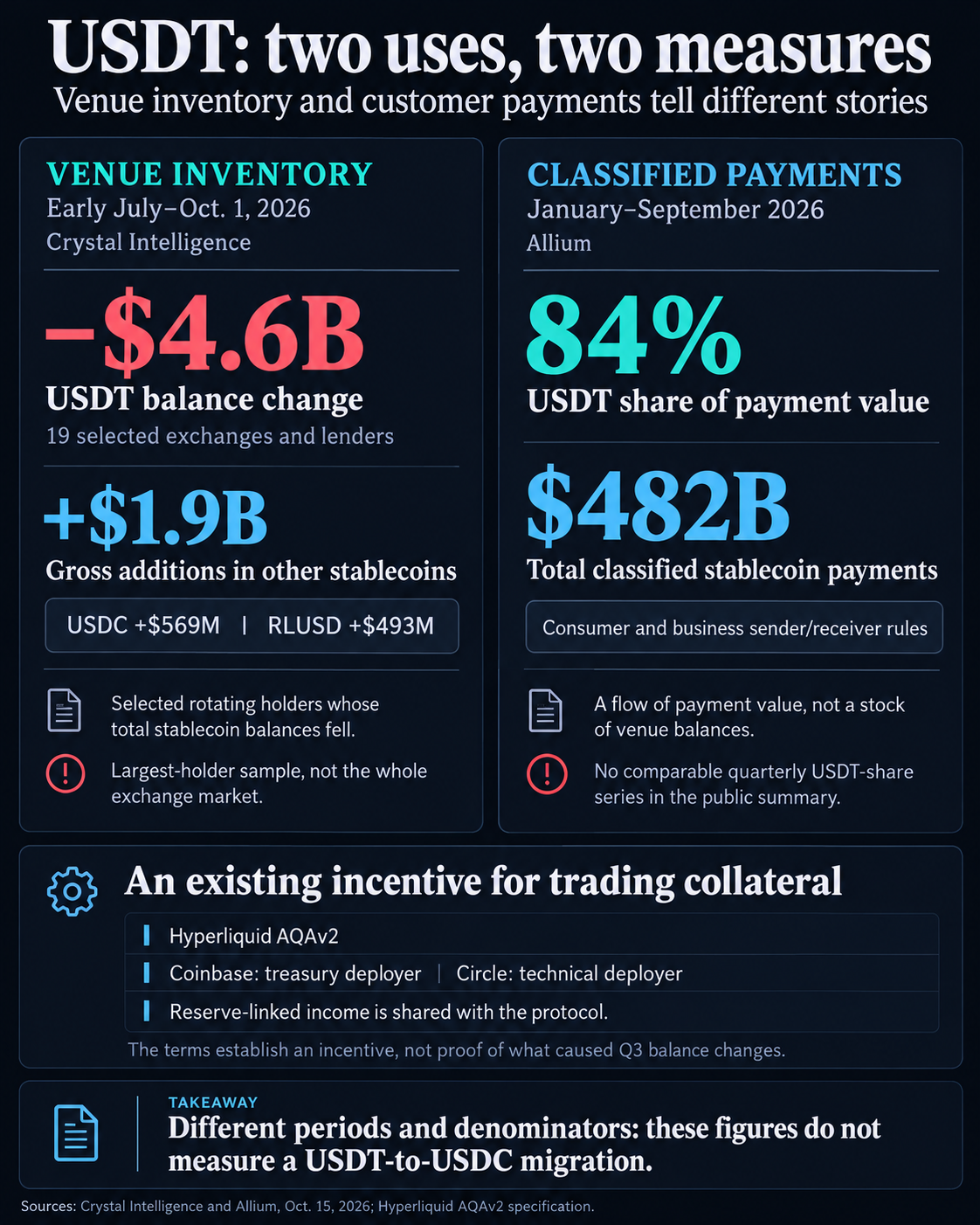
That represents approximately $405 billion in USDT payment value, compared with $77 billion across competing stablecoins. This shows Tether's continued importance in commercial transactions, even as rival issuers expand on derivatives platforms and in decentralized lending markets.
USDT also maintained significant liquidity on centralized exchanges. Crystal estimated that named exchanges held approximately $85 billion in tracked stablecoins at the end of September, with Tether representing roughly two-thirds of those holdings. Binance alone held $41 billion of USDT.
Meanwhile, the broader stablecoin payments market continued expanding faster than circulating supply.
Allium reported that payment value increased 45% from the corresponding period last year, while transaction counts climbed 71% to 1.04 billion.
The average payment declined from $544 to $462, reflecting more small, frequent transactions. September recorded $72 billion in payments, the highest monthly total in Allium's dataset.
The Tron blockchain processed approximately two-thirds of classified payment value, preserving a major distribution network for USDT as stablecoins gained traction in business and consumer transfers.
That established payments footprint further challenges issuers seeking to expand beyond trading collateral. Winning exchange deposits through financial incentives gives competitors access to liquidity, while expanding payment usage requires adoption by wallets, merchants and businesses moving money.
Mentioned in this article

Editorial credits

Oluwapelumi values Bitcoin's potential. He imparts insights on a range of topics like DeFi, hacks, mining and culture, underlining transformative power.