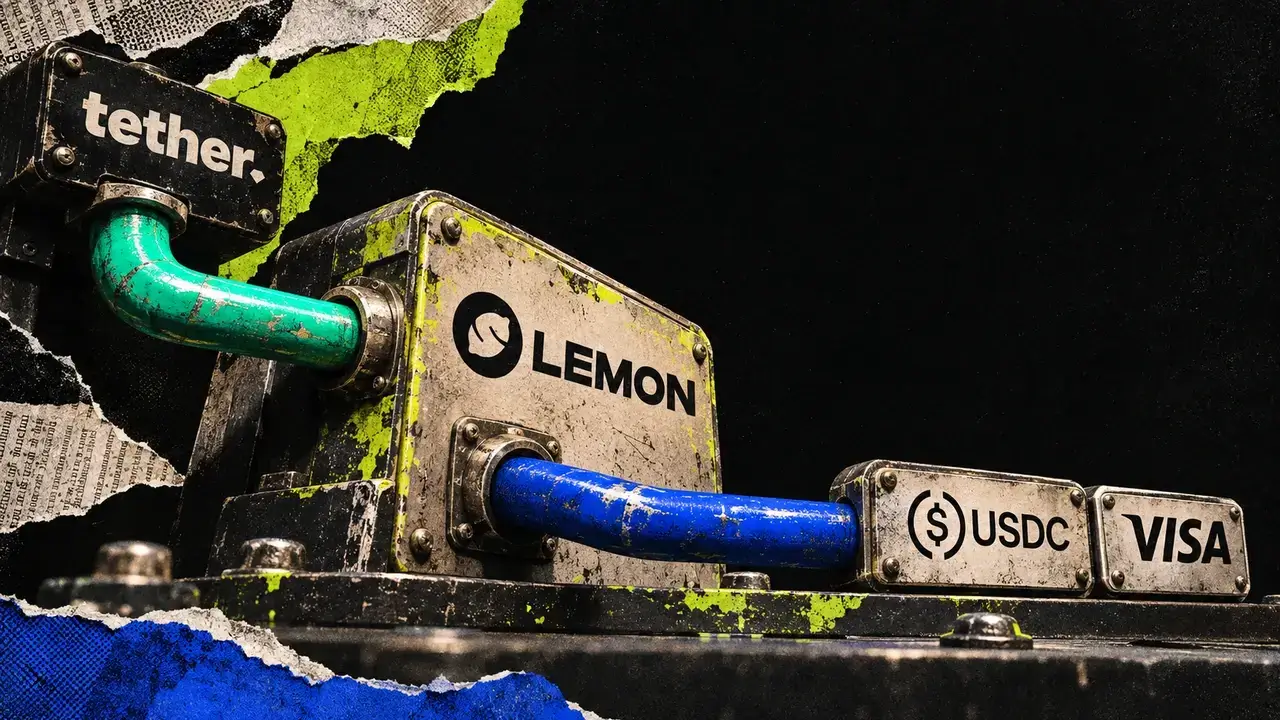
Tether commits $14.5 million to a fintech that uses rival Circle’s USDC for Visa settlement
Quick Take
- Tether’s investment backs Lemon’s existing USDT dollar balance, which credits transfers from U.S. banks in the stablecoin.
- Lemon named USDC for international Visa prepaid card settlement in April, while June guidance describes paying from USDT.
- Lemon reported more than 151,000 international card purchases during the winter holidays, up 61% from the previous winter holiday period.

Tether announced the investment in Argentinian fintech Lemon on Nov. 25 and said it aimed to expand the use of USDT and its tokenized gold, XAUT, in Latin America.
CEO Paolo Ardoino said people in the region are using USDT to get paid, spend, and send money across borders.
Lemon customers can keep the stablecoin in the app, send it to an Argentine bank, or spend it from their balance. Lemon’s April Visa rollout showed how Circle’s USDC can move between the companies handling a card purchase.
The fintech CEO Marcelo Cavazzoli told Forbes Argentina the $14.5 million package includes $5 million in equity and $9.5 million in incentives to develop products together.
Lemon's June Digital Dollar guide describes a single balance that automatically brings together USDT, USDC and USDS on a one-for-one basis. The fintech's deposit fee guide says transfer charges can reduce the amount credited, and the exchange rate may change by the time Bridge, its provider, converts the funds.
To withdraw to a bank, customers enter the account number for an Argentine dollar account in their own name. Lemon shows an estimated payout, and the transfer arrives as bank dollars.
The conversion rate can change while the transfer is being processed, and users sending money to a crypto wallet can choose the receiving token and network. Lemon handles the conversion if they choose USDC or USDS.
What moves through Lemon
Follow a U.S. bank transfer into Lemon and see what changes when the customer withdraws or pays abroad.
Choose how the balance is used
Argentina’s Visa prepaid card for foreign-currency purchases.
Bank transfers, app balances and card settlement can use different forms of dollars.
For the card route, the current Visa settlement asset and the payout currency for individual merchants remain unconfirmed.
Sources
Supporting facts
- Lemon says it credits incoming U.S. bank dollars as USDT. Its product guide describes one-for-one consolidation, while its dedicated fee guide says Bridge's exchange rate may vary and transfer charges can reduce the amount credited. [1] [2] [3] [4]
- Lemon says users can withdraw the app's Digital Dollars to an Argentine dollar bank account in their own name by entering its bank account identifier, with an estimated conversion amount that can change before processing. [1] [5]
- On April 21, Lemon announced that international purchases on the physical and virtual Argentine Visa prepaid card would settle in Circle's USDC, regardless of whether the customer paid with pesos, digital dollars or another asset. [6]
- Lemon's June 15 guide says it charges one Digital Dollar (USDT) per U.S. dollar on regular foreign-currency prepaid purchases funded from that balance. It quotes a 0.3% commission when customers fund purchases with ETH or BTC. Customers funding with pesos pay a 0.5% commission and buy USDT at 3.5% above the app price. [7] [8]
Method
The deposit and withdrawal paths come from Lemon’s published account guides. The card view places the April Visa rollout and June customer guide side by side. Arrows mark only documented transfers between bank dollars and the app balance.
Scope
For the card route, the current Visa settlement asset and the payout currency for individual merchants remain unconfirmed.
 CryptoSlate
Tether invests in fintech using USDC for payments
On April 21, Lemon announced that international purchases on its physical and virtual Visa prepaid cards in Argentina would settle in Circle’s USDC, whether the cardholder paid from pesos, digital dollars, or another asset.
In Visa’s general model for direct stablecoin settlement, an issuer can pay Visa in a supported token, and Visa’s custodian converts the funds to fiat to pay merchants.
Lemon’s June card guide lists a charge of one Tether's USDT per US dollar for regular foreign-currency purchases funded from the app’s Digital Dollar balance. Funding with Ethereum or Bitcoin carries a 0.3% commission.
A customer starting with pesos pays a 0.5% commission and buys USDT at 3.5% above the in-app price.
The prepaid card terms say foreign-currency purchases settle with the payment processor in a reference asset that can change. The June guide describes the USDT customers spend or buy to fund purchases.
Lemon reported more than 151,000 international Lemon Card purchases during Argentina’s 2026 winter holidays, up 61% from the prior winter holiday period.
Cavazzoli told Forbes Argentina that more than 85% of the volume moving through Lemon was in local currencies such as Argentine pesos, Peruvian soles and Colombian pesos.
The Argentine central bank counted 791.6 million instant peso transfers sent and 122.8 million peso payments initiated through interoperable QR codes nationwide in September. Lemon’s dollar balance sits alongside a peso network that people already use at scale for transfers and purchases.
For Tether, the opportunity is the balance customers can keep between a deposit and their next transfer or purchase. The value of that position depends on how much customers keep in USDT between transactions, a figure the card and peso payment counts leave open.
Mentioned in this article
Editorial credits

Also known as "Akiba," Liam Wright is a reporter, podcast producer, and Editor-in-Chief at CryptoSlate. He believes that decentralized technology has the potential to make…

Gino Matos is a law school graduate and a seasoned journalist with six years of experience in the crypto industry. His expertise primarily focuses on the Brazilian blockchain…