South Korea clears way for courts to seize and sell Bitcoin for unpaid debts under new November rules
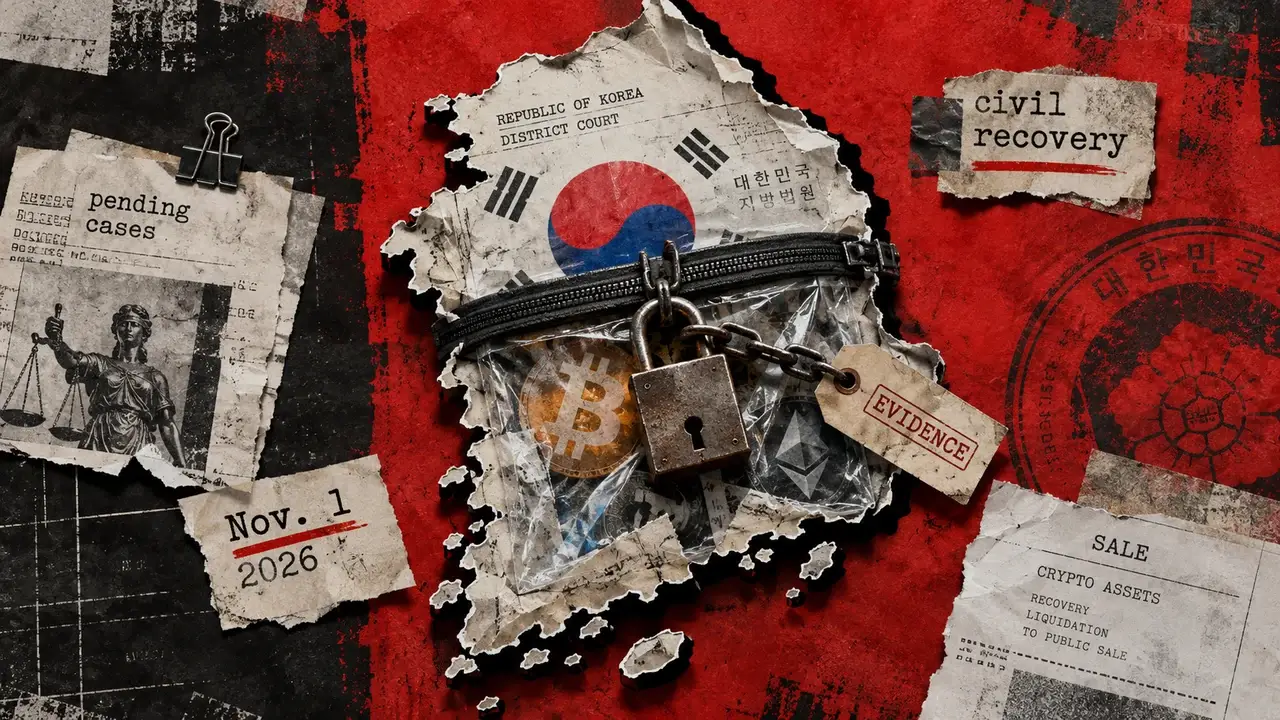
South Korea has established procedures for courts to seize and sell debtors' cryptocurrency to satisfy civil claims.
On Oct. 12, the Supreme Court promulgated Rule 3280, introducing standardized procedures for freezing, transferring, and liquidating digital assets to recover unpaid debts. The regulations take effect on Nov. 1 and cover cryptocurrencies held on exchanges and in private wallets.
One provision allows court officers to take possession of directly held crypto before debtors receive formal notice of an attachment order, potentially limiting opportunities to move assets beyond creditors' reach.
The changes come as cryptocurrency holdings increasingly feature in South Korean debt-recovery proceedings, prompting authorities to establish consistent procedures for assets that can be transferred rapidly without relying on traditional financial intermediaries.
Crypto exchanges face new obligations under debt-recovery rules
Under the framework, creditors seeking repayment from cryptocurrency held on exchanges can obtain court orders attaching a debtor's right to receive those assets.
Once an attachment order is served, the exchange or other custodian must prevent the transfer of covered assets to the debtor, who is also prohibited from disposing of the claim or receiving the cryptocurrency.
Creditors can also ask courts to compel custodians to disclose information about the targeted holdings within one week of receiving the order.
The required information includes whether the custodian recognizes the debtor's claim, the type and quantity of cryptocurrencies held, and whether other creditors have existing claims or priority rights over the assets.
The disclosure obligation applies when creditors seek it through the prescribed court procedure, giving them a means to identify assets available for repayment and potential competing claims.
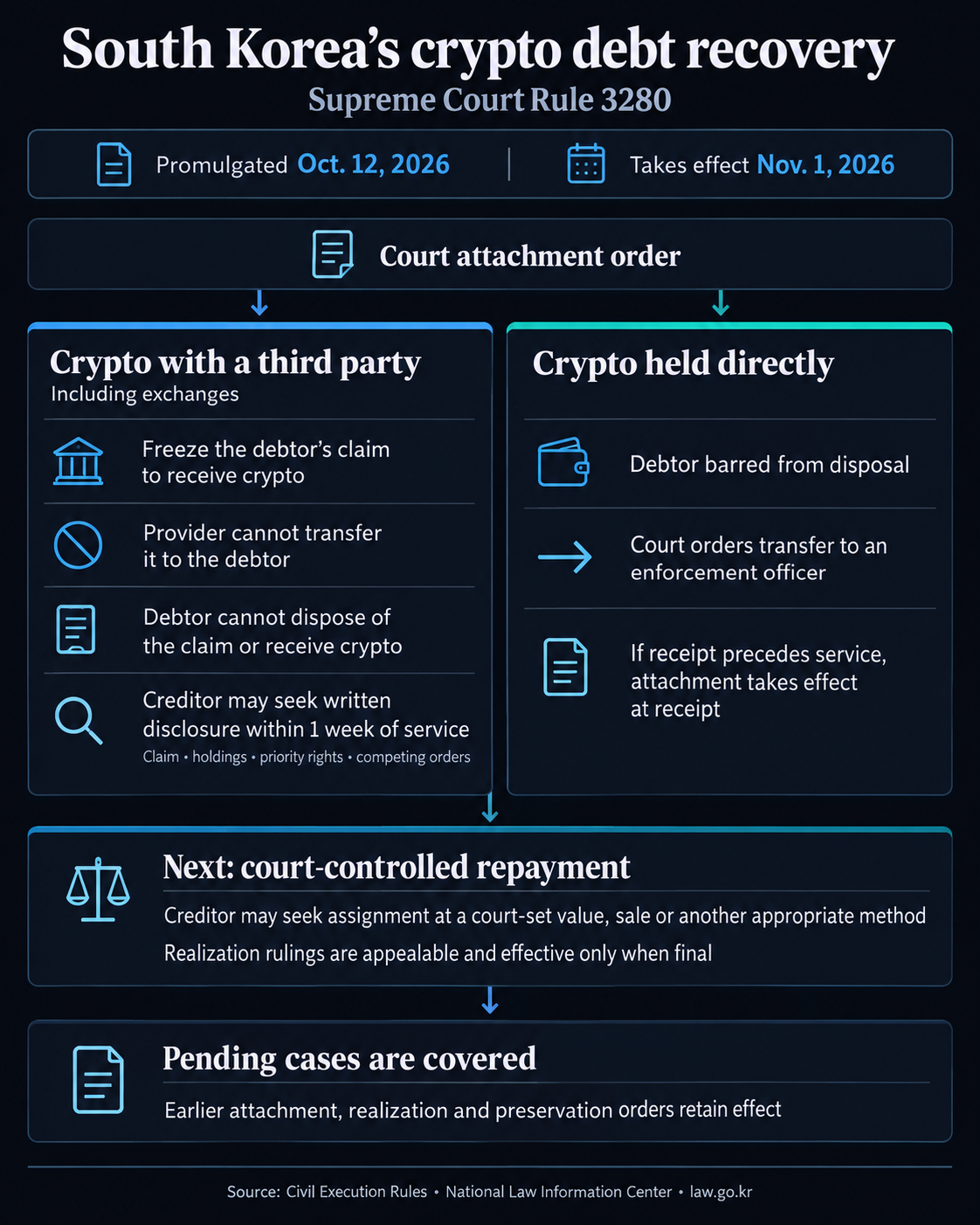
For cryptocurrencies held directly by debtors, courts can prohibit transfers and order the assets delivered to an enforcement officer.
The rules permit that transfer to occur before the attachment order is formally served on the debtor. If the officer receives the cryptocurrency first, the attachment becomes effective upon receipt.
However, enforcement against self-custodied assets could remain challenging where debtors control the private keys needed to authorize transfers.
Once creditors attach cryptocurrencies, they can seek additional court orders to recover their value.
Judges may authorize transfers to creditors at court-determined valuations or direct enforcement officers to arrange sales through virtual asset service providers.
For exchange-held crypto, the rules also permit sales through the existing custodian, transfers to accounts controlled by enforcement officers, or conversion into assets that can be more easily liquidated.
Sales must use the prevailing market price on the transaction date or another appropriate valuation, introducing a defined process for assets whose prices can fluctuate sharply during enforcement proceedings.
Debtors retain the ability to appeal decisions authorizing asset transfers or sales, which take effect only after becoming final. The regulations also establish procedures for restoring assets when enforcement is withdrawn or canceled.
The Supreme Court said the amendments are intended to improve legal certainty and consistency as courts handle a growing number of cryptocurrency-related enforcement cases.
The Nov. 1 implementation will also cover proceedings already before the courts, with existing attachment and preservation orders remaining valid. Exchanges and other custodians handling those cases will need to apply the new disclosure, transfer and sale procedures once the regulations take effect.