Solana Just Got Faster—Is It Bullish for SOL?

In brief
- The Agave v4.2 client turned on the first 50ms slot-time cut, from 400ms to 350ms, this week. I- t's step one of four under the approved SIMD-0525 proposal, each gated to a later epoch so the network can pause if block-skip rates rise.
- Solana's goal is a 2x faster confirmation and tighter leader windows that double as a censorship-resistance measure.
The speedy Solana network just got faster, upgrading the way transactions on the network are processed for the first time since genesis. What it means is applications on Solana will now confirm transactions a bit quicker—increasing the efficiency of its "internet capital markets" across the network. Does it bode well for investors in the network’s native token SOL?
First, here’s what the upgrade does, from a technical perspective: Solana validators running the Agave v4.2 client flipped on the first of four scheduled slot-time reductions this week, dropping the network's base timing from 400ms to 350ms, meaning confirmations now take a lot less.
The change is the first cut to Solana's slot length since genesis, and it's the opening move in a plan to reach 200ms. For context, that's far shorter than Bitcoin's ~10-minute block time and Ethereum's ~12-second blocks—Solana already confirms transactions in well under a second, and this week's step trims a slot from 400 milliseconds to 350ms.
A slot is the fixed window in which a leader (the validator temporarily in charge of building the block) gets to produce it. Shrink the window and transactions reach finality faster, meaning the point at which a Solana transaction can no longer be reversed. Because each step has its own feature gate and switches on in a later epoch (the time to produce 432,000 slots, which is around 2 to 3 days) than the one before, the network can halt between steps if block-skip rates climb—the canary that the timing got too tight for the hardware.
We're in a new era of 350ms
Next stop, 300ms https://t.co/DQuyZR9rWl
— Solana (@solana) August 21, 2026
The reduction was first floated in SIMD 469, shorthand for a Solana Improvement Discussion, which is how changes on the network are proposed and finalized. It was then formally approved as SIMD-0525. Per the Solana Foundation's upgrade page, it leans on performance gains already shipped in the validator clients, especially in Turbine (how blocks fan out across the network) and Replay (how validators re-process them).
The Foundation frames it two ways. One is latency: the protocol becomes "more competitive" on confirmation speed. The other is censorship resistance—a shorter slot narrows the monopoly a leader holds over block building, and paired with a separate proposal to cut consecutive leader slots, it limits how long any single validator controls the pipeline.
Is it bullish for SOL? Not by itself, but it does help
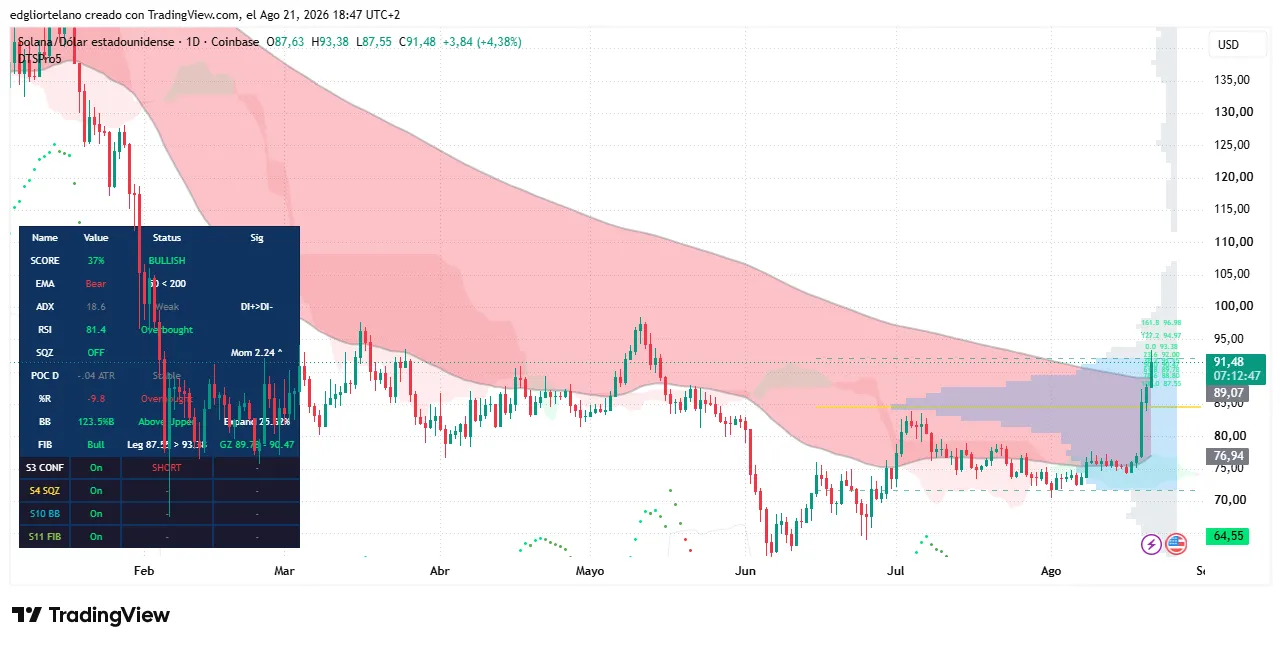
Solana’s native token SOL sits at around $91 at the moment, up roughly 4.4% on the day and well off its June low near $64.55. Momentum is hot: The daily Relative Strength Index, or RSI, printed 81, deep in overbought territory—and the 200-day average is still tagged "bear," meaning the longer trend hasn't flipped.
The slot-time cut is real infrastructure work, but it's a multi-month rollout whose final 200ms step isn't live yet. Markets tend to price this as a quiet competence signal, not a catalyst.
The broader lift in SOL right now is riding the same wave as the rest of the majors: Bitcoin's push to its highest level since June, with roughly $3 billion in shorts liquidated this week, dragged altcoins up with it. In terms of short-term price movements, the upgrade is less impactful than the overall macro conditions..
The one place the upgrade could matter for price is narrative and fundamentals. Solana has spent years defending its throughput lead against rivals; a public, staged march to 200ms is ammunition for the "fastest chain" story that funds and developers actually weigh. The technical change is bullish for the network, not necessarily for the price directly—at least not yet.