Should you leave Australia to avoid paying 47% tax on crypto gains?


 Written by Andrew Fentonstaff editorEdited by Felix Ngstaff editor
Some Australian crypto investors are moving overseas to avoid the huge CGT increase from July 2027. But there are also less drastic ways you can pay less tax.
In part one of our special on how to avoid Australia’s massive hike in capital gains taxes on crypto in July next year, we looked at borrowing against your Bitcoin or setting up a self-managed super fund (SMSF), among four ways to mitigate the impact of the taxes.
While an SMSF offers Australians the greatest tax advantages, it’s only suitable for older investors, or those who are willing to lock up their crypto for decades until they retire. For younger investors, moving overseas could reduce your future crypto tax bills to 0% — but there are less drastic options to save on tax too.
5. Leave Australia and move to country with 0% CGT
Australia’s impending tax changes have already inspired crypto king Fred Schebesta, founder of Finder.com, to become a tax exile in Singapore.
From July, the top rate on real, long-term crypto gains will increase to 47%, minus the effects of inflation on the cost basis.
For upwardly mobile, single crypto investors, the “nuclear option” of leaving the country to avoid giving almost half their gains to the government will look increasingly attractive.
Many of the world’s top crypto hubs — Singapore, Portugal, Malta, UAE and Hong Kong — offer 0% capital gains taxes on long-term crypto gains in an attempt to attract wealthy investors.

Also read: The one thing these 6 global crypto hubs all have in common...Should you leave Australia to avoid paying 47% tax on crypto gains?
Ben Simpson, founder of crypto advisory service Collective Shift, says some of his members have already pulled the trigger.
“Yeah, we’ve had a number of people that have sort of packed up and gone basically, ‘f—- this. I’m off to the Bahamas or whatnot,’” he says.
Andrea Yuen, CEO of Sywftx, says she is keenly aware of the tax advantages of living outside of Australia.
“I lived in Singapore for 30 years. I do miss my no capital gains tax,” she says. But she didn’t move there for tax reasons, and cautions that uprooting your life to avoid a bit of tax is a pretty drastic step.
“I would never say that we should structure our lives only to think about tax outcomes,” she says. “There are many other wonderful reasons why I’ve come back to Australia and continued to live in Australia.”
“I think if you’re moving countries solely based on a decision about whether you know your crypto is going to get taxed, then you probably need to think a little bit harder.”
Simpson has considered the idea, given he already spends half the year in America looking after Collective Shift US, but looking into the rules put him off.
“You really have to cut pretty much all ties to Australia. So if you are genuinely happy to leave and don’t want to come back for the majority of the year, and cut your healthcare and cut all your ties back to Australia, then that is a strategy.”

“Bitcoin Jesus” Roger Ver gave up his US residency in 2014, and ten years later he was arrested and charged over failing to correctly report the value of his crypto holdings and paying exit taxes. He was forced to pay almost $50 million to make the case go away.
Similarly, Australians leaving the country face a hefty exit tax on departure, which may require selling a decent amount of your stack.
“They tax you on the way out. If you’ve got a lot of gains or profits you’re sitting on, they’ll catch you when you leave,” says Adrian Forza, director of Crypto Tax Australia. “Arguably it’d be bigger in the future, but it’s still difficult to stomach selling off everything to leave.”
Forza explains you also have the option of paying the Australian taxes later on, but on the full value of the gain after you sell the asset. So if you expect Bitcoin to go up, you’d be best off paying the exit tax now.
Related: Australia releases draft bill to adopt OECD crypto tax reporting framework
6. Set up a company to benefit from the company tax rate
Simpson is only 27 and the prospect of locking up his crypto portfolio for forty years holds little appeal. Instead, he trades and holds crypto via a company to benefit from the 25% company tax rate.
Running a single-person company is easier than you might think, but not worth the hassle unless you have a reasonable amount of capital and intend to make a lot of trades. It requires registering the company with ASIC and paying an annual fee, paying an accountant to produce financial statements and/or an annual company tax return and mucking about with payroll software and payday superannuation contributions if you plan to pay yourself an income. You can pay yourself a dividend at any time when you need some money.
“The company structure is good if you’re wanting to cap the capital gains tax at the company tax rate,” he says, but notes there’s a big catch: when you take funds out of the company, you need to pay the difference between the 25% company tax rate and your personal tax rate.
“You still need to pay your marginal income tax rates. If you’re on the top tax rate, like 47%,” he says.
You may be wondering: if you have to pay your income tax rate anyway, which will equal the CGT rate from July, what is the benefit in paying a few thousand dollars and filling out a bunch of paperwork to run a company?
Simpson explains that the key advantage is that while you are building up your crypto portfolio by trading in and out of different coins, you only pay the 25% company rate for each sale. That means paying up to 22% less than CGT each time you exit a position, which builds into an even more significant saving over time.
“Instead of paying 47% because you’ve just taken the profits… then the CGT amount is only 25% — the company tax rate. So when you put that money back in, you’ve got more capital to play with.”
However, if you don’t trade enough, it might be taxed at 30%.
Forza says the advantages are greater for those on higher incomes.
“If you’re a single person, then you’ve got a company, and you’re earning, you know, 150 grand a year, um, or over 200, then yeah, definitely a company would be the way to go, especially now that the CGT discount has gone out the window.”
It’s not a particularly useful structure if you just plan to just hold your Bitcoin, however. There are some potential advantages but arguably not enough of them to be worth the hassle.
7. Just get out of crypto entirely to avoid high CGT rates
The 50% CGT discount has been replaced by an indexation discount, which takes into account how much inflation affects how much you paid originally for an asset.
This means that investors who buy and hold dividend stocks or index funds for a long period will receive a bigger CGT discount. So should you drop crypto and buy a bunch of ETFs so you can pay less tax?
The short answer is no: the new CGT ‘discount’ is largely an illusion, as it simply measures your real gain after inflation.
Simpson says crypto has been hit hard by the CGT changes, but it still offers the best risk-reward opportunity.
“For us in Bitcoin, the growth ... heavily outweighs the tax considerations. In my point of view. If you’ve got the right portfolio, that can give you the right upside.”
History suggests that despite volatility and years-long bear markets, the return from investing in Bitcoin over time would still leave investors ahead of ETF investors even after paying more tax. Investing further down the risk curve with altcoins however, can either pay off handsomely or end in total disaster.
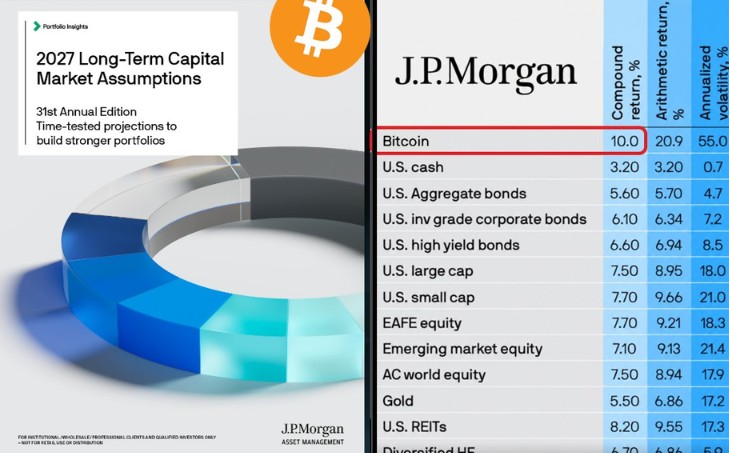
JPMorgan assumes that Bitcoin will compound by 10% on average in the years ahead. (Source JPMorgan/Bitcoin Archive)
Simpson says he convinced his younger sister, who is a basketball player on a low income, to invest in Bitcoin two years ago rather than putting money into a savings account.
“She’s up like 40% or 50% in her portfolio and she’s like, ‘wow, this is going to get me so much further towards buying a house one day than sitting in cash and losing 10% [to inflation over time],” he says.
“That’s why I think Bitcoin makes so much sense to accumulate. And the tax considerations are not really there for most people I think.”
Yuen says crypto is one of the few asset classes that offers investors the chance to make double-digit returns in a few months, or to potentially double their money. Even after paying the new taxes, crypto investors with those sorts of returns will still be ahead.
“My dad always said to me, it’s a good thing, if you’ve made profits, you should be happy to pay some tax on it.”
Well maybe not happy about it, but you’ll still be making money.
Also read: How Aussie Bitcoiners can avoid 2027’s shock CGT hike, Part 1