SEC changes token buyback guidance as spending hits $638M
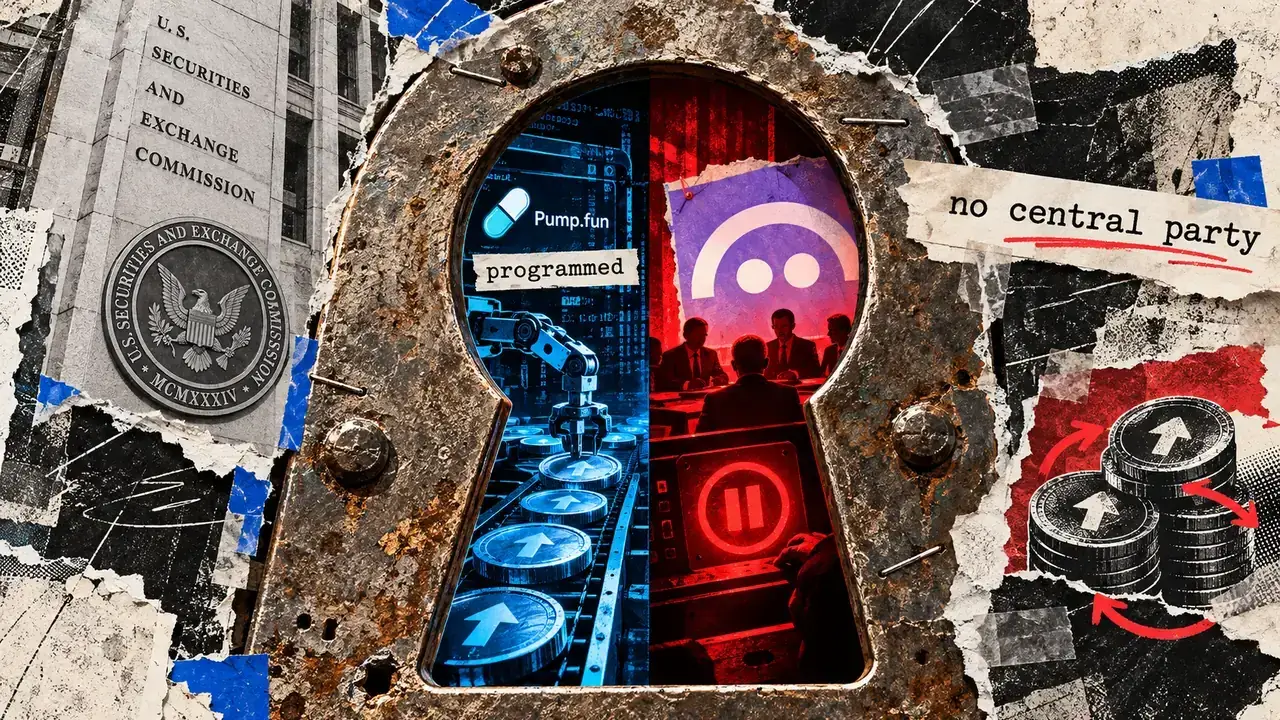
The US Securities and Exchange Commission tightened its guidance for crypto token buybacks just three days after publishing it.
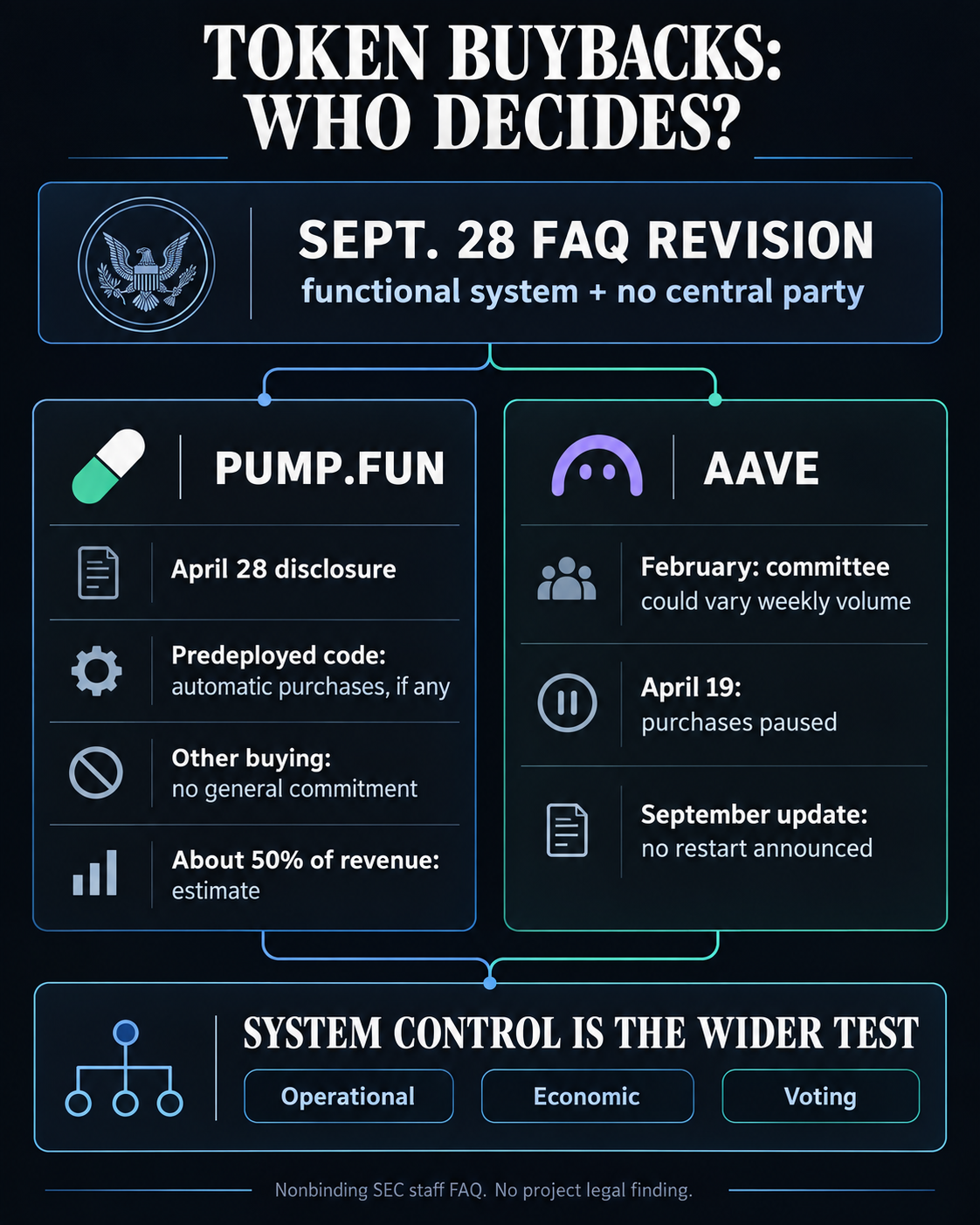
On Sept. 25, SEC staff said a token issuer could announce a buyback without that announcement being treated as a promise to manage the token's value, as long as the crypto system was already functional. On Sept. 28, the agency changed that answer by adding another condition: the system must also have “no central party.”
It represents an important change to the guidance, as many crypto projects use buybacks while still giving people, companies, or committees some control over how those purchases happen.
The SEC staff's updated answer now says that a buyback announcement for a non-security crypto asset would not, by itself, amount to a promise of essential managerial efforts when the system is both functional and has no central party.
If the system is not yet functional, the SEC staff says a buyback announcement could count as such a promise if the issuer presents the purchases as a way to generate yield or returns for holders.
The change comes as token buybacks have become increasingly important across crypto. Crypto projects spent a record $638 million on token buybacks through late August, according to previous CryptoSlate reporting.
The FAQ reflects the views of SEC staff. It is not legally binding and does not determine whether any particular token is a security. Still, the change raises a practical question for projects using buybacks: who actually controls the buying?
A project may have already spent millions buying its token, but that number says little about who can decide whether the next purchase happens, how large it is, or whether the program stops entirely.
The question behind the buyback
The SEC gave a clearer definition of a “central party” in its March crypto-asset interpretation.
It defines a central party as a person, company, or group that has operational, economic or voting control over a crypto system. A decentralized system, by contrast, operates without that kind of control.
That definition applies to the crypto system as a whole. So, having control over a project's treasury or buyback program does not automatically mean the entire system has a central party. But it can be one piece of evidence when looking at who holds economic control.
This becomes important when a project combines automatic buybacks with decisions made by people.
A smart contract might automatically buy tokens under one part of a program, while a company, committee, or DAO can decide whether other purchases happen.
The key question is therefore not just whether some buying happens automatically, but whether people still have meaningful power over the system and its economic decisions.
Pump.fun is a good example of this. In an April 28 disclosure, the platform said references to PUMP purchases and a “buyback program” generally described plans or smart-contract functions rather than a firm promise to buy tokens. It made an exception for purchases that were already programmed to happen automatically through on-chain code deployed before April 28, 2026 UTC.
Pump.fun also said statements about using roughly 50% of platform revenue for token purchases were estimates, not guarantees. It added that third parties could carry out some purchases.
Its PUMP token page says 50% of defined platform revenue was programmatically locked and allocated to be burned for one year beginning April 28. However, the same page says future purchases can generally be started, stopped, or changed unless they were already programmed to happen automatically.
The two disclosures also use slightly different dates when describing which purchases fall into that automatic category. The April 28 disclosure refers to code deployed before April 28 UTC, while the token page refers to activity programmed before April 29.
Nonetheless, the important point is this: Pump.fun describes two types of activity.
Some token purchases are programmed in advance and happen automatically. Others still depend on future decisions. That does not establish whether Pump.fun has a “central party” under the SEC's definition. Answering that question would require looking at who controls the wider system, not just its buybacks.
Aave's pause shows discretion in action
Aave is another example of how people can still control a token-buyback program.
In a Feb. 28 funding update, DAO service provider TokenLogic said the Aave Finance Committee could adjust weekly AAVE buyback volumes within a 75% range. The committee could make those changes based on factors including liquidity, market volatility, timing, and protocol revenue. TokenLogic said the DAO had allocated $42 million to buy more than 205,000 AAVE during the program's first 10 months.
The committee's discretion became clear in April. An April 22 governance notice said AAVE buybacks had been paused from April 19 after an rsETH bridge incident the previous day.
TokenLogic said the pause was intended to give the treasury more flexibility while the consequences of the incident were assessed. It also said any restart would be announced through a normal funding update.
A later August/September funding update included AAVE among the assets that could be purchased through updated token budgets.
However, that update did not clearly say that AAVE buybacks had restarted, nor did it provide a record of completed purchases after the pause.
The April notice therefore confirms that the program was stopped at that point. The later update shows that capacity to buy AAVE existed, but does not clearly establish whether purchases had resumed.
Aave's experience shows why the SEC's new wording matters.
People were able to change the size of the buyback program and later stop purchases when conditions changed.
That does not automatically mean Aave has a central party under the SEC's definition. The SEC's test is broader and looks at who has operational, economic, or voting control over the entire crypto system.
But for investors trying to understand how decentralized a buyback really is, there is now a straightforward question to ask:
Who can start, stop, or change the next purchase, and what other power do they have over the system?