Robinhood now makes more money from predicting the future than trading crypto

Quick Take
- Robinhood's crypto revenue plunged 55% to $120 million in Q3, falling behind the $173 million generated by prediction markets.
- Crypto's share of Robinhood's total revenue shrank from 21% to 8.4%, while options and prediction markets powered record company earnings.
- Robinhood Chain contributed $26 million, masking a 6% quarterly decline in the rest of its crypto business despite rising trading volumes.

Robinhood's cryptocurrency revenue fell 55% in the third quarter, even as its new blockchain helped offset declining trading income.
The brokerage reported $120 million in crypto revenue for the three months ended Sept. 30, trailing the $173 million generated by prediction-market contracts. Meanwhile, total company revenue rose 12% to a record $1.42 billion.
The results highlight a growing divergence between Robinhood's digital asset business and its other trading products, with options and prediction markets emerging as larger revenue contributors.
Robinhood Chain offsets declining crypto trading revenue
According to Robinhood's earnings presentation, its Ethereum-based Layer 2 network, Robinhood Chain, generated more than $50 million in transaction fees during its first quarter on mainnet, contributing $26 million to the company's reported crypto revenue.
The network processed more than $80 billion in decentralized exchange trading volume during the period, ranking among the five largest blockchains by revenue and trading activity, according to Robinhood.
Tom Wan, head of data at Entropy Advisors, noted that Robinhood Chain accounted for approximately 22% of the company's cryptocurrency revenue, generating more than four times Bitstamp's $6 million contribution.
Without the blockchain business, Robinhood's crypto revenue would have declined 6% quarter over quarter to $94 million. Instead, the additional $26 million lifted total crypto revenue 20% from the preceding quarter.
The weakness persisted despite a recovery in trading activity. Cryptocurrency volumes increased 23% sequentially to $49.8 billion, with Bitstamp contributing $29.2 billion and Robinhood's retail application generating $20.6 billion.
However, compared with the same period last year, total crypto trading volume fell 38%. Activity on Robinhood's retail app fell 48%, while Bitstamp's volume contracted 28%. It explained:
“Crypto Notional Trading Volumes decreased 38% year-over-year to $50 billion, including Robinhood App Notional Volumes which decreased 48% year-over-year to $21 billion, and Bitstamp Notional Volumes which decreased 28% year-over-year to $29 billion.”
Robinhood's app generated $88 million in crypto trading revenue, down from $94 million in the second quarter, while Bitstamp's contribution remained unchanged at $6 million.
The decline reduced cryptocurrency's share of Robinhood's overall revenue to 8.4%, down from about 21% a year earlier.
Prediction markets and options drive Robinhood's growth
The cryptocurrency downturn contrasted with accelerating activity across Robinhood's derivatives and equities businesses.
Prediction-market revenue increased more than sixfold year over year to $173 million, surpassing cryptocurrency trading as the platform's second-largest transaction-based revenue category.
Customers traded a record 16.4 billion event contracts during the quarter, more than seven times the volume recorded a year earlier.
Options remained Robinhood's largest transaction-based revenue source, generating $399 million, up 31% annually. The company also reported a record 905 million options contracts traded, up 48%.
Equities revenue rose 41% to $121 million, supported by a 53% increase in trading volume to a record $992 billion.
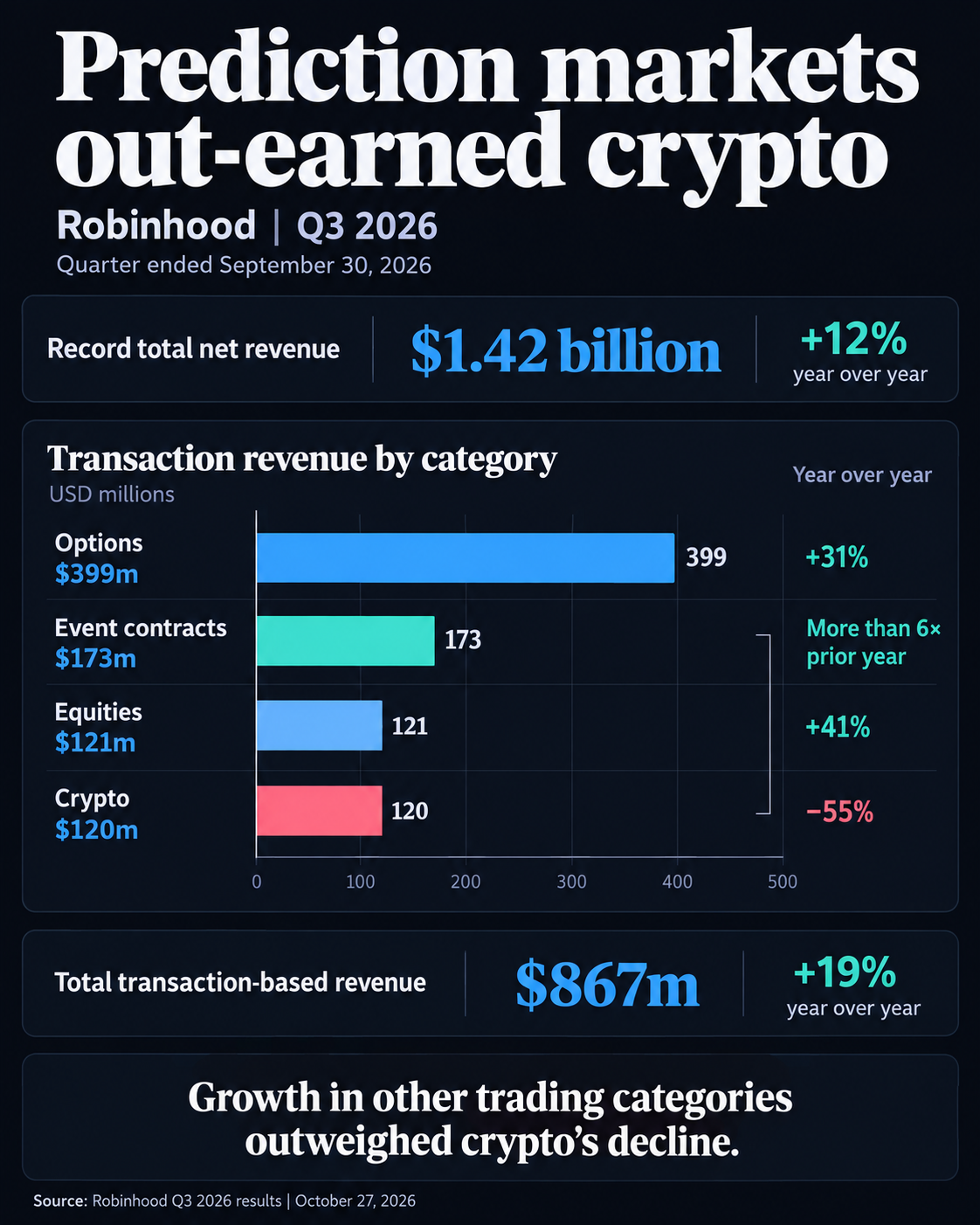
Together, the gains lifted transaction-based revenue 19% to $867 million, despite the substantial contraction in cryptocurrency revenue.
Wan identified prediction markets and options as Robinhood's principal growth engines, while describing Robinhood Chain as the business responsible for the sequential improvement in crypto revenue.
The broader revenue gains did not translate into higher quarterly profits. Net income fell 14% to $476 million, while diluted earnings per share declined 16% to $0.51.
Robinhood also reported 28.7 million funded customers, up 7% from a year earlier, and $396 billion in platform assets, up 19%.
The company's prediction-market expansion continued through Rothera, its joint venture with Susquehanna International Group, which exceeded $100 million in annualized revenue during its first full quarter of operations.
Mentioned in this article
Editorial credits

Oluwapelumi values Bitcoin's potential. He imparts insights on a range of topics like DeFi, hacks, mining and culture, underlining transformative power.