Pearl price surges 66% as FP8 mining upgrade advances, but is AI demand real?



Pearl price has rallied nearly 66% over the past seven days as developers advance an upgrade designed to allow artificial intelligence infrastructure providers to mine the cryptocurrency while handling customer workloads.
- Pearl price gained nearly 66% over seven days as its market cap approached $900M.
- Pearl’s FP8 upgrade introduces mining support for Nvidia Hopper and Blackwell GPUs.
- Blockworks estimates that fewer than 1% of Pearl blocks match genuine AI models.
- Preliminary FP8 testing found AI inference throughput reductions of 20% to 40%.
- Pearl Research Labs, its team and shareholders collectively reported holding 98M PEARL.
According to CoinGecko, PEARL traded at $2.34 on Thursday, up nearly 35% over 24 hours. Its market capitalization reached $899.28 million, while daily trading volume stood at $58.33 million, placing the cryptocurrency among the 75 largest digital assets.
The rally follows Coinbase’s introduction of PEARL spot trading on Nov. 13, alongside an announcement covering perpetual futures markets in supported jurisdictions.
Meanwhile, cryptocurrency investment firm Syncracy Capital disclosed that it had accumulated a substantial position in PEARL over the past two quarters, citing the network’s potential to benefit from investment in AI infrastructure.
Pearl’s FP8 upgrade targets AI data center mining
Pearl is a layer-1 blockchain that uses matrix multiplication, a mathematical operation central to AI training and inference, to secure its network through proof of useful work.
Unlike Bitcoin, whose mining algorithm requires specialized hardware to calculate cryptographic hashes, Pearl allows graphics processing units (GPUs) to earn cryptocurrency rewards while performing calculations that AI models already require.
On Nov. 17, developers merged a software update scheduling FP8 activation on Pearl’s test network. The mainnet activation height remains unset.
Pearl currently relies on integer-based calculations for mining. Its proposed FP8 upgrade introduces support for eight-bit floating-point calculations, a numerical format commonly used by modern AI inference systems.
However, the upgrade initially restricts supported mining hardware to Nvidia’s Hopper and Blackwell GPU architectures.
Research firm Kairos Research, which holds PEARL, estimates that approximately two-thirds of the network’s existing computational power could become incompatible under the proposed hardware requirements.
Its preliminary tests on an Nvidia H100 found that mining through the FP8 implementation reduced AI serving throughput by 20% to 40%, compared with reductions of 30% to 65% under the existing integer-based implementation.
The findings contrast with Pearl’s expectations of substantially lower computational overhead, although Kairos tested an early software build on a single GPU.
How much of Pearl’s mining serves paying AI customers?
A Nov. 2 research report by Blockworks analysts Sam Schubert and Nick Carpinito estimated that fewer than 1% of Pearl’s blocks matched genuine AI models, while consumer-grade GPUs accounted for approximately 82% of the network’s computational power.
Pearl’s protocol verifies that the required mathematical operations occurred but does not independently establish whether miners performed them in response to paying customers’ requests.
The project has secured at least one commercial integration. In May, AI infrastructure provider Together AI announced an exclusive partnership with Pearl Research Labs, introducing a modified Gemma AI model priced more than 25% below its standard rate through anticipated cryptocurrency mining proceeds.
However, Together AI’s current product page states that the model “is not available on Together’s Serverless API.”
Pearl Research Labs operates its own inference platform, which provides developers with API access to AI models. Publicly available documentation does not quantify its paying customer base or the proportion of mining activity attributable to commercial inference requests.
Syncracy Capital co-founder Ryan Watkins believes the FP8 upgrade could encourage serverless inference providers and eventually larger AI data center operators to participate in Pearl mining.
“The immediate goal is to drive the overhead from mining Pearl toward zero,” Watkins wrote in his investment thesis.
In the coming years, Pearl could surpass Bitcoin as the world's largest cryptocurrency by compute and energy footprint.
— Ryan Watkins (@RyanWatkins_) November 18, 2026
As this day approaches, we believe it will cause an earthquake in the digital SoV market.
Our thesis on Pearl's "last mover" advantage in the age of AI.
1/ https://t.co/3klRdXrFkP
The investment firm’s assessment follows a period in which traditional Bitcoin mining companies have committed substantial resources to AI infrastructure, including financing packages worth billions of dollars.
Pearl token distribution draws criticism
While Syncracy Capital has positioned Pearl as a potential long-term competitor to Bitcoin, decentralized finance researcher and Pink Brains co-founder Ignas raised concerns over its early token distribution and the relationship between PEARL holders and Pearl Research Labs’ equity investors.
Ignas noted that nearly 121.7 million PEARL were mined during the network’s first six days, representing nearly 32% of its current circulating supply.
Pearl Research Labs, its team and shareholders collectively reported holdings of approximately 98 million PEARL as of Nov. 9, equivalent to roughly 25.5% of today’s circulating supply.
The company and its team have committed to locking at least half of their respective holdings until May 2027.
Ignas questioned whether six months represented a sufficient commitment for an asset promoted as a long-term store of value. He further argued that owning PEARL does not entitle investors to revenue generated by Pearl Research Labs’ commercial inference business.
Pearl price approaches its all-time high
On the daily chart, PEARL has established successive higher highs and higher lows, trading above its upper Bollinger Band at $2.1714 and its 20-day simple moving average at $1.6662.
The Relative Strength Index stands at 65.23, below the conventional overbought threshold of 70.
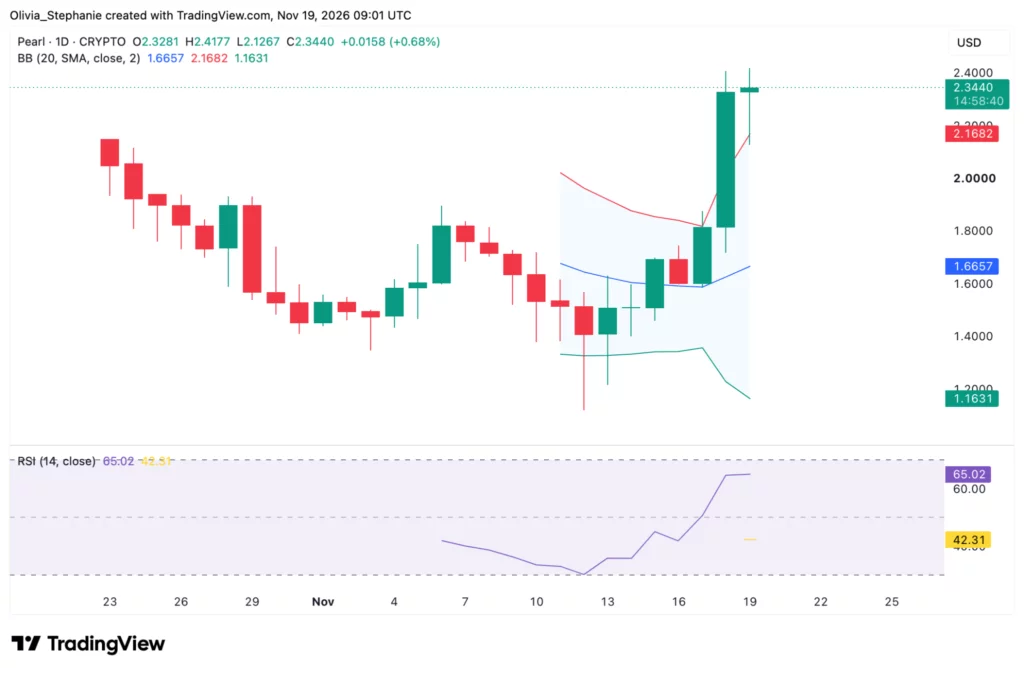
Immediate resistance lies between $2.39 and the cryptocurrency’s $2.46 all-time high. A sustained move above that record could bring PEARL into price discovery, while a rejection would leave $2.1714 and $2.00 as potential support levels.