Over 6 million bitcoin sit behind exposed public keys as AI warnings mount
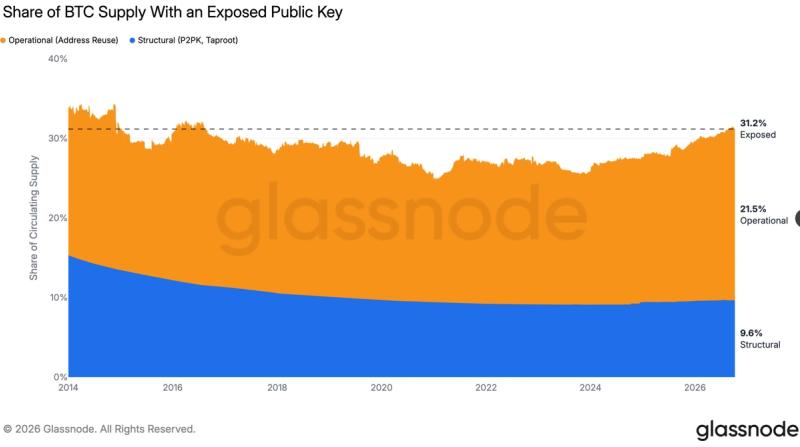
- More than 6 million bitcoin, representing 31.2% of circulating supply, sit behind public keys already visible on-chain, roughly 5 to 6 percentage points above the 2023 low.
- Exposed supply has increased by 222,000 BTC since May, with exchanges holding 1.79 million BTC behind visible public keys.
- The figures measure address usage, not immediate security risk. No practical attack on bitcoin or ether wallet keys has been demonstrated.
More than 6 million bitcoin BTC$82.690,34 sit behind public keys already visible onchain, highlighting the scale of holdings potentially exposed if advances in AI or quantum computing undermine Bitcoin’s cryptography.
Those coins represent 31.2% of circulating supply, roughly 5 to 6% above the low reached in 2023, according to Glassnode data.
Glassnode co-founder Rafael Schultze-Kraft said exposed supply has increased by 222,000 BTC ($18.2 billion) since the firm’s May report, while total bitcoin supply grew by just 64,000 BTC.
Exchanges accounted for 123,000 BTC of that increase and now hold 1.79 million BTC behind visible public keys.
The proportions vary considerably. Coinbase’s exposed share stands at 10%, compared with 83% at Binance.
Beyond exchanges, Fidelity holds approximately 375,000 BTC with just 2% exposed. Grayscale’s share is 49%, Revolut’s 99% and Robinhood’s 100%. U.S., U.K. and El Salvador government holdings show no exposure under this methodology.

Public keys can become visible through address reuse or appear directly in certain bitcoin output types, including early pay-to-public-key outputs and Taproot. A sufficiently capable quantum computer, or a hypothetical mathematical breakthrough could potentially allow an attacker to derive the corresponding private keys.
The update comes amid warnings from Ethereum researcher Justin Drake, who urged the industry to prepare for “bunker mode.” Drake argued that AI could potentially uncover a shortcut to breaking wallet cryptography “in months, not years” in a worst-case scenario, before quantum computers arrive.