North Korea’s $30M crypto cashout just handed legacy finance its best weapon to kill DeFi’s US debut
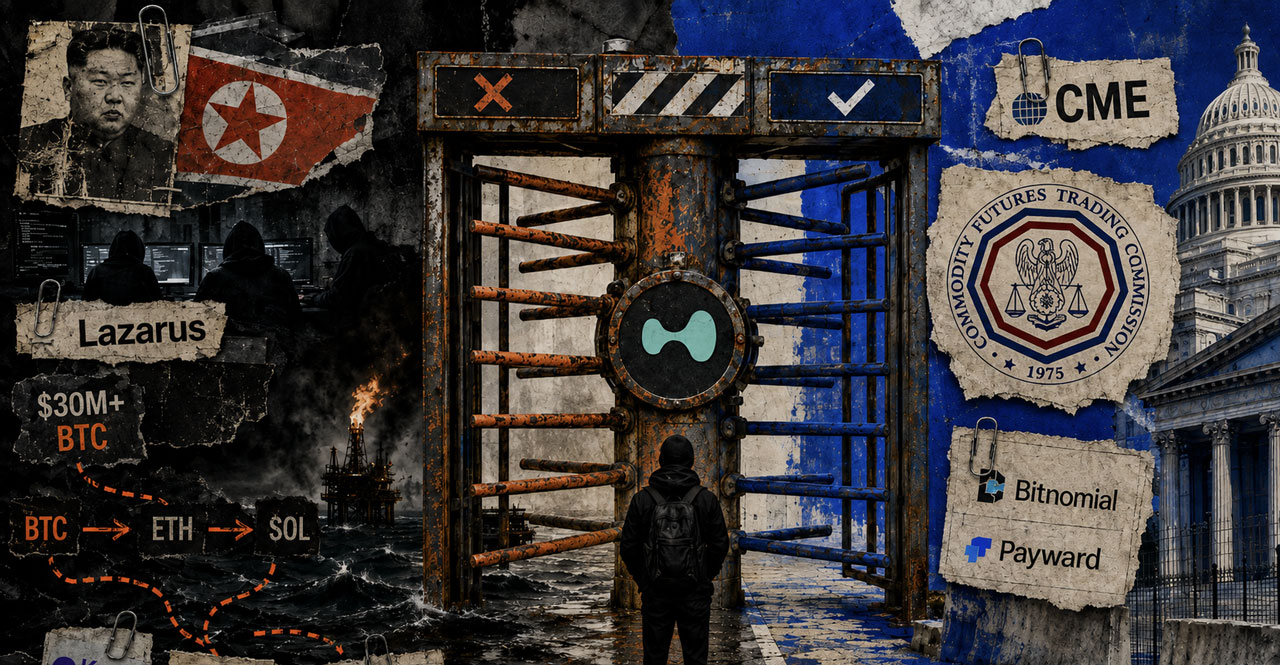
CME and ICE told Washington in May that Hyperliquid's pseudonymous, always-on markets could let sanctioned state actors circumvent enforcement.
On Aug. 31, an Arkham analysis reviewed by CoinDesk found that wallets linked to North Korea's Lazarus Group had sold more than $30 million of Bitcoin through Hyperliquid over the prior three weeks.
The proceeds were converted into ETH and SOL before funds moved to Kraken, LBank, and KuCoin. The same day, Bloomberg reported that Hyperliquid Labs was in advanced talks with Kraken parent Payward over a regulated US entry point.
On paper, the timing could hardly be worse for Hyperliquid. Whether it threatens the push to bring the exchange onshore depends on a detail neither Bloomberg's report nor the Lazarus findings answer: how the proposed US structure would connect to Hyperliquid's market.
| Date | Event | Why it matters |
|---|---|---|
| May | CME and ICE warn Washington about Hyperliquid’s pseudonymous, always-on markets | Establishes that sanctions and market-integrity concerns predated the Lazarus finding |
| June 18 | CME files Chicago Mercantile Exchange Inc. v. Selig | Shows CME was already fighting the regulatory pathway for US crypto perpetuals |
| Aug. 19 | Trump says Selig is working to bring Hyperliquid into the US legally | Turns Hyperliquid’s US entry into a public political priority |
| Aug. 31 | Bloomberg reports Hyperliquid-Payward talks involving Bitnomial | Reveals the likely US-facing regulated venue |
| Aug. 31 | CoinDesk/Arkham identify $30M+ in Lazarus-linked BTC sales via Hyperliquid | Gives CME’s earlier warning a concrete, timely example |
| Sept. 2 / Oct. 2 | CFTC/Selig response deadline, then CME opposition deadline | Keeps the legal fight immediate rather than historical |
The plumbing for the Hyperliquid deal remains a mystery
Bloomberg reported that US customers would use Payward's Bitnomial exchange to trade perpetual futures tied to the price of crypto tokens built on Hyperliquid's blockchain technology, subject to regulatory approval.
Bitnomial would be the US-facing venue, the products would be perpetual futures, and Hyperliquid-related tokens would sit underneath them economically.
The report does not establish whether Bitnomial orders would ever touch Hyperliquid's existing order book, or whether the two venues would share liquidity. It also leaves open whether positions would settle on Hyperliquid's chain, or whether Payward and its market makers would hedge Bitnomial exposure by trading directly on Hyperliquid.
That gap determines whether Lazarus becomes a distant offshore data point or a direct question about who US-regulated customers could end up transacting against.
CME is already fighting the framework in court
CME filed Chicago Mercantile Exchange Inc. v. Selig on June 18 in the US District Court for the District of Columbia. The suit challenges the CFTC's decision to let Kalshi and other designated contract markets list crypto perpetual contracts as futures, a classification CME argues should have been swaps under a separate regulatory structure.
CME's complaint points to differences in swap-dealer registration, margin treatment, transaction reporting, collateral rules, and tax treatment. It alleges competitive injury from a regime that lets newer products compete directly with CME for retail derivatives customers.
The court ordered the CFTC and Selig to respond by Sept. 2, with CME's opposition to an expected motion to dismiss due Oct. 2.
CME's case turns on a narrow statutory question: whether perpetual contracts meet the legal definition of futures under the Commodity Exchange Act, or whether they function as swaps subject to a different regulatory structure entirely.
Whether North Korean wallets moved $30 million through an offshore venue has no direct bearing on that classification question. Lazarus gives CME a far more intuitive story to tell outside the courtroom, in front of the CFTC's product-review process, in congressional hearings, and in public advocacy.
A concrete sanctions-evasion example lands harder there than a technical swaps argument ever could.
ICE has drifted away from CME's position
The original May warning grouped CME and ICE. ICE CEO Jeffrey Sprecher has since struck a far more conciliatory tone, saying ICE was “not freaked out about Hyperliquid” and describing the two companies as helping each other understand their respective worlds.
Those comments followed a round of meetings between the two sides. He called Hyperliquid a wake-up call, a framing well short of a threat to reject outright. That breaks the tidy version of this story where legacy exchanges unite against a common DeFi rival.
CME is actively litigating the CFTC's framework, while ICE looks more interested in understanding the model while still pushing for a level regulatory playing field.
Payward agreed to acquire Bitnomial for up to $550 million in April and completed the deal May 1. The purchase gave it a full CFTC-regulated derivatives stack: a designated contract market, a derivatives clearing organization, and a futures commission merchant.
Kraken has already listed CFTC-regulated crypto perpetuals through that infrastructure for US users. Bitnomial functions as regulated market infrastructure that Payward acquired specifically for this kind of product, carrying its own designated contract market, clearing organization, and futures commission merchant licenses.
Two opposite conclusions for Hyperliquid
CME's version treats Lazarus as proof of concept. A sanctioned North Korean hacking group apparently moved tens of millions of dollars through the kind of pseudonymous, permissionless market CME warned regulators about months earlier.
That market lacks the identity and surveillance architecture required of conventional US intermediaries.
Keeping Hyperliquid offshore leaves the protocol running as it does now, available to the same global actors, with US regulators holding no more control over it than they already do.
A customer entering through a registered FCM, DCM, and DCO structure instead faces onboarding, compliance, and surveillance requirements that offshore access never required in the first place.
| Question | CME’s argument strengthened? | Why |
|---|---|---|
| Did Lazarus validate the category of risk CME and ICE warned about? | Yes | It gives a concrete example of a sanctioned state-linked actor using Hyperliquid’s pseudonymous market. |
| Does it prove crypto perpetuals are legally swaps, not futures? | No | CME’s lawsuit turns on statutory classification, not who used Hyperliquid offshore. |
| Does it raise the political cost of approving a Hyperliquid-linked US product? | Yes | It gives Congress, the CFTC, and legacy exchanges a national-security example. |
| Does it automatically block Hyperliquid’s US entry? | No | The effect depends on whether Bitnomial is segregated from or connected to Hyperliquid liquidity. |
| Could it support the onshoring argument? | Yes | Selig/Payward can argue offshore access is the problem, while US access would impose onboarding, surveillance, and compliance controls. |
CME can litigate the CFTC's classification decisions, lobby Congress, press for stricter surveillance and sanctions-screening requirements, and contest future agency actions if it has standing. Its current complaint already leans on a competitive-injury theory to establish that standing.
CME cannot veto the Payward-Hyperliquid agreement directly, order the CFTC to reject a product, or stop Congress and the CFTC from building a different lawful pathway if this one gets blocked.
Even a full win in its current lawsuit would mean Hyperliquid-linked products cannot use this specific futures framework, a narrower outcome than closing off every compliant path Hyperliquid could take into the US.
Whether the plumbing vindicates the warning or the onshoring push
The bull case for the CFTC's approach has Bitnomial running as a genuinely segregated market, handling its own onboarding, clearing, and participant controls, while Hyperliquid supplies only technology, token exposure, and reference pricing underneath.
Under that path, Lazarus becomes mostly a benchmark and surveillance question, well short of evidence that sanctioned wallets could ever transact against US customers. The episode ends up strengthening the case that bringing this activity onshore beats leaving it purely offshore and unsupervised.
| Scenario | How the structure works | Who benefits rhetorically? | Main regulatory issue |
|---|---|---|---|
| Segregated Bitnomial market | US users trade on Bitnomial; onboarding, clearing, and controls stay inside regulated US infrastructure | Selig / Payward | Lazarus becomes mostly an offshore optics, benchmark, and surveillance issue |
| Shared Hyperliquid liquidity | Bitnomial trades execute against or settle through Hyperliquid’s permissionless market | CME | Sanctioned wallets could be closer to US-regulated exposure |
| Separated US market, offshore hedging | US users stay on Bitnomial, but Payward or market makers hedge exposure on Hyperliquid | Mixed / contested | Regulated US risk may indirectly depend on pseudonymous offshore liquidity |
The bear case has Bitnomial activity executing against, settling through, or getting hedged on Hyperliquid's own permissionless liquidity in some meaningful way.
In that scenario, the compliance picture gets much harder fast: wallet sanctions screening, counterparty exposure, settlement finality, and whether regulated US positions can end up economically dependent on the same liquidity environment Lazarus just used.
That is the scenario where CME's May warning reads as an accurate prediction of what happened.
Lazarus may end up as evidence for two opposite visions of American market regulation at once. One holds that pseudonymous derivatives markets are inherently too dangerous to connect to US finance, while the other holds that leaving them offshore was the danger all along.
Which argument wins probably depends on a technical detail nobody involved has explained publicly yet.