New Jersey officials petition US Supreme Court over prediction markets


 Written by Turner Wrightstaff writerReviewed by Sam Bourgistaff writer
New Jersey’s Attorney General and gaming authorities filed a petition for a writ of certiorari to the US Supreme Court over Kalshi offering sporting event contracts to residents.
New Jersey’s Attorney General and the state’s interim director for the Division of Gaming Enforcement have officially petitioned the US Supreme Court to hear a case aimed at resolving whether state authorities or federal agencies have jurisdiction over prediction market companies.
On Wednesday, Attorney General Jennifer Davenport and gaming enforcement interim director Mary Jo Flaherty filed a petition for a writ of certiorari to the US Supreme Court over New Jersey’s enforcement against prediction market platform Kalshi over sporting event contracts. Officials cited civil cases brought by gaming authorities in “at least 20 states,” seeking the highest court in the US to decide whether prediction market companies could be in compliance with the Commodity Futures Trading Commission (CFTC) while violating state laws.
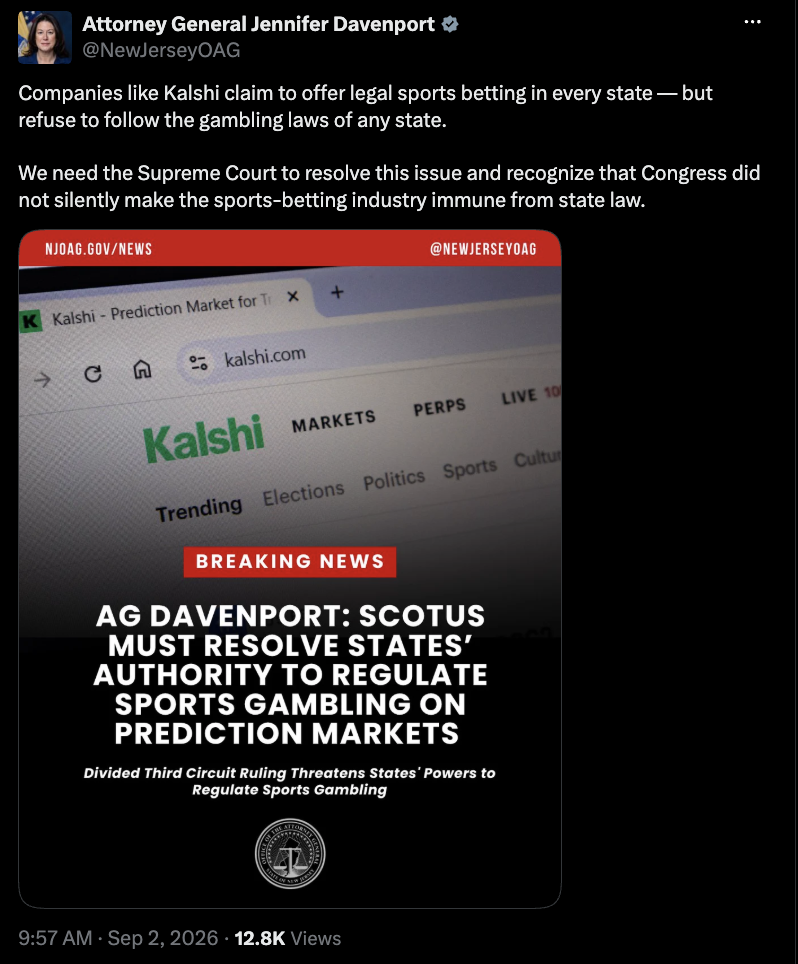
“Companies like Kalshi claim to offer legal sports betting in all 50 States, but they refuse to follow the gambling laws of any State,” said Davenport. “These companies have no right to offer their sports bets without following state law, which is why dozens of States across the ideological spectrum have opposed them [...] We’re calling on the Supreme Court to resolve this issue and recognize that Congress did not silently make the sports-betting industry immune from state law.”
Source: New Jersey Attorney General
Citing New Jersey’s enforcement against Kalshi, the petition presented the Supreme Court with the question of “whether the 2010 Dodd-Frank Wall Street Reform and Consumer Protection Act preempted States from regulating sports bets that occur within their jurisdictions if those bets are offered on markets registered with the [CFTC].” Cointelegraph reached out to the CFTC for comment but did not receive an immediate response.
Related: Kalshi issues first lifetime ban for Republican politician over insider bets
The petition challenges an April opinion from the US Court of Appeals for the Third Circuit, in which judges ruled 2-1 against New Jersey’s gaming authorities, saying Kalshi’s argument that the company had a ”reasonable chance of success” in claiming that the CFTC’s Commodity Exchange Act preempted state law. It specifically challenges the CFTC’s claim that sports bets on prediction market platforms amount to “swaps” under the agency’s purview and argued “federal law does not preempt state sports-gambling laws regardless.”
What are the potential consequences for Kalshi and other prediction markets?
“Because federal law prohibits trading swaps off CFTC-registered markets, a victory for Kalshi would mean that all sports gambling off such CFTC-registered markets would seemingly become illegal even if state law allows it,” said the New Jersey AG’s announcement on the petition.
Kalshi spokesperson Dani Lever told Cointelegraph that the company disagreed with New Jersey’s decision to appeal to the Supreme Court, saying that it could not be “regulated by 50 different regulators.“
”We remain confident in the lower courts’ rulings, and nothing in New Jersey’s filing today changes our view,” said Lever.
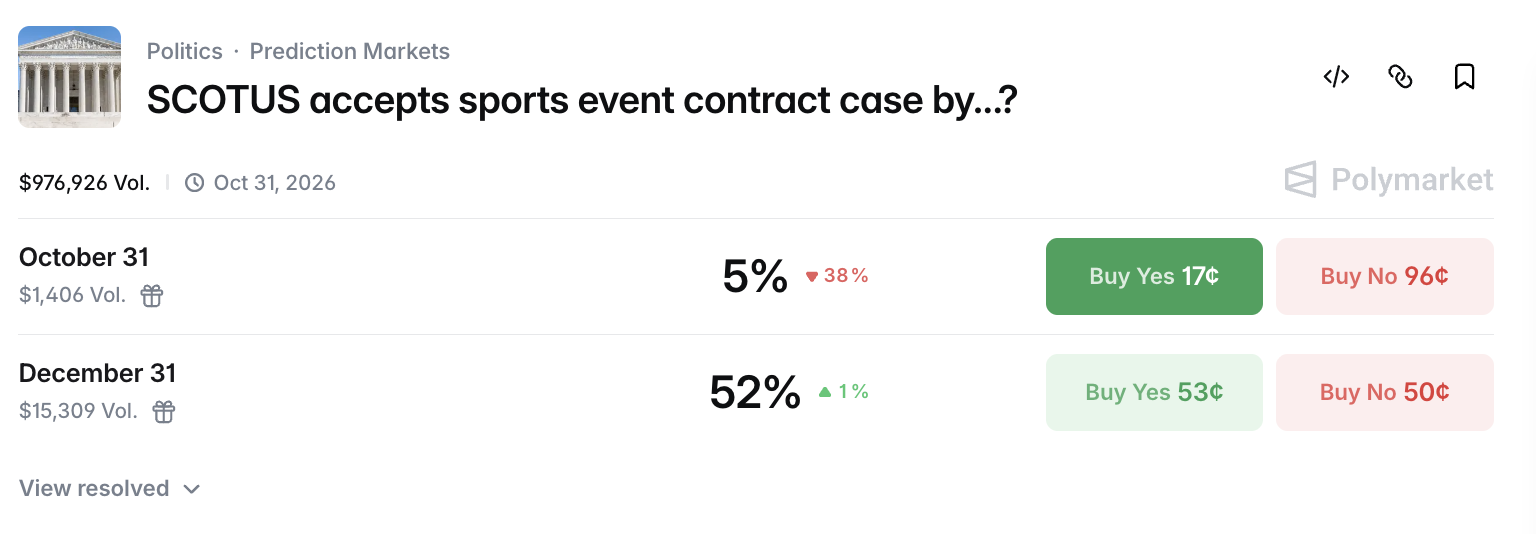
Event contract on when the US Supreme Court will hear a prediction markets case. Source: Polymarket
Whether the Supreme Court justices will take up the issue of prediction markets is unclear. Many experts have been speculating that the justices could weigh in on a case that went to the appellate court in Nevada. Whether the court chooses the Kalshi case in Nevada, the one in New Jersey or an enforcement action against a different company down the road, any potential decision could decide which authorities can regulate prediction markets.
Magazine: Who is legally liable when an AI agent goes rogue?


Subscribe to daily byte-sized crypto news from Cointelegraph
More on the subject