Monero’s Delisting Nightmare Continues: XMR Price Plunges 15%

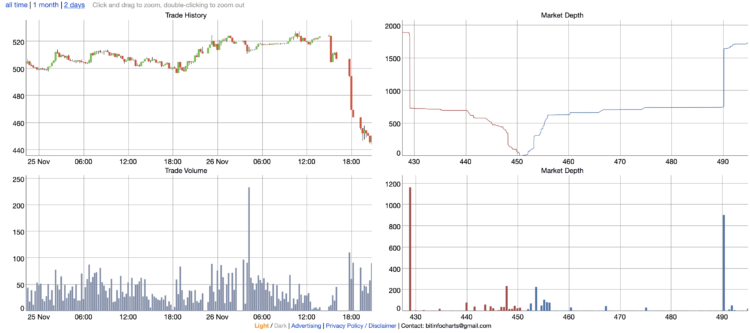
- Monero fell about 15% on Thursday, from $525.36 to $446.54 per BitInfoCharts, after KuCoin announced it will delist XMR.
- KuCoin will end all four XMR spot pairs on November 30 at 08:00 UTC; deposits are already suspended and withdrawals stay open until December 31.
- XMR will also stop being accepted as collateral for VIP loans, so borrowers may need to add other collateral to avoid liquidation.
- KuCoin is the most active XMR venue (about $62.6 million in 24-hour volume on XMR/USDT per CoinGecko), following MEXC, Binance and Kraken EEA exits.
- The network does not depend on KuCoin, but liquidity does: watch where volume migrates and how much slippage the remaining exchanges show.
Monero (XMR) lost around 15% of its value in less than five hours on Thursday after KuCoin announced plans to remove the privacy coin from its platform. The decision comes just nine days after rival exchange MEXC discontinued XMR spot trading, leaving investors with fewer options to trade one of the cryptocurrency market’s largest privacy-focused assets.
Data from BitInfoCharts shows that Monero fell from $525.36 to $446.54 during Thursday’s trading session. For longtime XMR investors, the sell-off is an uncomfortable reminder of what happened when Binance announced its Monero delisting in February 2024.
This time, however, the list of major exchanges available to Monero traders is considerably shorter.
KuCoin Gives Monero Traders Four Days Before Trading Ends
In a November 26 announcement, KuCoin confirmed that it will remove all four Monero spot trading pairs against USDT, USDC, ETH and BTC on November 30 at 08:00 UTC.
The exchange has already suspended XMR deposits and does not intend to reopen them. Withdrawals are scheduled to remain available until December 31 at 08:00 UTC, although KuCoin reserves the right to close them earlier if problems affecting the network arise.
Monero’s removal extends beyond spot trading. KuCoin will discontinue XMR flexible savings on November 27, followed by its conversion and automated trading services on November 30.
There is another detail in the announcement that deserves particular attention. KuCoin will stop accepting XMR as collateral for its VIP loan products. Customers who have borrowed against their Monero holdings may need to provide alternative collateral to avoid liquidation.
For holders planning to leave their coins on the exchange until the withdrawal deadline, KuCoin also warned that remaining balances could be converted into stablecoins, although “such conversion is not guaranteed.”
The exchange cited its platform policies but did not identify a specific regulatory requirement behind the decision.
Monero’s Liquidity Problem Is Getting Harder To Ignore
KuCoin is not the first exchange to abandon Monero this month, but its departure could prove particularly significant given the amount of XMR trading it handles.
A November 26 snapshot from CoinGecko identified KuCoin as Monero’s most active exchange, with its XMR/USDT pair recording approximately $62.6 million in trading volume over a 24-hour period.
Earlier this month, MEXC discontinued spot trading for Monero on November 17. Binance removed the cryptocurrency in February 2024, while Kraken halted XMR trading for European Economic Area customers in October of the same year, explicitly citing regulatory changes.
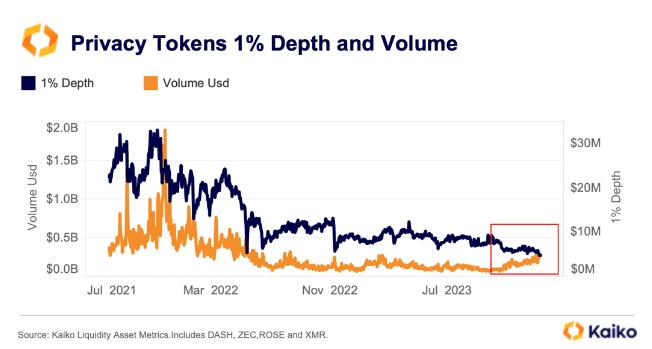
Kaiko’s historical research illustrates how liquidity across privacy cryptocurrencies had already deteriorated by early 2024, following a series of exchange restrictions.
Trading volume does not simply disappear when an exchange delists an asset. Some of it will move elsewhere, and investors who intend to keep their holdings can withdraw them to private wallets.
The bigger question is how efficiently the remaining exchanges can absorb that activity. If fewer venues are competing for the same orders, particularly during periods of market stress, large trades could become more expensive to execute and price swings more pronounced.
For Monero, that is increasingly a market structure problem rather than a question of whether its underlying technology works.
Can XMR Survive Another Major Exchange Exit?
There is a case against assuming that Thursday’s sell-off marks the beginning of a prolonged decline.
Monero has survived previous exchange removals and even managed to establish new price highs in 2026 despite mounting restrictions. As NewsBTC previously reported, XMR traded above $700 earlier this year, long after Binance stopped supporting its spot markets.
The cryptocurrency’s network does not depend on KuCoin to process transactions. Its utility as a privacy-focused payment system remains separate from its availability on centralized trading platforms.
But a functioning network does not guarantee a liquid market. Investors still need practical ways to enter and exit their positions without incurring excessive trading costs.
November 30 will therefore be an important test for Monero. Rather than focusing solely on whether XMR recovers the $500 level, traders should watch where KuCoin’s trading volume migrates and whether the remaining exchanges can absorb larger orders without substantial slippage.
That will offer a better indication of whether Thursday’s decline was a temporary reaction to another delisting or a warning of a deeper liquidity problem.