JPMorgan models Bitcoin reaching $385,000 in 10-year bull case despite CEO Jamie Dimon’s criticism
Quick Take
- JPMorgan's first Bitcoin outlook models a $385,000 bull case and $215,000 base case over 10 years, despite CEO Jamie Dimon's longstanding criticism.
- Its 10% annual base-case return exceeds forecasts for US stocks and gold, highlighting Bitcoin's growing importance to institutional investors.
- Yet 55% projected volatility and unstable correlations keep Bitcoin out of JPMorgan's core portfolio models.

JP Morgan Asset Management sees Bitcoin potentially reaching $215,000 within a decade, despite CEO Jamie Dimon's longstanding criticism of the cryptocurrency.
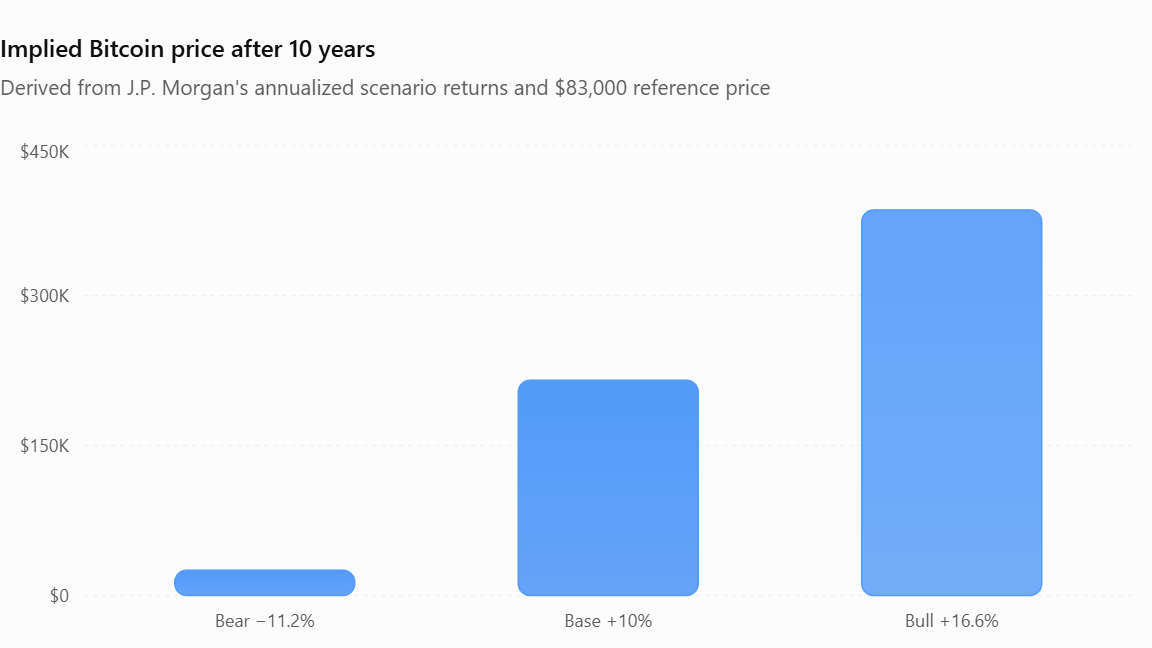
The Wall Street firm's 2027 Long-Term Capital Market Assumptions, released Oct. 19, outlined three scenarios for Bitcoin's performance over the next decade, ranging from a collapse toward $25,000 to a rally approaching $386,000.
Its base case assumes BTC generates compound annual returns of 10%, implying a price of about $215,300 from the report's $83,000 reference price.
The bullish scenario projects annualized returns of 16.6%, taking Bitcoin toward $385,500, while the bearish case assumes yearly losses of 11.2%, reducing its value to roughly $25,300.
The projections mark J.P. Morgan Asset Management's first long-term Bitcoin scenario analysis in its 31-year annual outlook history, reflecting the cryptocurrency's growing importance to institutional investors.
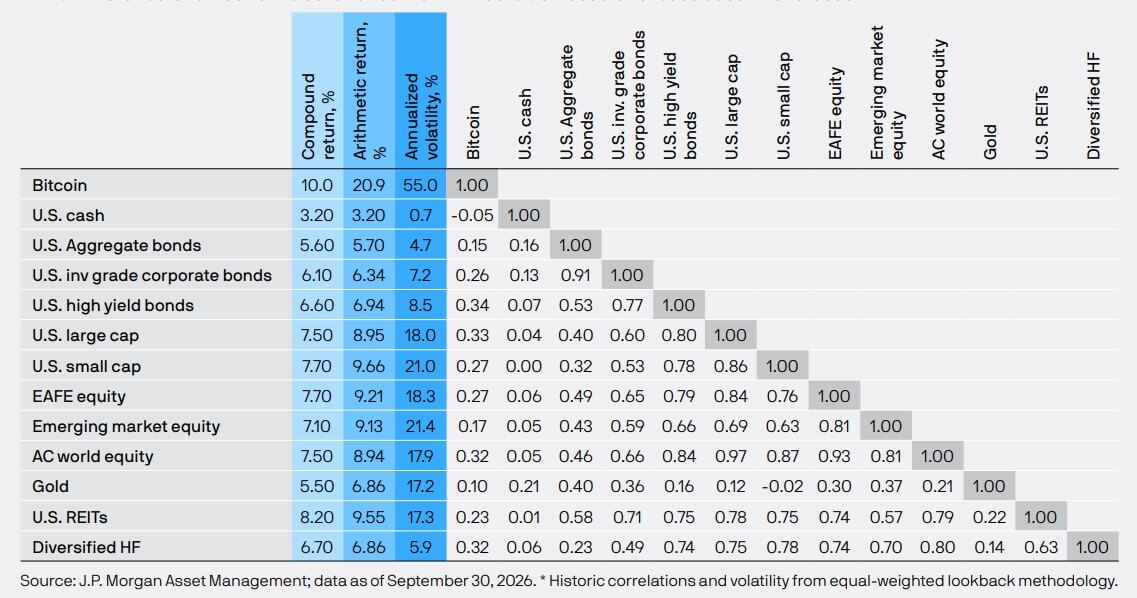
Bitcoin's projected 10% annual return exceeds the firm's 7.5% assumption for US large-cap stocks and 5.5% for gold. However, its estimated annualized volatility of 55% is more than three times the 18% projected for American equities.
The firm considers it premature to adopt a definitive 10-year Bitcoin forecast for strategic portfolio construction, instead presenting the estimates as potential outcomes under different market conditions.
Why JPMorgan expects Bitcoin to appreciate
The report identifies monetary expansion and competition with gold as the dominant forces behind Bitcoin's long-term valuation.
Its forecasting framework assigns 65% of its weighting to Bitcoin's supply growth relative to US dollar and global money supply expansion, while another 30% reflects its potential to attract investment traditionally allocated to gold.
The firm assigns only 5% to Bitcoin network adoption, which produces a -3.2% annualized return under its base scenario.
Both the monetary supply and gold allocation models generate annualized returns of 10.7%, suggesting JP Morgan expects Bitcoin's investment appeal to depend primarily on monetary conditions and its ability to compete with established stores of wealth.
The firm also assumes Bitcoin will receive little direct benefit from the expansion of tokenized assets operating on other blockchains, limiting the contribution of broader crypto infrastructure adoption to its valuation.
JPMorgan describes BTC as a speculative asset and a hedge against monetary easing, observing that its price generally responds to global liquidity conditions much like other high-risk investments.
It nevertheless challenges expectations that concerns about currency debasement will automatically drive investors toward cryptocurrencies, arguing that Bitcoin's volatility and unstable correlations complicate that investment thesis.
Its standalone portfolio analysis estimates Bitcoin's historical correlation with US large-cap equities at 0.33 and with gold at 0.10, relationships the firm considers too unpredictable to support a dependable diversification role.
Despite those advances, portfolio manager Sheena Shah and digital asset strategist Dennis Cristallo, who authored the BTC analysis, maintained that extreme volatility and unstable correlations restrict its usefulness in diversified portfolios.
They identified declining volatility, more consistent correlations, deeper liquidity and improved price discovery as conditions that could strengthen Bitcoin's suitability for strategic investment.
J.P. Morgan's Bitcoin embrace deepens despite Dimon's opposition
The analysis marks another expansion of JPMorgan's cryptocurrency activities despite years of public criticism from Chief Executive Jamie Dimon.
Dimon previously dismissed BTC as a fraud and questioned its economic value, repeatedly citing speculative trading, criminal activity, and regulatory risks.
However, during the bank's May 2025 investor day, Dimon confirmed that J.P. Morgan would let clients buy Bitcoin and reflect those holdings on their account statements, while initially avoiding custody services.
“I am not a fan of it,” Dimon said at the time, defending clients' freedom to invest in Bitcoin despite his personal objections.
Bitwise Chief Investment Officer Matt Hougan seized on the contrast after J.P. Morgan published its latest projections. He wrote on X:
“First they ignore you, then they laugh at you, then they fight at you, then they add you to their Long-Term Capital Markets Assumptions paper and predict you'll be the best-performing asset of the next decade.”
His remarks highlight Bitcoin's growing institutional acceptance, as the bank's expanding engagement reflects rising customer demand for cryptocurrency exposure, more established investment products, and supporting infrastructure.
Mentioned in this article

Editorial credits

Oluwapelumi values Bitcoin's potential. He imparts insights on a range of topics like DeFi, hacks, mining and culture, underlining transformative power.