Japan’s services inflation split complicates the BOJ outlook before Friday’s decision

Quick Take
- Japan’s September services producer inflation reached 3.7%, while the rate excluding international transport held steady at 2.9%.
- High-labor-cost services price growth slowed to 2.6%, complicating the policy signal before the BOJ’s October 30 decision.
- Bitcoin funding pressure remains conditional on the policy outlook, yen strength and independently observed deleveraging across risk assets.

Freight pushed Japan’s services producer inflation higher in September while price growth in labor-intensive services slowed, complicating the policy signal for Bitcoin investors watching Friday’s Bank of Japan decision. The potential crypto risk runs through yen borrowing costs and the currency’s response to the BOJ’s outlook.
The BOJ’s preliminary October 27 release put annual inflation in its Services Producer Price Index (SPPI) at 3.7%, up from August’s revised 3.5%. Ocean freight added 0.2 percentage points to the change in annual inflation, matching the overall net 0.2-point acceleration at published precision. That is its contribution to the acceleration, rather than its share of the inflation level.
Two narrower readings were steadier. Annual inflation excluding international transportation stayed at 2.9%, while price growth in services with a high labor-cost ratio eased to 2.6% from August’s revised 2.7%.
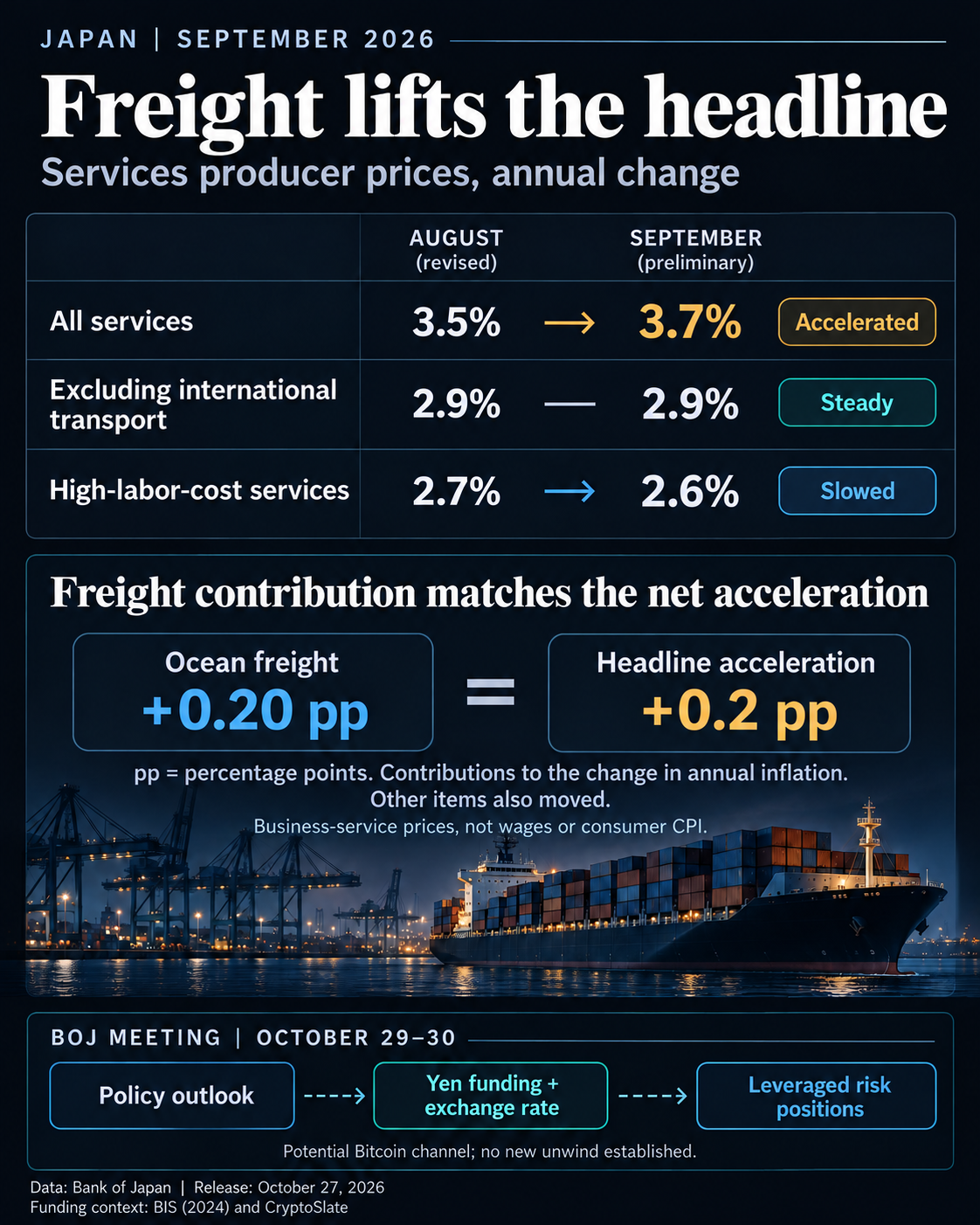
The SPPI measures services sold to businesses and governments, so its labor-cost grouping tracks selling prices rather than employee pay. It is also distinct from consumer inflation. The BOJ’s underlying-inflation framework considers how widely consumer prices are rising alongside labor tightness, the output gap, expectations and wage growth.
Separate wage evidence adds another dimension: final August labor-survey results, released October 23, show scheduled cash earnings rose 3.8% from a year earlier across all employment types at establishments with at least five employees.
The yen-funding test
The BOJ meets October 29–30, with its policy statement and the Bank’s View section of the October Outlook Report scheduled for Friday, October 30. Its September 18 decision set the overnight call-rate target around 1.25%, effective September 24. The bank retained a path toward further increases, with their timing and pace dependent on activity, prices, financial conditions and outlook risks.
For positions financed with borrowed yen, a tighter-than-expected policy path could lift funding costs. Yen appreciation would also make that debt more expensive to repay from other currencies. Together, those conditions could force leveraged investors to reduce risk, potentially affecting Bitcoin exposure.
The Bank for International Settlements’ August 2024 analysis illustrates how leveraged equity and currency unwinds, deleveraging and higher margin requirements can amplify volatility. That historical example does not quantify current yen-funded Bitcoin positions or establish a fresh unwind.
A more persuasive warning would combine markets pricing in higher Japanese short-term rates, yen strength and independently observed deleveraging across risk assets. Yen weakness or stable funding would weaken the case.
Mentioned in this article

Editorial credits

Also known as "Akiba," Liam Wright is a reporter, podcast producer, and Editor-in-Chief at CryptoSlate. He believes that decentralized technology has the potential to make…