Higher wages don’t have to mean higher inflation. That could matter for Bitcoin
Quick Take
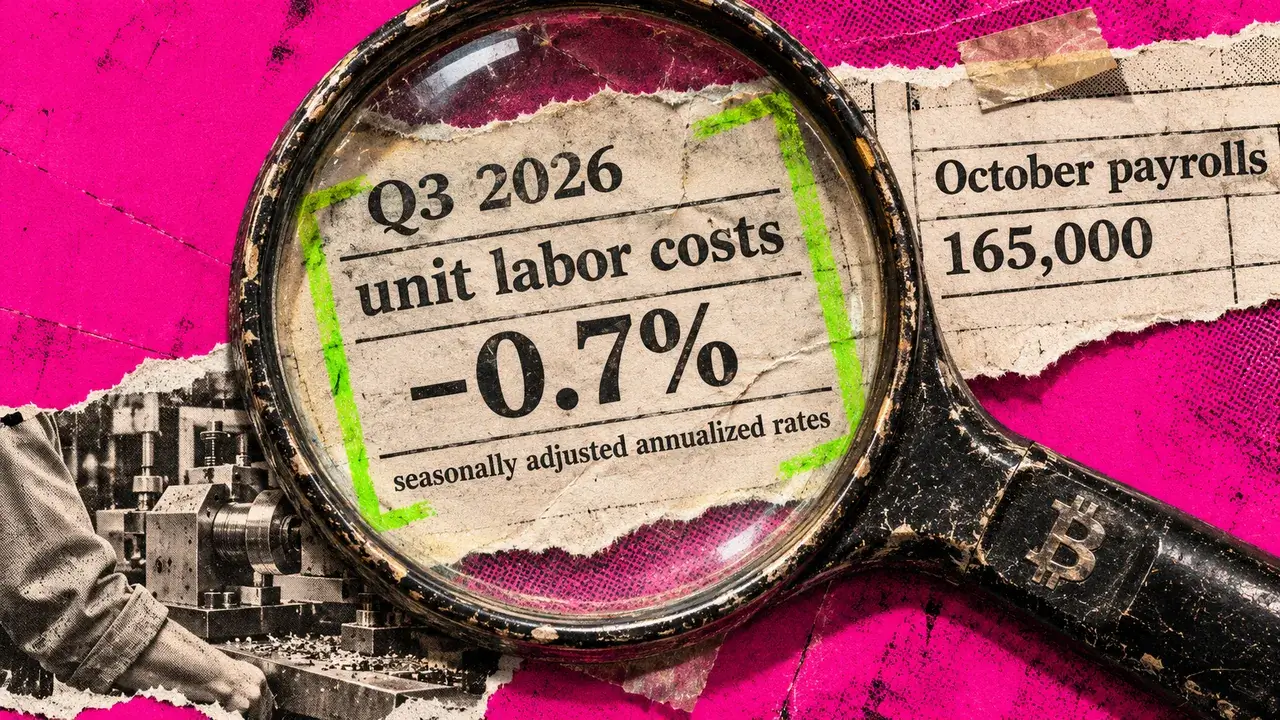
- US nonfarm business unit labor costs fell 0.7% at an annualized rate in Q3 as productivity outpaced hourly compensation.
- October's 165,000 payroll gain alone cannot settle wage-driven inflation pressure, because productivity can offset higher pay.
- Unit labor costs remained 2.4% higher year over year, leaving Bitcoin's potential rates relief dependent on cooler inflation.

US nonfarm businesses produced more per hour in the third quarter, allowing labor costs per unit of output to fall even as hourly compensation rose. For Bitcoin, that offers a potential offset to jobs-driven rate fears: if lower cost pressure helps cool inflation and expected interest rates, financing could become less expensive.
The Bureau of Labor Statistics' preliminary November 5 release showed nonfarm business productivity rising 3.6% as output increased 3.7% and hours worked rose 0.1%. Hourly compensation increased 2.9%, while unit labor costs fell 0.7%. All those quarterly changes are seasonally adjusted annualized rates.
Unit labor costs track compensation relative to output. BLS divides hourly compensation by productivity: when each hour produces more, businesses can pay more per hour without incurring higher labor costs for each unit they produce.
Higher pay, lower labor cost per unit
Q3 productivity grew faster than hourly compensation. The quarterly cost decline coexisted with a positive year-over-year cost reading.
Productivity can absorb higher pay; quarterly labor-cost relief does not settle the inflation outlook.
Preliminary Q3 nonfarm business estimates, published November 5, 2026. Quarterly figures are seasonally adjusted annualized rates; the 2.4% figure is year over year. This is not consumer-price inflation, October productivity or a Bitcoin response.
Sources
Supporting facts
- Nonfarm business labor productivity increased at a 3.6% seasonally adjusted annualized rate in Q3 2026, as output rose 3.7% and hours worked rose 0.1%, according to BLS's November 5 preliminary release. [1]
- Nonfarm business unit labor costs fell 0.7% in Q3 2026 as hourly compensation rose 2.9% and productivity rose 3.6%, all at seasonally adjusted annualized rates; unit labor costs remained 2.4% higher than a year earlier. [1]
- BLS defines unit labor costs as hourly compensation divided by labor productivity, so greater output per hour can offset higher compensation per hour. [1]
Method
Plot reported Q3 annualized changes on one linear scale: 80 SVG units per percentage point on desktop and 44 on mobile. The 2.4% four-quarter change is shown separately without a comparable bar. No growth-rate subtraction or new calculation.
Scope
Preliminary Q3 nonfarm business estimates, published November 5, 2026. Quarterly figures are seasonally adjusted annualized rates; the 2.4% figure is year over year. This is not consumer-price inflation, October productivity or a Bitcoin response.
 CryptoSlate
That complicates a reading of the November 6 employment report as an automatic inflation warning. October payrolls increased 165,000, above the prior 12 months' average monthly gain of 48,000. Average hourly earnings for private nonfarm employees rose 0.4% over the month and 3.1% over a year.
The reports cover different periods and measures. Third-quarter productivity does not establish how productive workers were in October, and its annualized growth rate cannot simply be subtracted from monthly earnings growth. Higher hiring and pay alone leave the question of labor costs per unit of output unanswered.
Lower labor costs leave the Fed with an inflation problem
Nonfarm business unit labor costs remained 2.4% higher than a year earlier. The quarterly decline eases one source of cost pressure, while leaving both the durability of that improvement and its effect on consumer prices unsettled.
The Fed's latest decision illustrates the policy tension. On October 28, before either November labor release, the Federal Open Market Committee held its target range at 3.75% to 4.00% in a 10-2 vote. Lisa Cook and Beth Hammack preferred a quarter-point increase.
That statement described productivity growth as strong while calling inflation elevated. The two conditions already coexisted in the Fed's assessment, limiting the case for treating better productivity as an automatic signal of easier policy.
For Bitcoin, the financing channel depends on what happens to rate expectations. Expected short-term rates can influence longer-term rates, borrowing terms and the relative attractiveness of assets. A sustained decline in inflation pressure could ease a potential rates headwind for Bitcoin if it brings lower expected rates and funding costs.
Persistent inflation or upward labor-cost revisions would weaken the case for relief in Bitcoin prices.
Mentioned in this article

Editorial credits

Also known as "Akiba," Liam Wright is a reporter, podcast producer, and Editor-in-Chief at CryptoSlate. He believes that decentralized technology has the potential to make…