Galaxy’s AI data centers bring $79 million in lease revenue and a small net loss

Quick Take
- Galaxy’s first full Helios lease quarter generated $69 million in adjusted EBITDA and a $435,000 Data Centers net loss.
- Treasury & Corporate drove Galaxy’s recovery, leaving exposure to digital-asset and investment swings despite the new AI income.
- Phase II deliveries remain scheduled for Q2 2027, while project debt and tenant performance shape the diversification case.

Galaxy Digital’s first full quarter of AI data-center lease operations generated $69 million in adjusted EBITDA, but its Data Centers segment still posted a $435,000 net loss. The company’s Oct. 27 results put a number on both the new earnings stream and the financing burden accompanying its expansion.
For a business still exposed to digital-asset and investment swings, the operating contribution is substantial. Galaxy’s much larger group recovery came primarily through Treasury & Corporate.
The quarter ended Sept. 30 was the first with a full period of revenue-generating operations under the Helios I, Phase I lease to CoreWeave. All 133 megawatts of critical IT load had been delivered by the end of Q2. Data-center leasing revenue reached $79 million.
In CryptoSlate’s August coverage, approximately $80 million of quarterly lease revenue was still guidance. Q3 supplies the first full-quarter results, alongside the costs determining how much reaches the bottom line.
What reaches Galaxy’s bottom line
Adjusted EBITDA strips out financing expenses and several accounting items, making it useful for examining operating performance. It does not measure free cash flow or the final profit available after those costs.
Galaxy’s Data Centers reconciliation shows why the distinction matters. Starting with the segment’s net loss, the company makes the following adjustments to reach adjusted EBITDA:
| Q3 2026 Data Centers reconciliation | USD |
|---|---|
| Net loss | -435,000 |
| Add equity based compensation and related expense | +785,000 |
| Add notes interest and other expense | +75,439,000 |
| Subtract tax benefit | -24,000 |
| Add depreciation and amortization expense | +17,325,000 |
| Other adjustment | -24,344,000 |
| Adjusted EBITDA | 68,746,000 |
The largest adjustment is the $75 million labeled “notes interest and other expense.” That is an accounting adjustment, not a disclosed cash-interest payment. Depreciation and the equity awards themselves are noncash accounting items.
The negative $24 million Other adjustment also matters. Galaxy’s footnote groups non-operating income and expenses with discrete items outside ongoing operating performance, without isolating the underlying Data Centers components. The segment loss therefore cannot be explained by subtracting interest alone from the headline EBITDA figure.
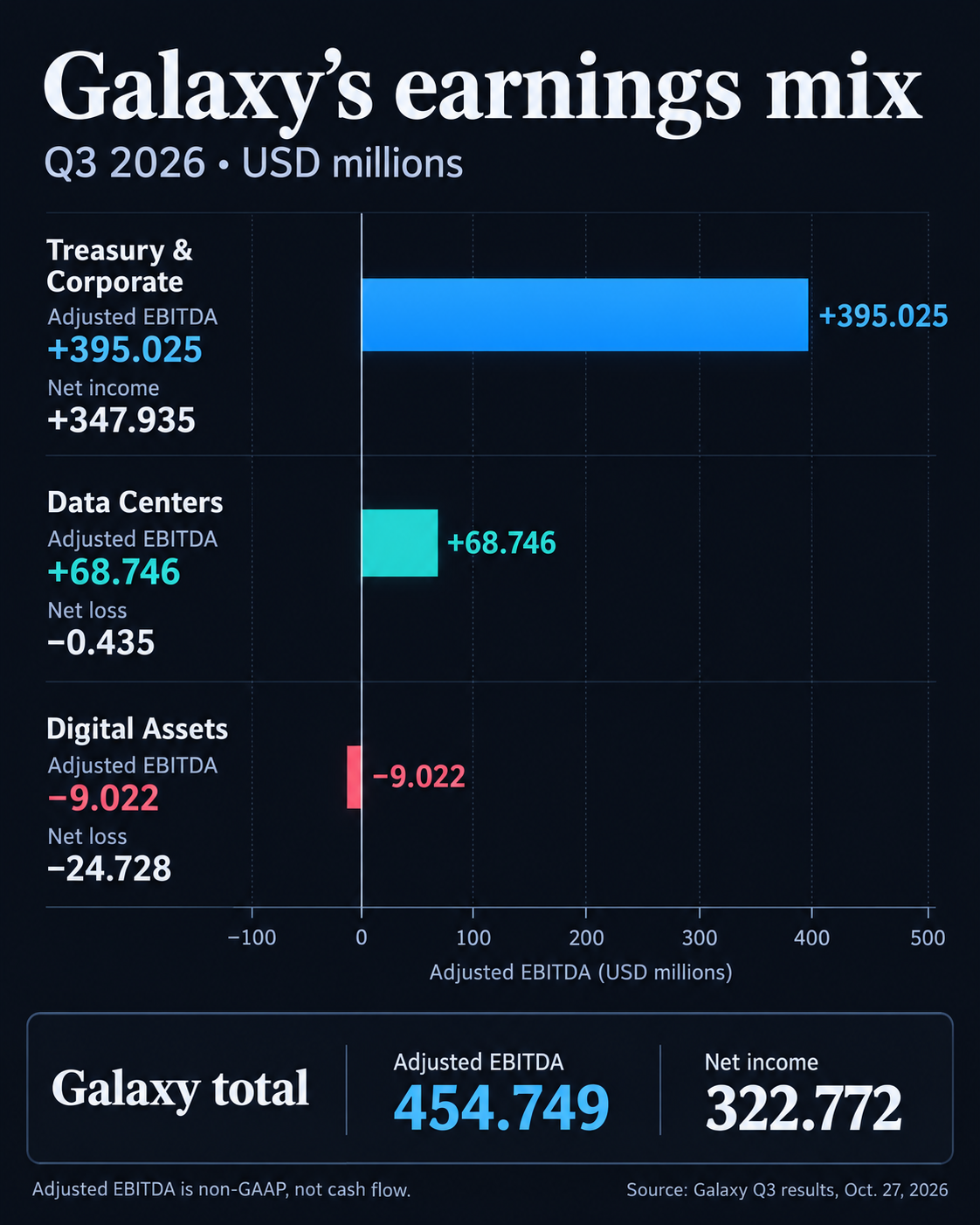
Galaxy reported $323 million in consolidated Q3 net income. Treasury & Corporate produced $348 million, while Digital Assets lost $25 million and Data Centers lost $435,000.
The adjusted figures tell a similar story. Treasury & Corporate generated $395 million of the group’s $455 million adjusted EBITDA. Data Centers contributed $69 million, and the Digital Assets operating segment recorded negative $9 million.
In Q2, Treasury & Corporate had posted negative $78 million of adjusted EBITDA. Data Centers earned $11 million, and Digital Assets recorded negative $11 million. The comparison places the largest swing in Treasury & Corporate, even as full-quarter leasing materially increased the data-center contribution.
That distinction matters because Treasury & Corporate carries Galaxy’s digital-asset and investment exposure. Its positions span spot holdings, derivatives, ETFs, equities and private investments. Net digital assets and investments reached a rounded $1,700 million at Q3’s end, against $1,200 million at Q2.
AI income adds a different source of earnings. The scale of the treasury result and the remaining investment exposure show why a strong group quarter cannot yet be read as proof of protection from crypto volatility.
Expansion adds construction and tenant exposure
The operating 133 MW lease sits alongside a much larger construction program. Galaxy reported $757 million of Data Centers capital expenditure in Q3 and said Helios I, Phase II was fully financed and under construction. Initial data-hall deliveries are scheduled for Q2 2027.
The July 23 financing announcement priced $3,507 million of 9.875% senior secured notes through Galaxy Helios Data Centers II LLC, an indirect wholly owned subsidiary. October’s results subsequently reported completion of the offering.
The intended proceeds finance part of two buildings containing eight data halls, with 400 MW of utility capacity and 260 MW of critical IT capacity, plus debt-service reserves. Those figures describe later capacity, separate from the 133 MW already delivered.
As CryptoSlate’s July financing analysis explained, the debt introduces obligations before the expansion’s operating contribution arrives. Cash interest is payable semiannually beginning Feb. 1, 2027. Principal amortization is set at 4% of original principal annually, subject to adjustment, with the first installment at least ten months after project completion. The notes mature Aug. 1, 2031.
Galaxy Helios II LLC, the issuer’s direct subsidiary, guarantees the notes. First-priority liens cover substantially all issuer and guarantor assets, subject to exclusions, and all issuer equity held by its direct parent. The pricing disclosure names those project entities as obligors and does not identify Galaxy Digital Inc. as the note guarantor.
Because existing operations and expansion are at different stages, the combined segment result leaves Phase I’s standalone economics unresolved.
CoreWeave’s growth supports the commercial case for the campus, while its balance sheet remains relevant to the durability of Galaxy’s lease income.
The tenant’s Q2 results reported $2,575 million in revenue, a $626 million net loss and $640 million of net interest expense. Its June 30 balance sheet also reported $25,170 million of noncurrent recourse debt and $2,385 million of noncurrent non-recourse debt.
CoreWeave reported approximately $104 billion of revenue backlog at June 30. Its definition includes remaining performance obligations and other estimated future revenue under committed contracts, conditional on delivery and service availability.
Its Sept. 17 update reiterated more than $25 billion of net new commitments added early in Q3 and excluded from that June backlog. It also described three-to-six-month compute contracts priced at approximately $40 million per MW, calculated as annualized revenue divided by the power required for the clusters. That is CoreWeave compute pricing, not Galaxy’s rental yield.
For Galaxy, the next tests are whether lease income can lift segment net profit after financing costs and whether Phase II begins deliveries on the stated Q2 2027 schedule.
Mentioned in this article
Editorial credits

Also known as "Akiba," Liam Wright is a reporter, podcast producer, and Editor-in-Chief at CryptoSlate. He believes that decentralized technology has the potential to make…