Even if Bitcoin rises 30% a year this renewable mining model still loses money as hashrate keeps pace
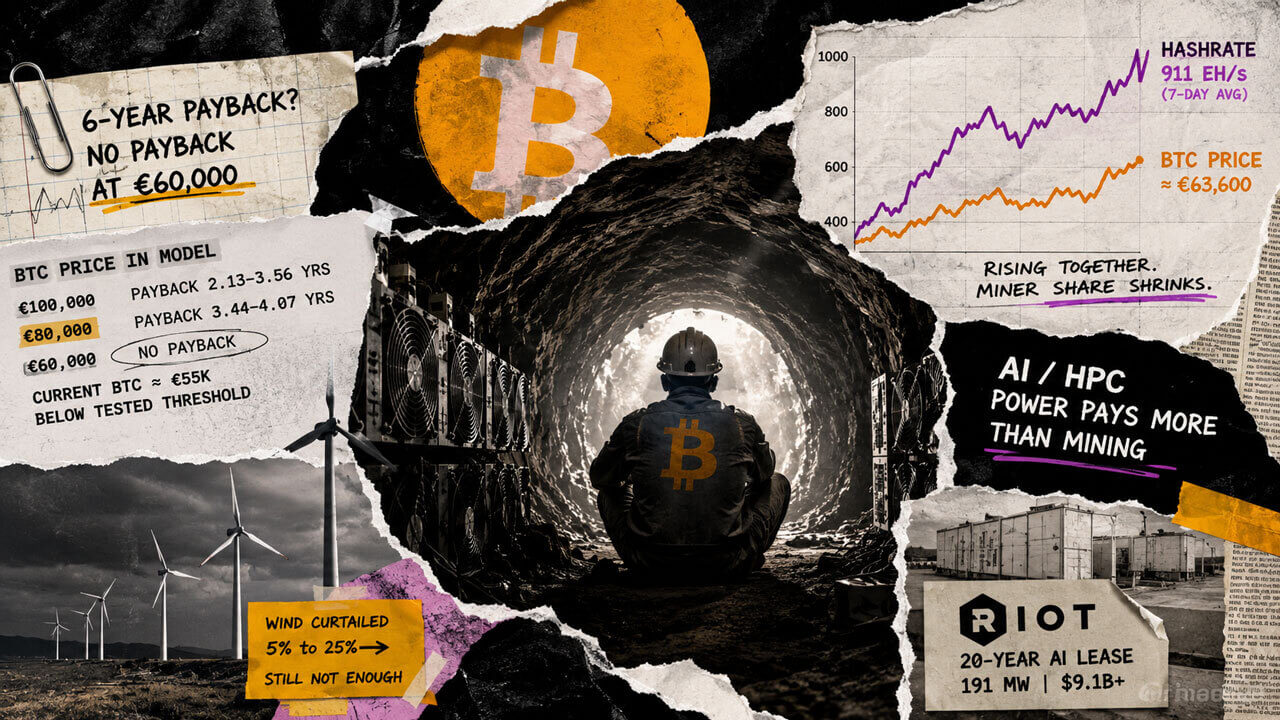
Bitcoin trades near $63,600, below the lowest Bitcoin price researchers tested against a modeled wind-powered mining operation in a new Energy Economics study.
At that price level, their model shows no payback within six years under any curtailment scenario they ran.
The study, by researchers at the Technological University of the Shannon, models a 20 MW Bitcoin mine connected to a hypothetical 100 MW Irish wind farm, using hourly market data from 2024.
Even with 25% of the wind farm's output curtailed, the modeled project fails to recover its investment inside the six-year equipment horizon once Bitcoin's price falls to €60,000.
The bullish case comes first
The 20 MW mine captures 83.1% of the wind farm's annual dispatch-down energy, the electricity Irish grid operators instruct offline because transmission lines cannot carry it. Total system revenue climbs from €22.2 million to €29.2 million, a 32% increase, and the wind farm's effective capacity factor rises from 29% to 32%.
Scaling the mine to 30 MW pushes absorption to 93.4% of curtailed power and system revenue to €31.1 million.
The researchers find diminishing returns beyond that range, and a larger installation incurs significant hardware costs while capturing only a small amount of additional curtailed electricity.
At €100,000 per BTC, the modeled 20 MW project pays back in 2.13 to 3.56 years, depending on how much wind is curtailed. At €80,000, payback stretches to 3.44 years at 25% curtailment and 4.07 years at 20%, while every lower-curtailment scenario misses the six-year window entirely.
At €60,000, none of the tested curtailment levels, from 5% up to 25%, produces a payback inside six years. Bitcoin's current price sits below even that threshold.
| BTC price in model | 25% curtailment | 20% curtailment | 15% curtailment | 10% curtailment | 5% curtailment | Takeaway |
|---|---|---|---|---|---|---|
| €100,000 | 2.13 years | 2.29 years | 2.60 years | 2.99 years | 3.56 years | Strong payback across all curtailment cases |
| €80,000 | 3.44 years | 4.07 years | No payback | No payback | No payback | Only high-curtailment sites work |
| €60,000 | No payback | No payback | No payback | No payback | No payback | Study’s danger zone begins |
| Current BTC ≈ €55K | Below tested threshold | Below tested threshold | Below tested threshold | Below tested threshold | Below tested threshold | Current market is worse than the lowest tested price case |
The number Bitcoin miners need to beat
The study's central finding is a six-year sensitivity table that plots Bitcoin's price growth against global hashrate growth for the same 20 MW project.
Every point along the diagonal, where both variables grow at the same annual rate, lands on an identical result. Net present value is negative €10.1 million, with a negative 5.7% return.
That holds whether both grow at 5%, 15%, or 30% a year. A Bitcoin rally that size normally reads as spectacular, while it produces the same loss as a flat, stagnant market in this model.
A fixed mining installation earns Bitcoin according to its share of the entire network's hashrate, and that share shrinks every time a rival adds machines.
The project only turns profitable when Bitcoin's growth outpaces hashrate growth by a wide margin. Bitcoin compounding at 30% annually, with hashrate compounding at 15%, yields a positive net present value of €7.7 million.
Narrow that gap to 30% against 25%, and the project falls back to negative €5.1 million.
The researchers tested older Antminer S9 hardware, running at roughly 98 joules per terahash, and found it uneconomic under every 2024 scenario they modeled. Every viable case in the study runs on the newer Antminer S21 Hydro at 16 joules per terahash.
The researchers built the model on 2024 Irish electricity prices, a six-year equipment horizon, perfect foresight on future prices, and an Irish private-wire regulatory framework that has not yet been finalized.
A different site, a different hardware mix, or a different power contract would move every number in the study.
| BTC annual growth | Hashrate annual growth | Spread | Six-year NPV | Model result |
|---|---|---|---|---|
| 5% | 5% | 0 pts | -€10.1M | Loss |
| 15% | 15% | 0 pts | -€10.1M | Loss |
| 30% | 30% | 0 pts | -€10.1M | Loss |
| 30% | 25% | +5 pts | -€5.1M | Still loss |
| 30% | 20% | +10 pts | €0.7M | Barely positive |
| 30% | 15% | +15 pts | €7.7M | Profitable |
Current hashrate is already running hot
The study's price-versus-curtailment table holds hashrate fixed at 780 EH/s. Hashrate Index put Bitcoin's seven-day moving average at 911 EH/s and its 30-day average at 914 EH/s on Aug. 10, though hashrate estimates carry real noise and work best as directional context alongside the study's static assumption.
The same report put spot hashprice, the revenue a unit of hashing power earns per day, at $31.73 per petahash. Hashrate Index described that level as at or below breakeven for many miners, depending on their costs and hardware.
Riot Platforms said on Aug. 10 that it had signed a 20-year lease with a frontier AI lab for 191 MW of capacity at its Rockdale campus. The deal is worth an estimated $9.1 billion over the initial term and up to $16.1 billion if both five-year extensions are exercised.
CoinShares' first-quarter research put the cumulative value of AI and high-performance computing contracts across public miners above $70 billion. It projected that listed miners could pull as much as 70% of revenue from AI by year-end, up from roughly 30%.
Cheap power is finding buyers willing to pay more reliably than Bitcoin mining currently does.
Which way the Bitcoin spread breaks
In the bull case, Bitcoin's price growth outpaces hashrate growth over the coming years, as in the study's more favorable cells.
If Bitcoin compounds at 25% to 30% annually while hashrate trails by 10% or more, the modeled project turns solidly positive. Operators running efficient S21 Hydro-class hardware on genuinely stranded power capture that spreads first.
In the bear case, hashrate keeps pace with Bitcoin's price, as it has through much of the network's history. Every new machine that a rally attracts erodes the next machine's share of block rewards, keeping projects pinned near the study's diagonal outcomes even through a large Bitcoin rally.
| Pressure on miners | Current signal in the article | What it means |
|---|---|---|
| Bitcoin price | BTC near $63,600, roughly below the study’s €60K tested floor | Current price is already in the model’s no-payback zone |
| Network competition | Hashrate Index: 911 EH/s 7-day average; 914 EH/s 30-day average | Above the study’s 780 EH/s static assumption, directionally pressuring miner revenue |
| Hashprice | $31.73 per PH/s/day | Near or below breakeven for many miners, depending on cost and hardware |
| AI/HPC alternative | Riot’s 191 MW, $9.1B AI lease; sector contracts above $70B | Power campuses can earn contracted revenue outside Bitcoin mining |
| Next subsidy shock | 2028 halving inside the six-year horizon | Block rewards fall again before the modeled equipment life ends |
The 2028 halving then cuts the block subsidy again before six years are up.
Cheap, curtailed wind power used to look like the closest thing Bitcoin mining had to a guarantee. The study's own numbers reduce it to an entry fee, one that still requires Bitcoin to outrun every other machine racing for the same reward.