Developer Who Cloned Photoshop With AI Just Did the Same to Microsoft Office

In brief
- Developer Brandon Thomas released WordCraft, GridCraft and DeckCraft, free open-source clones of Microsoft Word, Excel and PowerPoint written in Rust with help from Anthropic's Claude.
- WordCraft covers 88% of Word's ribbon features and GridCraft handles 513 of Excel's 523 worksheet functions, but the team rates them only 50% to 60% ready for real work.
- The release follows Thomas' ArtCraft clones of Adobe's apps and targets a Microsoft 365 subscription that costs $99.99 a year for a single user.
You have two options: Pay $100 every year for Microsoft Office online, or pay nothing for the vibe-coded “Office” clone that does basically the same and runs fully offline. Which do you pick?
The developer who used AI to rebuild Adobe's Creative Cloud for free has now turned to Microsoft Office, releasing open-source clones of Word, Excel, and PowerPoint built with Anthropic's Claude.

Brandon Thomas, the engineer behind the ArtCraft project, published the apps on GitHub as WordCraft, GridCraft and DeckCraft. Open source means anyone can read, copy, and modify the code, and the MIT and Apache 2.0 licenses let people reuse it even commercially.
Earlier this month, Thomas made noise with ArtCraft, a set of free apps mirroring Photoshop, Illustrator, Premiere, and Lightroom, built with Claude Opus 5.5 after Adobe charged him its cancellation fee one too many times. It landed in the middle of a wave of AI cloning that has seen a developer get GTA V running natively on an iPhone and modders throw Minecraft creepers at an Elden Ring boss.
The Office clones are written in Rust, a programming language known for speed and for blocking the memory bugs that make software crash. A single codebase runs natively on Windows, macOS, Linux and BSD, and also inside a web browser.
Thomas calls the project a clean-room rebuild, meaning the apps were written from public file-format specifications and by watching how the originals behave, never by copying Microsoft's code. It's the same legal approach Compaq used to clone IBM's PC BIOS, the basic startup software of early PCs, back in the 1980s.
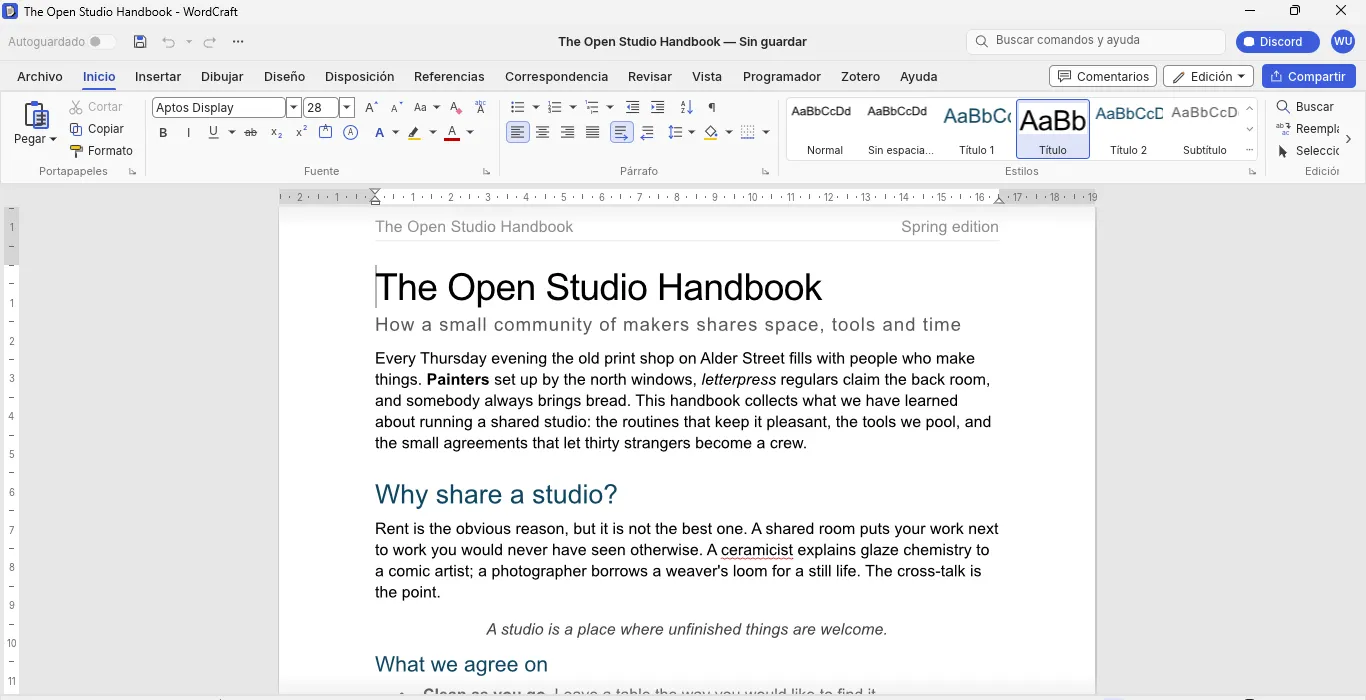
WordCraft reads and writes .docx, Word's native file format, and covers 88% of the features in Word's ribbon, the strip of tabs and buttons along the top of the screen. Track changes, footnotes, citations and mail merge—the tool that pulls names from a spreadsheet to personalize hundreds of letters—are already in.
Counting file fidelity and stability, though, the team estimates WordCraft is only about 60% of the way to replacing Word for real work. It's still labeled alpha, an early test version where bugs come standard.
We tried it. It’s only 91Mb, feels snappy and looks almost the same as the normal Microsoft Word. For everyday office jobs, this can easily replace the premium suite.
GridCraft, the Excel clone, already handles 513 of Excel's 523 worksheet functions, the formulas like SUM or VLOOKUP that make spreadsheets do math, plus 89% of its ribbon commands. Its own developers rate it about 50% ready for real work, with compatibility on real-world .xlsx files next on the to-do list. In other words, it knows almost every formula but may still trip over your company's budget spreadsheet.
DeckCraft, the PowerPoint stand-in, covers about 79% of PowerPoint's features and 93% of the core ones, according to its GitHub page. It opens and saves .pptx files, runs transitions and animations, and exports to PDF, but it hasn't reached its first alpha yet.
Every button in all three apps doubles as a command that an AI agent, a model that takes multi-step actions on its own, can trigger. They plug in through MCP, the Model Context Protocol, a standard Anthropic created so AI models can operate outside tools. In practice, a user could ask Claude to build a chart in a spreadsheet or reformat a report without touching the mouse.
Microsoft charges $99.99 a year for Microsoft 365 Personal and $129.99 for the family plan, which is how most households get Word and Excel today. A free look-alike that opens the same files is a direct shot at that bill.
Free Office alternatives have existed for decades: OpenOffice.org was born when Sun Microsystems released the code of its StarOffice suite in October 2000, and LibreOffice split off from it in 2010. Both took years of work by large developer communities, while Thomas shipped his three apps less than two weeks after the Adobe clones, working with an AI model.
Its design is very similar to the Microsoft Office suite, so heavy users should not struggle too much with the switch, which is the main reason preventing people from switching software providers.
The model behind ArtCraft, Claude Opus 5.5, launched September 22 at $4 per million input tokens and $20 per million output tokens; tokens are the chunks of text an AI reads and writes, and the unit AI companies bill by.
On Terminal-Bench 4.0, which tests whether an AI agent can finish complex professional tasks in a command-line environment and scores the share of tasks completed, Opus 5.5 hit 66.4%.
Thomas also has a habit of promising more than his apps deliver, at least so far. He already walked back his pledge to match Adobe's feature set within a month. Developers don't seem to mind the wait: WordCraft had collected more than 12,000 GitHub stars, the platform's version of a bookmark, as of Wednesday.
Before a beta, the roadmap says WordCraft still needs testing against real-world .docx files, charts, and SmartArt that survive a save, page layout closer to Word's, a stability sweep and native printing.
Daily Debrief Newsletter
Start every day with the top news stories right now, plus original features, a podcast, videos and more.
Join 72,000+ readers