Crypto’s bear market wiped out over $2 trillion, yet on-chain activity held above $9 trillion

The crypto industry lost $2.1 trillion in market value during the past year, yet measured on-chain economic activity declined just 1.6% as stablecoin use expanded.
The global crypto economy generated about $9.4 trillion in activity during the 12 months through June 30, down from $9.5 trillion a year earlier, according to Chainalysis’s 2026 Global Crypto Adoption Index published Sept. 23. That comparatively small contraction came as total crypto market capitalization fell about 50% during the period.
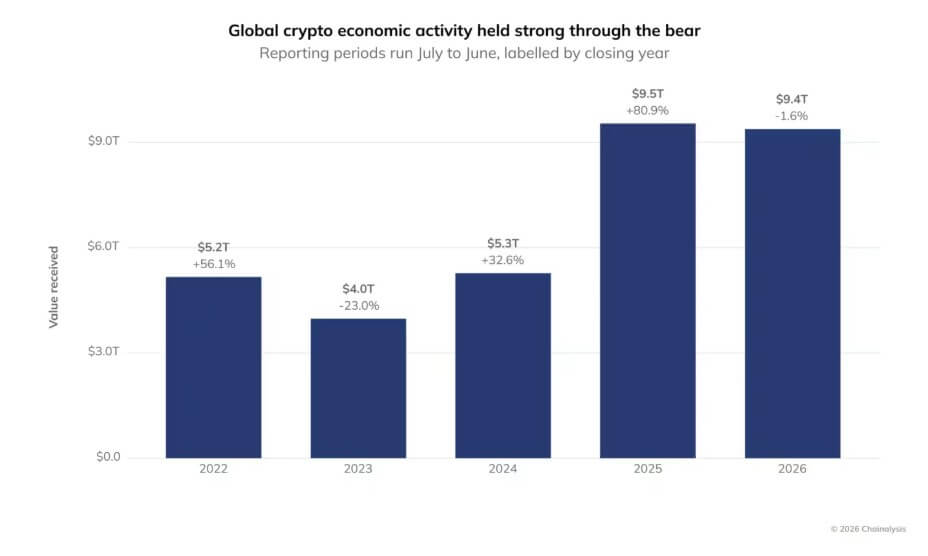
The divergence marks a shift in where activity occurs during market downturns. Value received by exchanges, decentralized-finance protocols and other crypto services fell 4.3% to $8.9 trillion, while transfers directly between personal wallets within countries surged to $228.7 billion from $56.8 billion.
Stablecoins accounted for much of that resilience. Inflows of dollar-pegged tokens into crypto services increased 5.3% even as overall service receipts declined, while Chainalysis said stablecoins now make up about 96% of domestic peer-to-peer activity.
Cross-border use accelerated alongside the shift. Stablecoin transfers between countries increased 77.5% to $220.3 billion from $124.2 billion, with estimated monthly volume more than doubling to $24 billion in June from about $11 billion in January 2025.
The average cross-border stablecoin transaction was roughly $3,000, a size Chainalysis said was consistent with supplier payments, remittances and people moving savings between currencies. The firm estimates the actual market is larger because its calculations exclude transfers where either end cannot be confidently assigned to a country.
Those flows helped cushion a market decline that otherwise rivaled crypto’s deepest downturns. Chainalysis said Bitcoin fell $67,000 from peak to trough during the reporting period, while the broader market lost roughly half its value. During the 2022-23 downturn, by comparison, measured crypto activity contracted 23% even though total market capitalization fell by a much smaller $300 billion.
Stablecoins separate from crypto’s price cycle
The latest downturn exposed a widening gap between activity tied to crypto prices and transactions whose dollar value remains relatively stable.
On-chain stablecoin balances ranged from $98 billion to $109 billion throughout the nine-month market drawdown, even as the value of other on-chain crypto assets fell 55.6%. Stablecoins consequently accounted for 22.5% of measured balances by June.
Service activity showed a similar split. Trading, lending and exchange inflows weakened as asset prices and speculative demand fell, while dollar-denominated transfers continued without the same valuation hit.
The change was visible even at the smallest transaction sizes. Transfers of less than $100 into crypto services jumped 78.4%, while transactions between $100 and $1,000 increased 58.6%. Those retail-sized flows totaled about $273 billion, a small share of the nearly $10 trillion measured economy but one that continued expanding through the downturn.
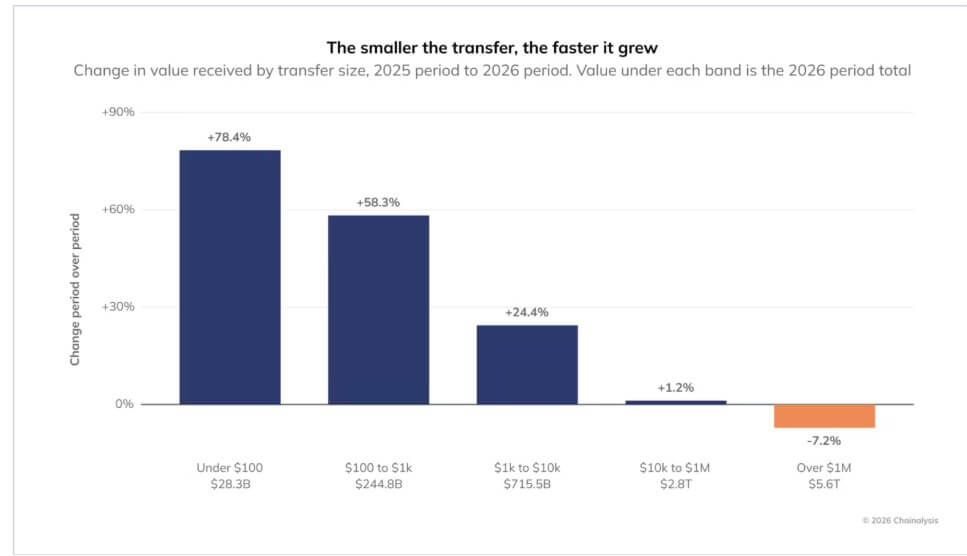
Larger transactions also proved more resilient than falling asset prices might suggest. Transfers worth at least $1 million declined 7.2% from the previous period, according to Chainalysis.
Meanwhile, cross-border growth is spreading beyond the largest existing routes. Chainalysis identified 4,708 new stablecoin corridors during the period, moving a combined $2.64 billion. Routes outside the busiest quartile handled $8.66 billion, up from just $260 million before the latest reporting period. USDT accounted for much of that expansion.
The trend is expanding the addressable market for stablecoin issuers, exchanges and payment companies seeking transaction revenue beyond crypto trading. Regulatory frameworks in the US, European Union, Japan, Hong Kong, Singapore and the UK are also giving financial firms clearer rules for integrating dollar-linked tokens into payment and settlement products, Chainalysis said.
How much of the growth ultimately becomes durable commercial payment volume remains harder to establish from blockchain transfers alone. Wallet movements can include remittances and supplier payments, but can also represent savings transfers and other movements that do not correspond to purchases.
That distinction will become more important as stablecoin companies and traditional financial firms compete to build payment networks around the same flows. Chainalysis’s data show activity increasingly persisting outside crypto’s trading cycle; the next test will be whether issuers and payment providers can turn that traffic into recurring consumer and business use as markets recover.