Coinbase Ireland’s cash safeguards fell €5 million short before 2024 fix
Quick Take
- Coinbase Ireland’s safeguarding shortfall peaked at about €5 million in 2024, according to a newly disclosed Irish settlement.
- The regulator found no evidence of actual consumer harm, but inadequate safeguarding could have hindered repayments in an insolvency.
- Coinbase Ireland accepted a €3,252,618 penalty and reprimand, which still require High Court confirmation before taking effect.

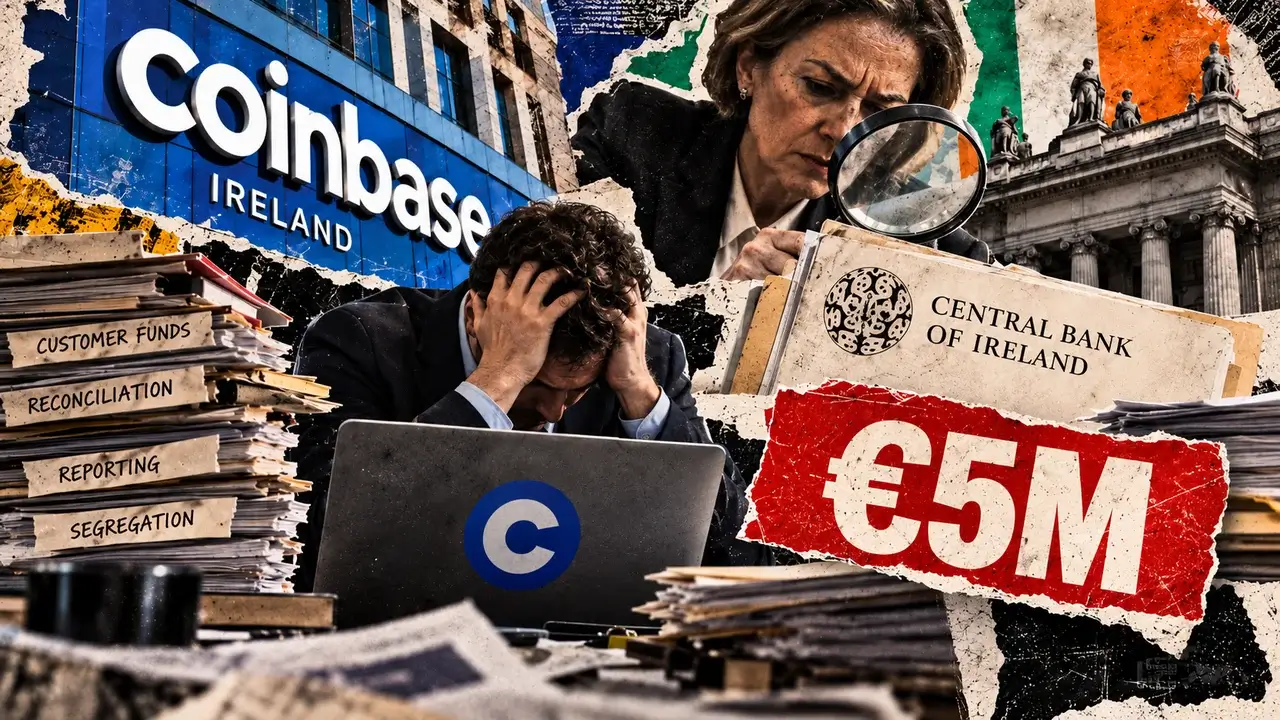
Coinbase Ireland’s customer-cash safeguarding account was short by about €5 million in 2024, a settlement disclosed by the Central Bank of Ireland on Oct. 22 shows. The regulator said the historical failures could have hindered customers’ recovery of their money if the company had become insolvent.
The Central Bank found no evidence that consumers suffered actual harm in this case. Coinbase Ireland admitted breaches and accepted a reprimand and a €3,252,618 penalty, according to the regulator’s announcement. Both sanctions still require High Court confirmation before taking effect.
The case concerns Coinbase Ireland Limited, the group’s e-money institution. It issues and redeems electronic money against fiat currency; customers use that money to trade crypto through other Coinbase companies.
In its Oct. 22 response, Coinbase said it had fully addressed the concerns and that no client suffered financial loss or an inability to access funds because of the historical practices.
How the cash safeguards failed
The settlement records daily underfunding from Jan. 1, 2023, through June 27, 2024. Maximum daily shortfalls were €3 million in 2023 and €5 million in 2024. Across that measured period, the average daily shortfall was 0.54% of Coinbase Ireland’s safeguarding obligations.
The calculation failures affected both retail and institutional customers across all currencies. Changes to reporting data in July 2022 left the firm calculating its daily safeguarding obligation from incomplete information. A separate defect omitted certain unallocated customer funds from reconciliation calculations between September 2023 and June 2024, causing further underfunding.
Coinbase Ireland corrected the funding shortfall in late June 2024. The underlying reporting defect and the separate unallocated-funds issue were fixed in October 2024.
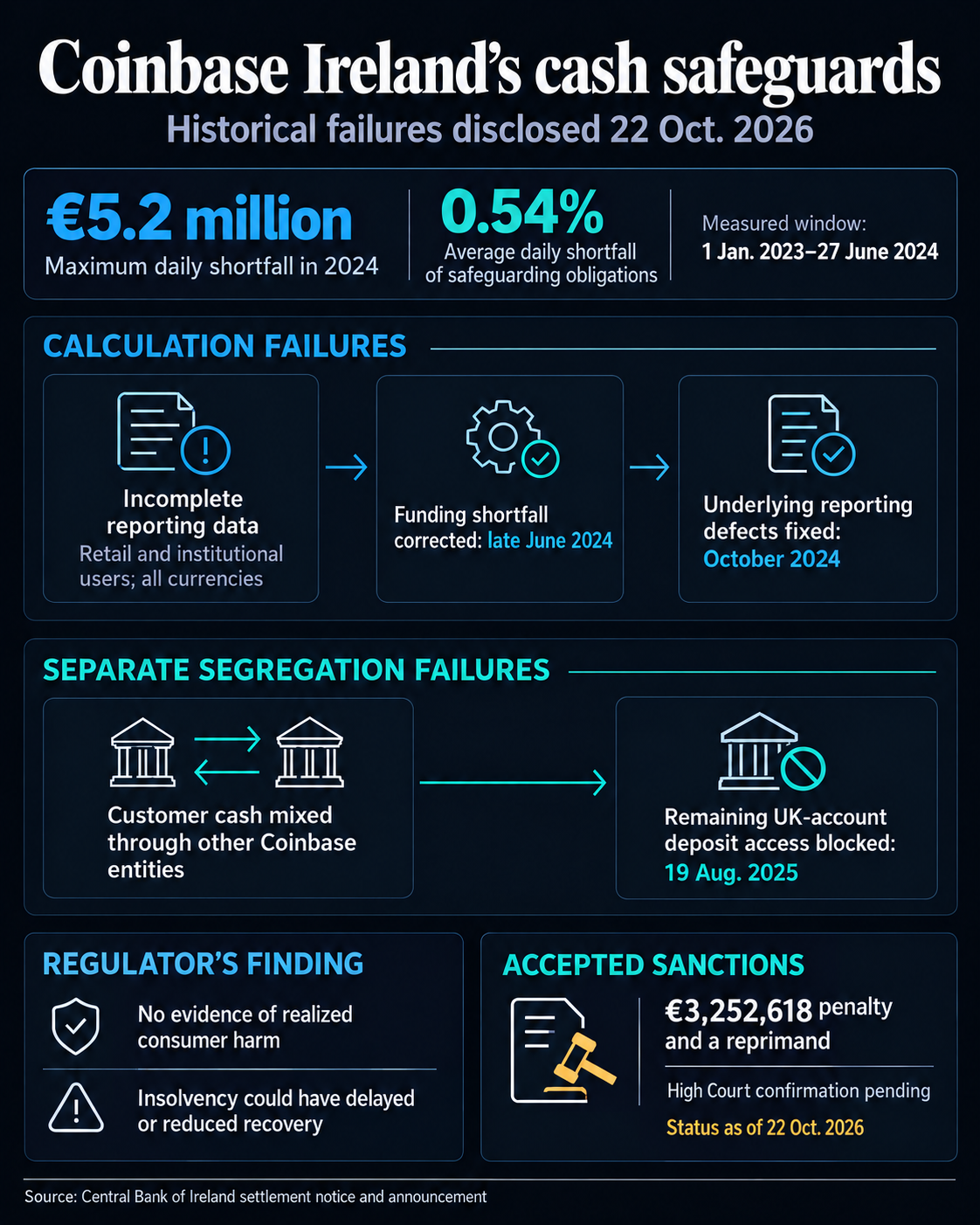
Separately, the bank found failures to keep funds apart across Coinbase companies. In March 2023, 30 institutional customers were directed to deposit dollars into accounts in Coinbase Inc.’s name. The firm cited customer ledgers and US deposit insurance as protections. The regulator said those measures did not satisfy the requirement for proper segregation in Coinbase Ireland’s name.
Some customers who migrated from Coinbase UK in 2020 continued depositing into UK accounts. A general rejection of those deposits began in March 2024, but an August 2025 audit found 33 users still had access and had made deposits. Remaining access was blocked on Aug. 19, 2025.
Coinbase Ireland’s safeguarding account also paid euro withdrawals for other Coinbase entities’ customers until Jan. 19, 2024.
Safeguarding is intended to keep customer money separate so it can be returned if the firm fails. Had Coinbase Ireland become insolvent during the shortfall period, the bank said, customers might not have recovered their money promptly and in full.
The Central Bank found excessive reliance on Coinbase Inc. without adequate Irish expertise or oversight. That outsourcing breach ended on Dec. 16, 2024, when Coinbase Ireland appointed an individual responsible for safeguarding. A subsequent risk mitigation program, issued in January 2025, closed in June 2026 following external assurance.
Under the settlement process, the Central Bank will seek High Court confirmation. The court will confirm the sanctions unless it finds them manifestly disproportionate, in which case it returns the matter for reconsideration.
Mentioned in this article
Editorial credits

Also known as "Akiba," Liam Wright is a reporter, podcast producer, and Editor-in-Chief at CryptoSlate. He believes that decentralized technology has the potential to make…