China P2P stablecoin wallets grew 43x despite crypto restrictions: Chainalysis


 Written by Ezra Reguerrastaff writerReviewed by Yohan Yunstaff editor
Unique wallets sending P2P stablecoin transactions in China grew 43-fold between Q1 2024 and Q2 2026 as crypto activity increasingly shifted toward direct wallet-to-wallet transfers.
The number of unique wallets sending peer-to-peer (P2P) stablecoin transactions in China grew 43-fold between the first quarter of 2024 and the second quarter of 2026, according to Chainalysis.
The blockchain analytics company recorded $104.1 billion across 18.1 million transfers involving China’s self-custodied stablecoin holdings during the 2026 reporting period, which ran from July 2025 to June 2026.
Stablecoin holdings turned over 33.2 times per year, more than three times the global average of 9.3, a pattern Chainalysis said was consistent with users treating stablecoins as working capital.
Chainalysis’s new report estimated that China’s crypto economy is worth at least $176 billion. Domestic P2P activity accounted for 59.1% of the total, 3.5 times its share in the 2025 reporting period.
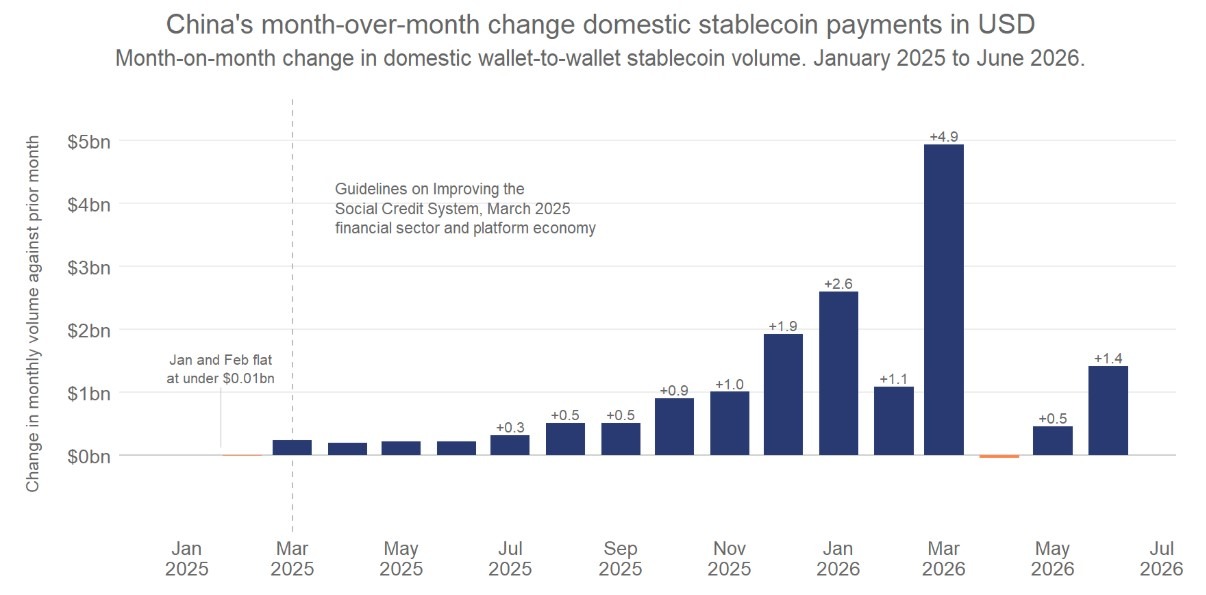
The growth comes despite China’s longstanding restrictions on crypto trading, which authorities reinforced in February with new rules targeting unauthorized yuan-pegged stablecoins and tokenized real-world assets.
East Asian markets take different crypto paths
China’s P2P-heavy market contrasts with South Korea, which Chainalysis ranked as East Asia’s largest crypto economy at $449.1 billion. Activity grew 12.3% from the previous period, with retail traders showing a strong preference for AI-linked tokens.
Hong Kong stood out for institutional activity. Chainalysis said institutional platforms accounted for 16% of service inflows, nearly three times the share in any regional neighbor. The city received almost $24 billion in inbound business-to-business flows. Hong Kong issued its first stablecoin licenses in April.
Related: Singapore crypto activity grows 55% as broader region contracts
In Japan, decentralized exchanges (DEXs) accounted for nearly 35% of service activity, the highest share among mature East Asian markets. Chainalysis said 65.7% of DEX swaps were between $10 and $1,000, and DEX activity had risen more than 200% since 2022.
Japanese lawmakers passed revisions in July that bring digital assets under the country’s financial-markets framework.
Magazine: China warns foreign spies about crypto, Singapore dominates Asia: Asia Express


Subscribe to daily byte-sized crypto news from Cointelegraph
More on the subject