Cardano’s Leios 6x scaling breakthrough comes with a much harder ADA problem

Cardano’s Leios upgrade has demonstrated sixfold throughput gains, but staking economics still depend on paying users.
The scaling protocol peaked at 26.8 transaction kilobytes per second during its first public testnet phase, compared with a 4.51 TxkB/s ceiling for Cardano’s existing Ouroboros Praos system, according to the network developer Input Output.
In the stable final days of the 41-day test, Leios carried 54% of traffic reaching the chain and processed 18 times the transaction count seen on Cardano mainnet over the comparable period. The traffic, however, was artificially generated to stress the system rather than produced by users paying to transact.
That distinction is becoming increasingly important for ADA holders.
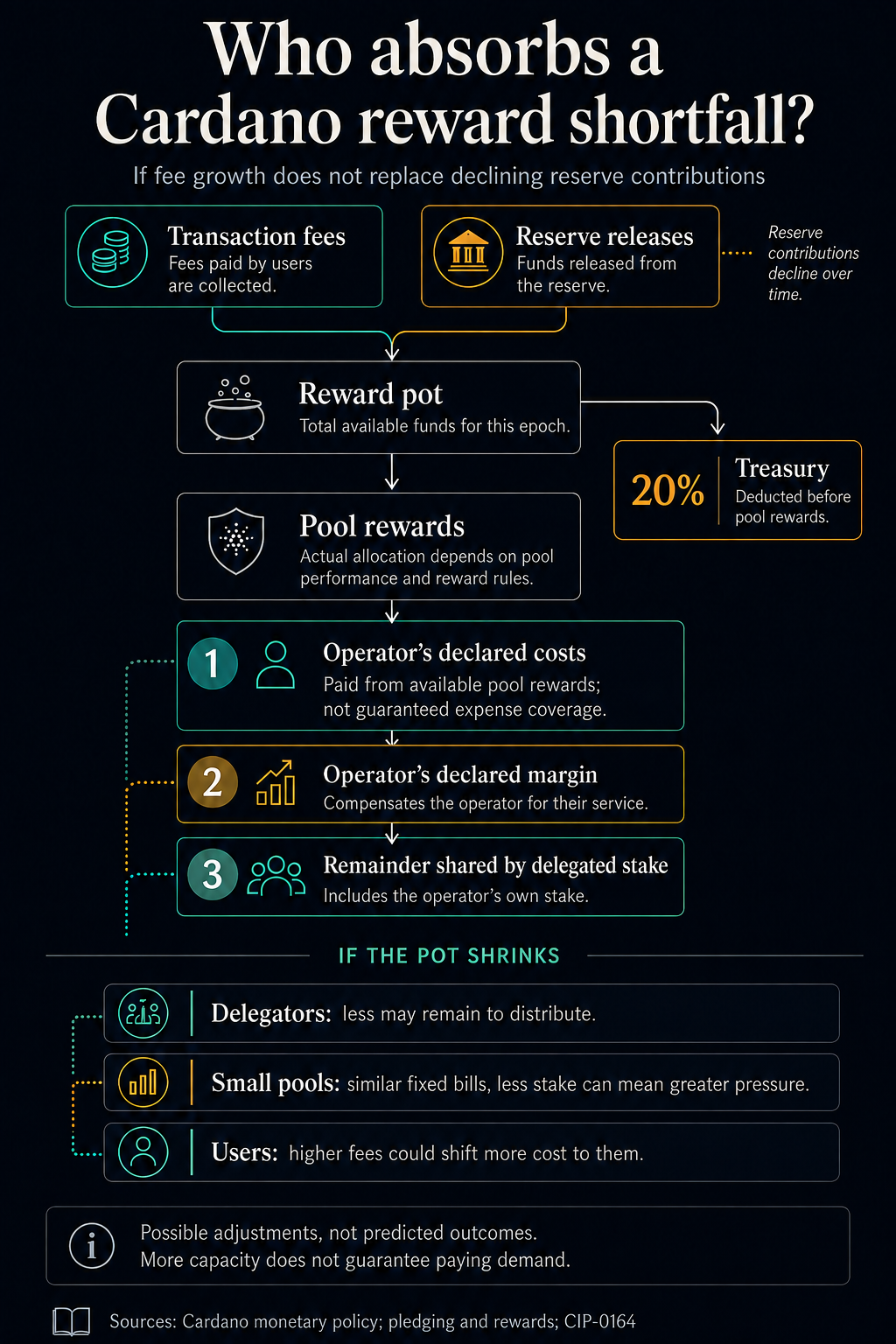
Cardano’s staking rewards come from a combination of transaction fees and releases from its remaining ADA reserve. The reserve contribution declines over time, leaving network activity to shoulder more of the cost of rewarding stake pool operators and delegators.
Leios is designed to remove the throughput ceiling that could otherwise prevent Cardano from generating enough transaction fees to make that transition. Its specification explicitly links greater capacity to the network’s long-term economic viability as reserve contributions diminish.
The engineering side of that equation is starting to take shape. Whether users fill the additional blockspace is now the harder question.
Leios creates the capacity, not the revenue
Cardano’s current Praos design constrains how much transaction data can move through the network while preserving reliable block propagation.
Leios adds parallel capacity through larger Endorser Blocks that carry additional transactions while the underlying Praos chain continues operating. Committees validate those blocks before recording the transactions, allowing Cardano to process more activity without replacing its existing security model.
The first public test shows the design can materially raise that ceiling.
Input Output said the testnet operated for 41 days, producing more than 127,000 blocks and announcing about 30,000 Endorser Blocks. Sixty-three stake pools registered during the phase, while developers shipped a series of fixes for memory leaks, chain forks, crashes, and other implementation problems discovered under load. Input Output said none of those incidents exposed a flaw in the underlying Leios protocol.
But more available blockspace generates no staking income until somebody pays to use it.
That is where Cardano’s economic model imposes a separate hurdle.
A cost analysis accompanying the Leios specification uses a baseline of 48 million ADA in monthly rewards and models a 43% decline by 2029, leaving 20.64 million ADA a month to be replaced through transaction fees under that scenario. The date is a modeling horizon, not when Cardano’s reserve is expected to run out.
Using an average transaction size of 1,500 bytes and a modeled fee of roughly 0.221 ADA, generating that amount would require about 36 transactions per second sustained continuously through a 30-day month. The broader Leios specification points to roughly 36 to 50 TPS as the relevant range.
Those figures cannot be directly compared with the testnet’s 26.8 TxkB/s result because they measure different things. The test demonstrates data-processing capacity; the economic model asks how many fee-paying transactions must actually arrive.
Staking increasingly becomes an adoption bet
The revenue threshold also changes depending on where you measure the money.
Cardano directs 20% of its reward pot to the treasury before distributing the remainder to stake pools. To replace 20.64 million ADA after that deduction, the same transaction and fee assumptions would require closer to 45 sustained TPS.
At 50 TPS, the model generates about 28.7 million ADA in gross monthly fees. At 20 TPS, it produces roughly 11.5 million ADA, leaving a 9.2 million ADA gap against the modeled target. Ten TPS generates about 5.7 million ADA.
| Sustained transactions per second | Gross fees over 30 days | Against the modeled 20.64 million ADA target |
|---|---|---|
| 10 | 5.74 million ADA | Below target |
| 20 | 11.48 million ADA | 9.16 million ADA short |
| 50 | 28.70 million ADA | 8.06 million ADA above |
Fee levels can move the target again. Cutting the average fee in half would require roughly twice as many transactions to generate the same revenue, while raising fees could increase revenue per transaction at the risk of discouraging activity.
That leaves Cardano facing the same economic tension that confronts many scaling networks: cheaper and more abundant blockspace can support adoption, but the network ultimately needs enough paid usage to finance the infrastructure securing it.
Input Output has set a longer-term goal of taking Cardano from roughly 800,000 transactions a month to more than 27 million while becoming economically self-sufficient as reserve funding declines. Leios is the main consensus upgrade intended to provide the capacity for that growth.
If usage falls short, the pressure moves elsewhere.
A smaller pool reward can leave less for delegators after operators take declared costs and margins. Smaller pools with fixed infrastructure expenses could face stronger pressure to accept lower earnings, subsidize operations or consolidate. Higher transaction fees offer another lever, but only if users continue paying them.
Leios does contain a protection against paying the full infrastructure cost before demand arrives. Under the proposed design, ordinary Praos blocks can continue handling low traffic without activating additional Endorser Block work, limiting some of the cost of unused capacity.
The project is now moving into the Water phase of its public testnet, where developers are testing different configurations, a redesigned mempool and production cryptographic keys.
Input Output says the goal is to make Leios mainnet-ready by the end of 2026, while acknowledging that delivering a consensus upgrade on that timetable would be unusually fast.
For stake pool operators and ADA delegators, the more consequential evidence will come after the capacity tests: sustained network transactions, the fees those transactions actually generate, and how much of the declining reserve contribution they can replace.