BNB’s $99 million ETF inflows came almost entirely before Binance’s hack

Quick Take
- BNB ETFs led October’s US spot crypto ETF inflows with $99 million, largely from a single pre-hack allocation.
- Bitcoin and Ethereum ETFs lost over $2 billion combined, while BNB outpaced XRP, NEAR and other altcoin funds.
- Binance faces a fresh test of investor confidence as BNB's ETF inflows were concentrated weeks before the security breach.

BNB exchange-traded funds (ETFs) led October inflows among US-listed spot crypto ETFs tracked by SoSoValue, with the largest allocation arriving weeks before Binance suffered a record $6.3 billion cryptocurrency hack.
The US-listed VanEck BNB ETF attracted $99 million during the month, ahead of $35 million for NEAR and $19 million for XRP, according to SoSoValue data.
The gains contrasted with broader withdrawals that saw investors pull $1.61 billion from Ethereum funds, $515 million from Bitcoin products and $144 million from Solana ETFs.
BNB inflows arrived before Binance's breach
VanEck's BNB ETF, trading under the ticker VBNB, accounted for the category's October inflows. SoSoValue's daily flow table records about $97 million on Oct. 2, or 98.8% of the monthly net total, weeks before the attack.
The same table shows fund assets of about $3 million on Oct. 1, $100 million on Oct. 2 and $103 million on Oct. 5. Subsequent flows were comparatively small: about $1 million entered on Oct. 9 and $285,000 left on Oct. 15. BNB's strong monthly ranking came from that early allocation.
VanEck introduced VBNB on May 28 to give US investors exposure to BNB through an exchange-traded product. The fund holds the token in custody arrangements separate from Binance, using qualified custodians including Anchorage Digital and BitGo. Its shares represent exposure to BNB and not an ownership interest in the exchange.
That distinction became especially relevant after Binance disclosed that attackers compromised its hot wallets at around 20:05 UTC on Oct. 29, stealing an estimated $6.3 billion in tokens.
The exchange said it would absorb the loss using corporate funds and its Secure Asset Fund for Users, while working with issuers and investigators to freeze stolen assets.
Binance said approximately $3 billion had been frozen on-chain. By Nov. 1, it reported having replenished about 95% of the assets affected by the theft, with purchases of harder-to-source tokens still underway.
The exchange also began reopening withdrawals in phases on Nov. 1. It said the initial surge in withdrawals had since eased.
Despite its strong monthly inflows, VBNB's assets declined from $98 million on Oct. 29 to $92 million on Oct. 30. Those figures also reflect changes in BNB's market price, meaning the decline cannot automatically be attributed to ETF redemptions.
Bitcoin's late reversal exposes fragile ETF demand
The last trading day of October produced a markedly different outcome in Bitcoin funds.
US spot Bitcoin ETFs lost roughly $643 million on Oct. 30, reversing a positive month-to-date balance and leaving October with $515 million in net withdrawals. The funds had previously been on course for a third consecutive month of inflows.
The reversal followed four consecutive sessions of Bitcoin ETF buying. Bitcoin-focused research firm Ecoinometrics, which had already warned that those inflows were too small to establish lasting demand, said the sudden selling exposed the market's vulnerability to another shock.
“ETF investors aren't buying the dip. They're selling it,” the research firm said, adding that the first serious disruption had undone October's tentative recovery.
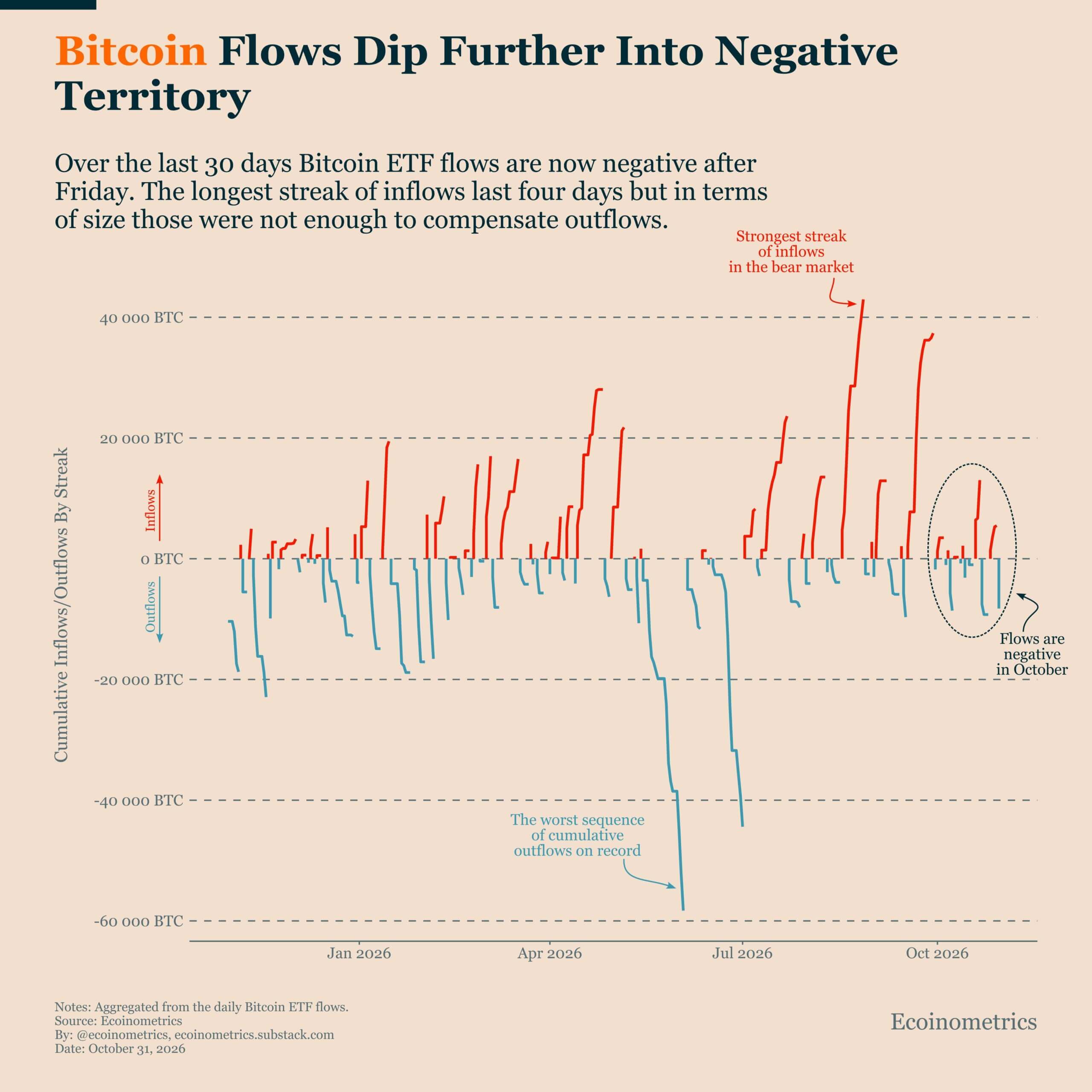
Bitcoin had fallen below $80,000 after the Binance breach. The selloff came against a backdrop of weak ETF demand even before the incident, making it difficult to attribute every redemption solely to the hack.
Ethereum faced a deeper and more persistent retreat. Its $1.61 billion in monthly ETF withdrawals was the largest since US spot Ether funds began trading in July 2024.
The first full trading week of November will better test BNB fund demand after the breach. In a Nov. 2 update, Binance said the full zero-knowledge proof for its Oct. 31 reserve snapshot had been completed for the ten covered tokens. It said about 95% of the impacted amount had been replenished, with acquisitions of the remaining assets continuing. The exchange plans a broader snapshot on Nov. 4, followed by a proof it estimates will take 40 to 50 hours to generate.
Mentioned in this article


Editorial credits

Oluwapelumi values Bitcoin's potential. He imparts insights on a range of topics like DeFi, hacks, mining and culture, underlining transformative power.

Also known as "Akiba," Liam Wright is a reporter, podcast producer, and Editor-in-Chief at CryptoSlate. He believes that decentralized technology has the potential to make…