Bitcoin rebounds after Democratic sweep despite three days of ETF outflows

Quick Take
- Bitcoin rebounded above $78,000 after Democrats won both chambers of Congress, while US spot ETFs had recorded three consecutive sessions of withdrawals.
- US spot Bitcoin ETFs lost approximately $1,157 million over the three trading sessions ending Nov. 3, adding a demand hurdle to the recovery.
- Ryan Kirkley's $85,000-$90,000 year-end forecast depends on stabilizing ETF flows, improving liquidity and renewed macro confidence.

Bitcoin rebounded above $78,000 on Wednesday after Democrats won both chambers of Congress, despite three consecutive trading sessions of US spot ETF withdrawals.
The Democratic victories in Tuesday's midterm elections dealt President Donald Trump a political setback. In a pre-election Bloomberg survey, respondents had forecast lower year-end Bitcoin prices under that outcome than under Republican or divided control.
The survey's median year-end forecast was $76,450 under a Democratic sweep, compared with $84,100 under divided congressional control and $90,800 if Republicans retained both chambers.
Ryan Kirkley, co-founder and CEO of blockchain infrastructure company Global Settlement Network, argued ahead of the election that Bitcoin could recover toward $85,000-$90,000 regardless of the outcome. His forecast depended on ETF flows stabilizing, liquidity improving and confidence returning to the broader economy.
“My view is that investors are probably giving Washington too much credit for Bitcoin's direction,” Kirkley said.
Bitcoin briefly fell below $76,000 as election results emerged before recovering above $78,000 on Wednesday.
Democratic sweep adds to crypto policy concerns
The election followed a sharp deterioration in cryptocurrency social sentiment.
According to blockchain analysis firm Santiment, Bitcoin's bullish-to-bearish social commentary ratio fell from about 1.8 on Oct. 20 to 0.51 as Democrats moved toward control of Congress.
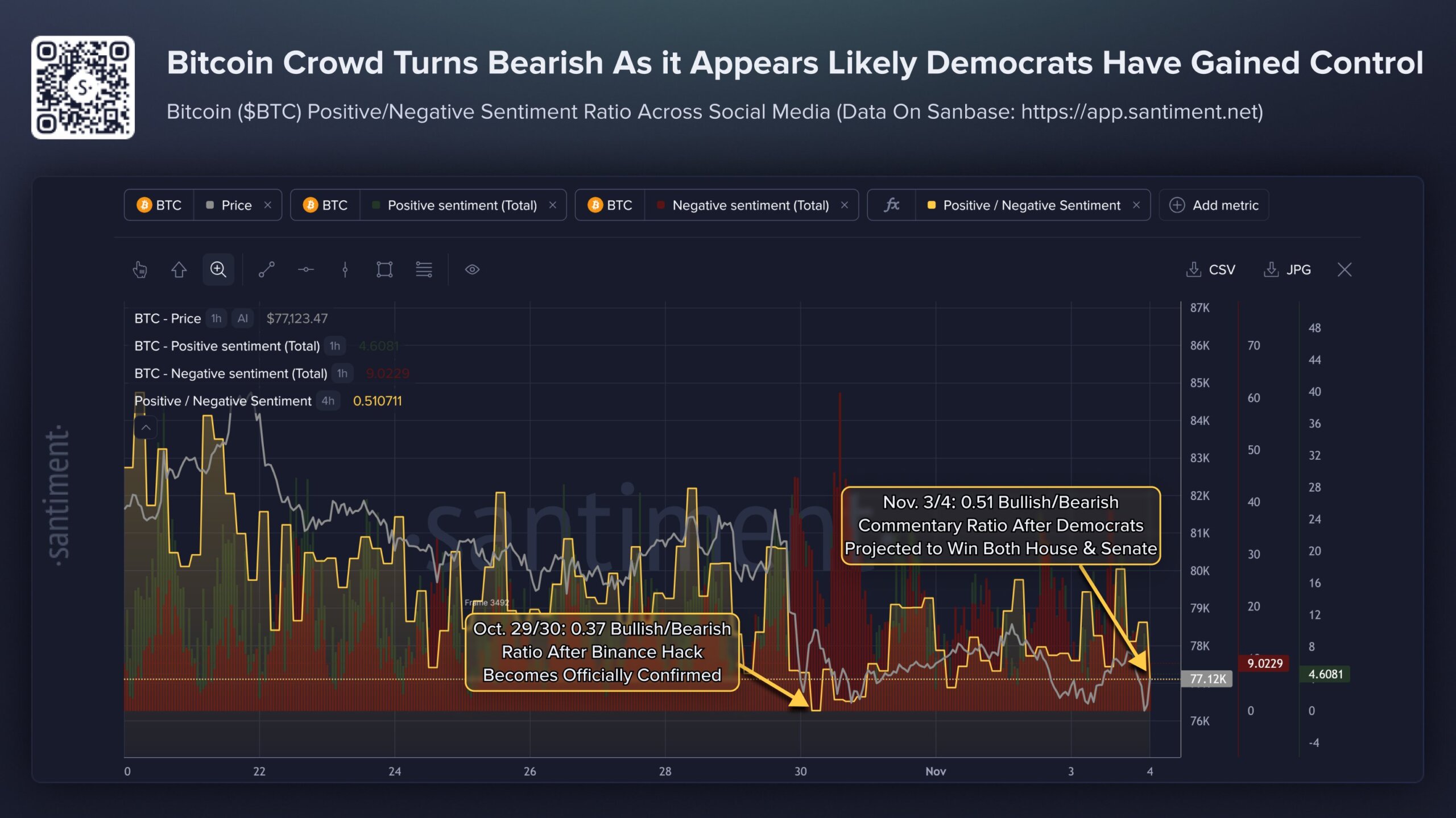
The decline accelerated after Binance suffered a roughly $6 billion security breach in late October, when the ratio briefly collapsed to 0.37 before recovering for several days.
Santiment attributed the renewed pessimism to perceptions that Republicans are more supportive of cryptocurrencies, with the prospect of Democratic control of Congress adding to concerns about the industry's political future.
However, the analytics firm suggested that the extreme pessimism could create conditions for a contrarian recovery, particularly if Bitcoin rebounds after traders have positioned themselves for further losses.
Analysts at Bitunix warned that Democratic control could reshape Washington's approach to cryptocurrency regulation, potentially shifting congressional priorities from advancing industry legislation toward investigations of conflicts of interest, exchange oversight and broader financial risks.
The industry's flagship market-structure legislation, the CLARITY Act, had already encountered resistance before the election.
On Sept. 15, the Senate rejected a procedural motion to advance the legislation by 49 votes to 50, falling short of the 60 votes required.
The bill seeks to establish clearer boundaries between Securities and Exchange Commission (SEC) and Commodity Futures Trading Commission (CFTC) oversight, an effort that crypto companies have long argued would reduce legal uncertainty.
Bitunix cautioned that the incoming Democratic majority could complicate negotiations, although some Democratic lawmakers have supported efforts to establish comprehensive digital asset rules.
The new Congress will not take office until January 2027, so the immediate market impact will depend largely on how investors price in future policy changes.
Bitunix also identified a potential counterweight to the political uncertainty. Declining Treasury yields and a weaker US dollar following the election could ease financial conditions and support risk assets, including Bitcoin.
Bitcoin's $90,000 recovery faces ETF withdrawals and heavy selling
Kirkley's bullish forecast faces a more immediate challenge from withdrawals from Bitcoin exchange-traded funds.
According to Farside Investors, US-listed spot Bitcoin ETFs recorded approximately $1,157 million in net withdrawals across the three consecutive trading sessions ending Nov. 3.
The outflows began with $643 million on Oct. 30, followed by $399 million on Nov. 2 and another $116 million on election day. BlackRock's IBIT accounted for $95 million of the Nov. 3 redemptions.
The withdrawals add to selling pressure from existing Bitcoin holders, many of whom acquired their assets at prices above current market levels.
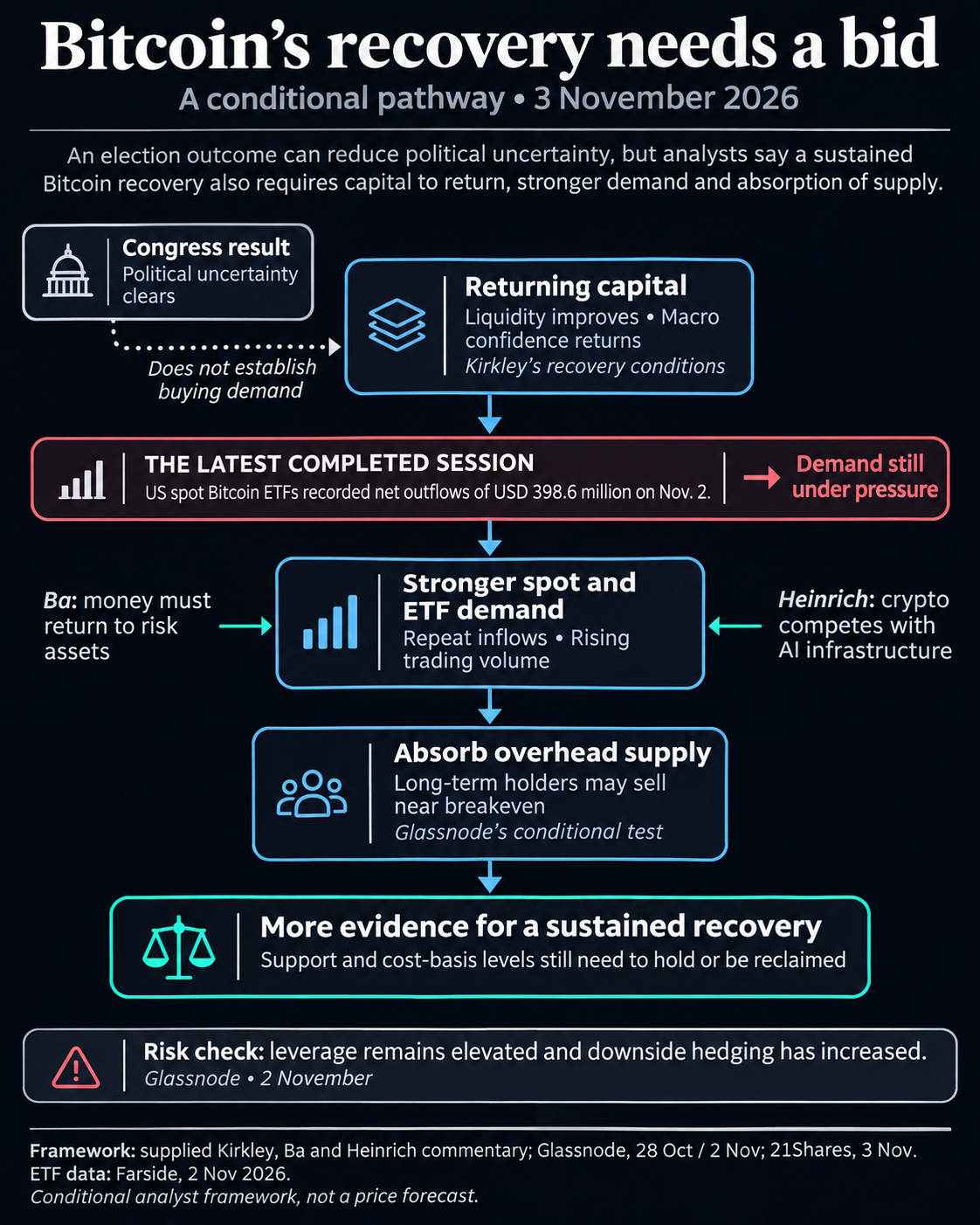
In its Oct. 28 market report, Glassnode estimated that about 4 million BTC held by long-term investors last moved between $85,000 and $118,000.
Some of those investors could seek to recover their initial investments as Bitcoin approaches those levels, creating a potential wave of selling near Kirkley's year-end target.
Glassnode identified $84,000-$85,000 as a particularly difficult resistance zone, having repeatedly rejected Bitcoin rallies throughout 2026.
Before reaching that level, Bitcoin would need to reclaim the aggregate cost basis of US spot Bitcoin ETF holdings, estimated at approximately $81,500 in Glassnode's October report.
A sustained move above $87,500, accompanied by repeated ETF inflows and rising trading volumes, would offer stronger evidence that buyers can absorb the supply waiting overhead.
Glassnode placed the short-term holder cost basis near $75,800. In its Nov. 3 outlook, 21Shares identified a broader support area around $75,800-$76,200, with the 200-day moving average near $73,000 below it.
The next test will come from ETF flows after the election, particularly whether investors reverse three consecutive sessions of withdrawals or continue selling as Bitcoin attempts to reclaim $80,000.
Mentioned in this article

Editorial credits

Gino Matos is a law school graduate and a seasoned journalist with six years of experience in the crypto industry. His expertise primarily focuses on the Brazilian blockchain…

Also known as "Akiba," Liam Wright is a reporter, podcast producer, and Editor-in-Chief at CryptoSlate. He believes that decentralized technology has the potential to make…