Bitcoin Lightning developers sound alarm over security flaws as second patch lands in five days
Quick Take
- Bitcoin Lightning's Eclair software received another security patch just five days after developers blocked a potential browser-based attack route.
- Malicious peers could exploit some of the newly fixed flaws, potentially exposing Lightning infrastructure supporting Bitcoin payments to security risks.
- Operators face pressure to upgrade while the full extent of the security risks remains unknown.

Bitcoin Lightning developer ACINQ urged node operators to upgrade Eclair after patching security flaws that malicious peers could exploit.
The company released Eclair version 0.14.5 on Oct. 20, its second security-focused update in five days, warning that some of the newly addressed vulnerabilities could be exploited by hostile nodes. The software powers Bitcoin Lightning nodes that maintain payment channels and route transactions across the network.
The developers credited security researchers Nuhiat-Arefin and mptfire with responsibly disclosing problems addressed in the update.
The warning places renewed pressure on Lightning node operators, who maintain Bitcoin-funded payment channels used to transfer funds across the network. Vulnerabilities involving interactions with malicious peers create potential security and operational risks for infrastructure supporting Lightning payments.
However, ACINQ has not detailed the newly patched exploit mechanisms or specified which older versions are affected. The announcement also reported no confirmed attacks or financial losses, leaving the potential financial consequences unclear.
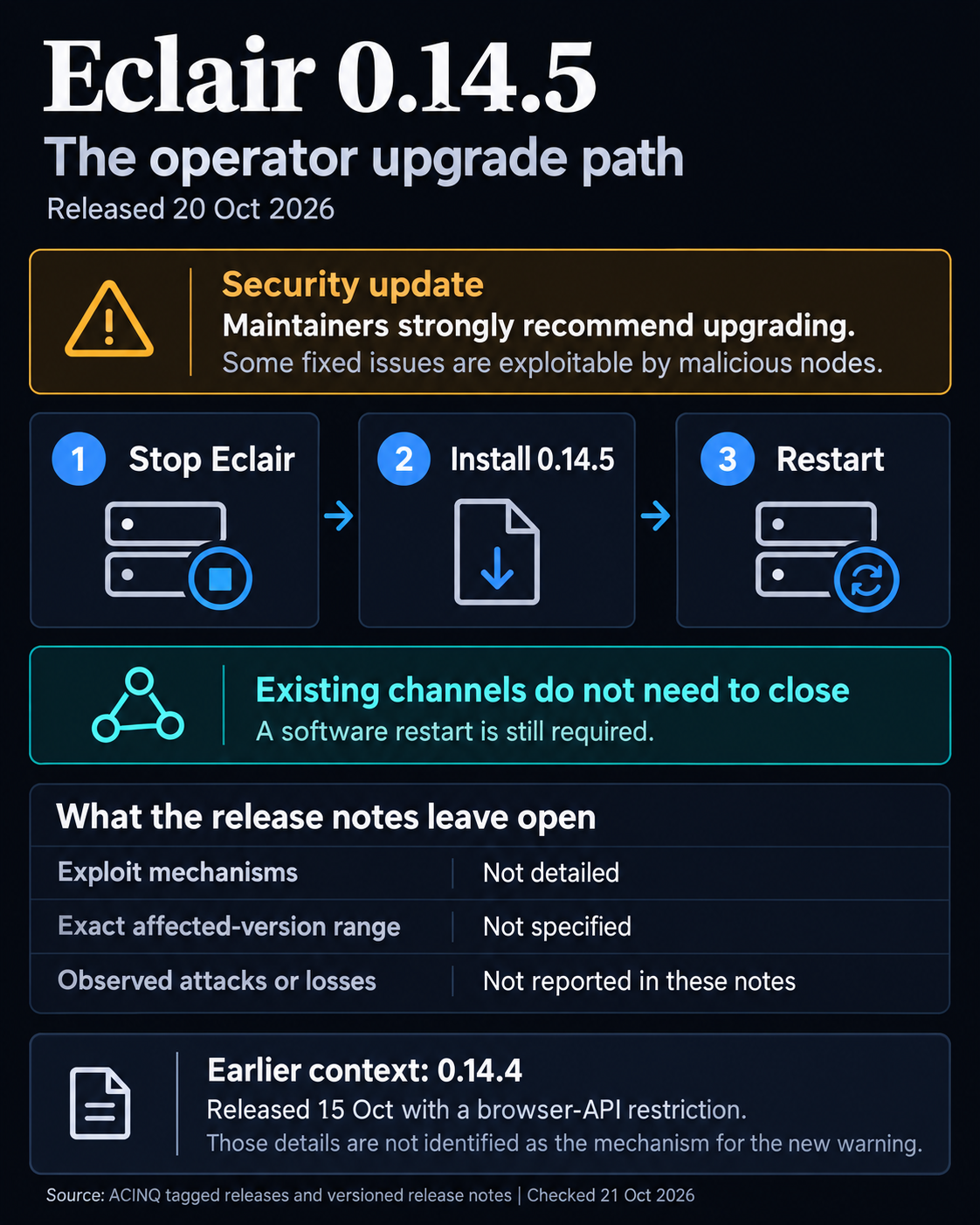
The developers have sought to minimize disruption from the upgrade. According to the release instructions, operators can install the update without closing existing payment channels.
Instead, they must stop Eclair, install the new version, and restart the software. This avoids the blockchain transactions and channel reconfiguration that closing and reopening Lightning channels can require.
Eclair's second security update in five days
The latest warning follows an Oct. 15 security release that introduced additional protections against malicious nodes and addressed a vulnerability involving Eclair's administrative interface.
That earlier update, version 0.14.4, blocked API requests carrying an Origin header, preventing direct browser access to the software's application programming interface.
The developers explained that browsers could automatically attach cached login credentials to cross-site requests. As a result, a malicious website a node operator visits could send authenticated commands to the node through a simple web form.
The change eliminated that attack route by rejecting browser-originated requests while preserving ordinary command-line access.
However, it also introduced an operational requirement for businesses and developers using browser-based Lightning management tools. Those interfaces now require an intermediary backend to communicate with Eclair's API.
The latest release extends the project's recent security work, although its maintainers have not linked the newly patched vulnerabilities to the previously documented browser issue.
The successive updates also mean operators who installed the Oct. 15 release must upgrade again to obtain the protections introduced five days later.
ACINQ has added safeguards to the installation process, including signed release files and SHA-256 checksums that let operators verify downloaded software before deploying it.
Those checks matter most for infrastructure handling Bitcoin-funded payment channels, where installing compromised software could introduce risks beyond the vulnerabilities being repaired.
Eclair 0.14.5 is now the project's latest release, so operators seeking the newest security protections must complete another installation cycle.
The remaining question is how widely older deployments are exposed. ACINQ has not yet published a detailed vulnerability breakdown or list of affected versions, leaving operators without a documented basis to determine whether their existing software can safely remain in production.
Mentioned in this article

Editorial credits

Oluwapelumi values Bitcoin's potential. He imparts insights on a range of topics like DeFi, hacks, mining and culture, underlining transformative power.