Bitcoin holders are taking profits, is a selloff coming?

Bitcoin has held near $84,000 while long-term holders take moderate profits and exchange balances decline, leaving improving on-chain signals without a confirmed recovery.
- Bitcoin long-term holders are realizing 72% profits, far below December 2024’s roughly 350% peak levels.
- Exchange reserves fell 1.03% as 12,153 BTC left trading platforms between September 17 and 23.
- Bitcoin open interest dropped 10.4% from September 21, while funding eased to 0.00570% by Thursday.
- September 22 produced 19,105 BTC outflows alone, meaning weekly withdrawals were not consistently dominant overall.
- Spot Bitcoin ETFs drew $191 million September 24, extending their net inflow streak to six.
CryptoQuant contributor Darkfost said in his September 25 analysis that long-term BTC holders are currently realizing profits of roughly 72%. His comparison puts the figure well below the nearly 350% profit level recorded in December 2024, when long-term-holder gains were much closer to previous cycle extremes.
CoinGecko currently places BTC near $84,403, with a 24-hour trading range between roughly $82,941 and $84,843. The market tracker shows BTC up around 10.3% over seven days after the rebound from September’s lower levels.
Are long-term Bitcoin holders starting to sell heavily?
Darkfost does not describe the current activity as aggressive distribution. The analyst said long-term holders tend to react less to short price swings than short-term holders, making their realized profits useful for tracking selling pressure during larger market moves.
His data place current realized profits near 72%, compared with approximately 350% in December 2024. Darkfost described the current phase as moderate and said similar readings have appeared during earlier bear-market periods, when long-term holders were less motivated to unload large positions immediately.
LTH are known to be more stable and less sensitive to market movements than STH.
— Darkfost (@Darkfost_Coc) September 25, 2026
This is why analyzing this cohort’s movements provides interesting context for reading the Bitcoin market.
In this context, tracking the profits realized by LTH allows us to gauge the strength of… pic.twitter.com/y3gSuPon7p
The 72% figure does not mean long-term holders have sold 72% of their BTC. It measures the profit performance associated with coins being spent by that cohort, which CryptoQuant defines through holding-age metrics.
Darkfost’s interpretation is that holders could continue waiting for higher profit levels before heavier selling emerges. His view remains an analyst assessment based on historical behavior, not a forecast that long-term holders will refuse to sell if market conditions change.
The distinction is relevant after BTC rallied from roughly $75,000 to above $87,000 within days. As crypto.news reported in the earlier $84,000 Bitcoin analysis, BTC has already faced two rejections around the $87,000 region while ETF demand and large-holder accumulation continued below the surface.
Bitcoin is leaving exchanges, but one day drove much of it
Exchange flows give another constructive reading, though the weekly pattern is less uniform than a headline net-outflow figure suggests.
CryptoQuant analyst CoinNiel reported in the latest exchange-flow analysis that exchanges recorded 12,153 BTC in net outflows between September 17 and September 23. The previous week had produced 6,142 BTC in net inflows, reversing the direction of the weekly figure.
CoinNiel cautioned that September 22 accounted for approximately 19,105 BTC in withdrawals by itself. His data therefore show that net outflows did not dominate every session during the seven-day period.
Exchange reserves moved lower at the same time. CoinNiel measured total reserves at roughly 2.726 million BTC on September 21 before they dropped to a provisional 2.698 million BTC on September 24, a decline of approximately 1.03%.
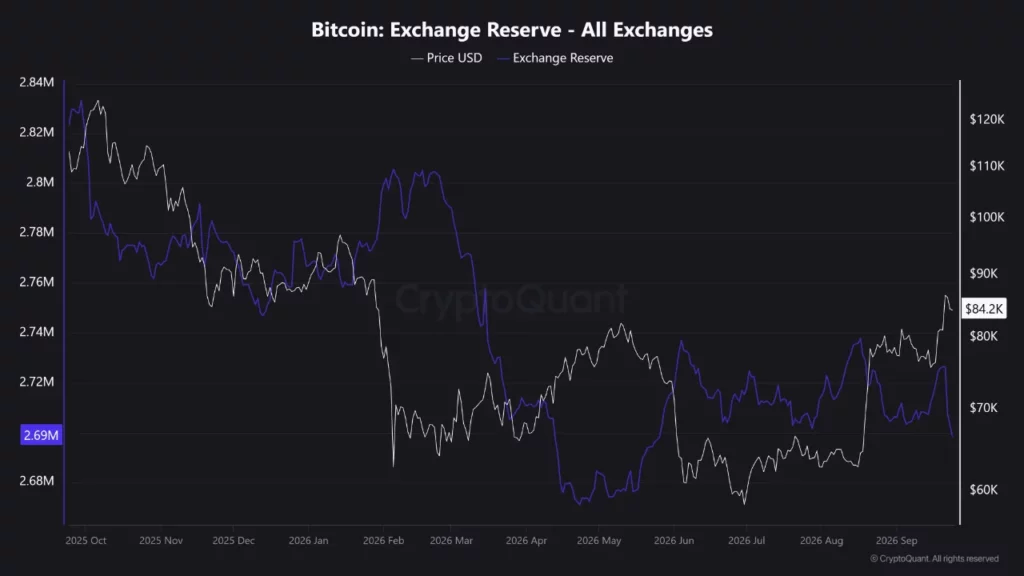
His analysis does not treat every withdrawal as a purchase. Coins can leave exchanges for private custody, transfers between institutions, collateral management or other purposes, so reserve declines alone cannot establish fresh spot demand.
A separate Binance reading adds more detail. As crypto.news reported earlier on September 25, Darkfost tracked more than 13,800 BTC leaving Binance on its largest daily net-outflow reading since 2023. Binance reserves fell from around 705,000 BTC to 685,000 BTC over four days.
Darkfost associated the Binance withdrawals with accumulation, while crypto.news noted that netflow data cannot identify the reason every holder moved coins. The Binance figure and CoinNiel’s all-exchange dataset measure different scopes, so the two readings should not be combined as one total.
Falling leverage is removing some pressure from Bitcoin
Derivatives data show leverage cooling after BTC’s move above $87,000.
CoinNiel reported that Bitcoin open interest fell from approximately $29.34 billion on September 21 to a provisional $26.29 billion on September 24. The 10.4% decline occurred as BTC pulled back from its recent high.
The analyst cautioned that open interest is measured in dollar terms, meaning part of the decline can come from changes in BTC’s price. CoinNiel therefore said the full drop cannot be attributed solely to traders closing leveraged positions.
Funding rates cooled as well. CoinNiel measured average funding near 0.00662% during the previous week before it increased to 0.00777% between September 17 and 23. The provisional September 24 reading then dropped to 0.00570%.
Lower funding reduces the cost of maintaining leveraged long positions compared with the previous readings. CoinNiel described the combination of easing funding, lower open interest and exchange withdrawals as “encouraging” but stopped short of treating it as proof of a renewed uptrend.
The change follows a period when leverage expanded quickly during BTC’s rebound. Crypto.news previously reported that leverage was rising as Bitcoin moved through $85,000, with futures traders adding more than $2 billion in positions after spot ETF demand helped start the rally.
Why Bitcoin’s recovery is still missing one confirmation
Spot demand remains the unresolved part of CoinNiel’s assessment. The CryptoQuant analyst said falling reserves and lower leverage create a better setup, but stronger evidence of persistent spot buying would be needed before describing BTC’s recovery as confirmed.
ETF activity provides one source of measured spot demand. U.S. spot Bitcoin ETFs received another $191 million on September 24, extending their net inflow streak to six consecutive sessions. As previously reported by crypto.news in the September 25 Bitcoin price report, BlackRock’s IBIT received roughly $163 million during the session while Fidelity’s FBTC took in approximately $12.86 million.
The six-day sequence followed much larger inflows earlier in the week. Crypto.news reported approximately $999 million on September 21, $714.7 million on September 22 and $346.98 million on September 23 before daily inflows moderated to $191 million.
ETF subscriptions have therefore remained positive even as BTC failed to stay above $87,000. CoinNiel’s exchange analysis still calls the recovery unconfirmed because ETF flows represent only one part of total spot-market activity.
His downside test is more direct. CoinNiel said renewed exchange inflows combined with rapidly increasing funding and open interest would weaken the current cautiously constructive reading. The analyst plans to watch whether exchange withdrawals persist once September 24 figures are finalized and whether spot buying becomes clearer.
Bitcoin’s derivatives market faces another large reset on September 25. Coinbase Markets data cited by crypto.news show roughly $18.1 billion in combined BTC and ETH options scheduled for quarterly expiry, with Bitcoin call open interest concentrated around the $90,000 and $100,000 strikes.