Bitcoin ETFs sold through 7 of 8 crashes even as Wall Street makes BTC selloffs less violent

Quick Take
- Bitcoin ETFs lost $8.2 billion during the May-June crash, following $6.9 billion in withdrawals during the previous major downturn.
- ETF flows were negative at seven of eight market bottoms and positive at seven of eight peaks, exposing Wall Street's tendency to chase momentum.
- Bitcoin crashes are slower but remain deep, raising questions about whether stronger market liquidity can absorb another wave of ETF selling.

Bitcoin ETFs recorded outflows during seven of eight major selloffs, challenging expectations that Wall Street investors would support prices during downturns.
A new DWF Labs report shared with CryptoSlate found that US spot Bitcoin exchange-traded funds consistently lost money during market declines of at least 15% since their January 2024 launch, while attracting inflows throughout all nine major rallies.
The findings challenge the belief that institutional adoption has created a dependable source of buying during market stress. They also expose a paradox in Bitcoin's changing market structure: selloffs have become slower and less frequent, even as ETF investors continue withdrawing billions during downturns.
The research, covering 694 trading days through Oct. 16, found that investors withdrew a record $8.2 billion during Bitcoin's 28.8% decline between May and June 2026. That followed $6.9 billion in withdrawals during the October 2025 to February 2026 downturn, when the cryptocurrency lost nearly half its value.
The two episodes represented the largest ETF withdrawals since the products launched, surpassing the $3.4 billion investors redeemed during the January-April 2025 correction.
Wall Street investors are buying Bitcoin rallies and selling crashes
DWF Labs found that ETF investors were still withdrawing money at seven of eight market bottoms and purchasing at seven of eight peaks, suggesting institutional flows have largely reinforced existing price trends.
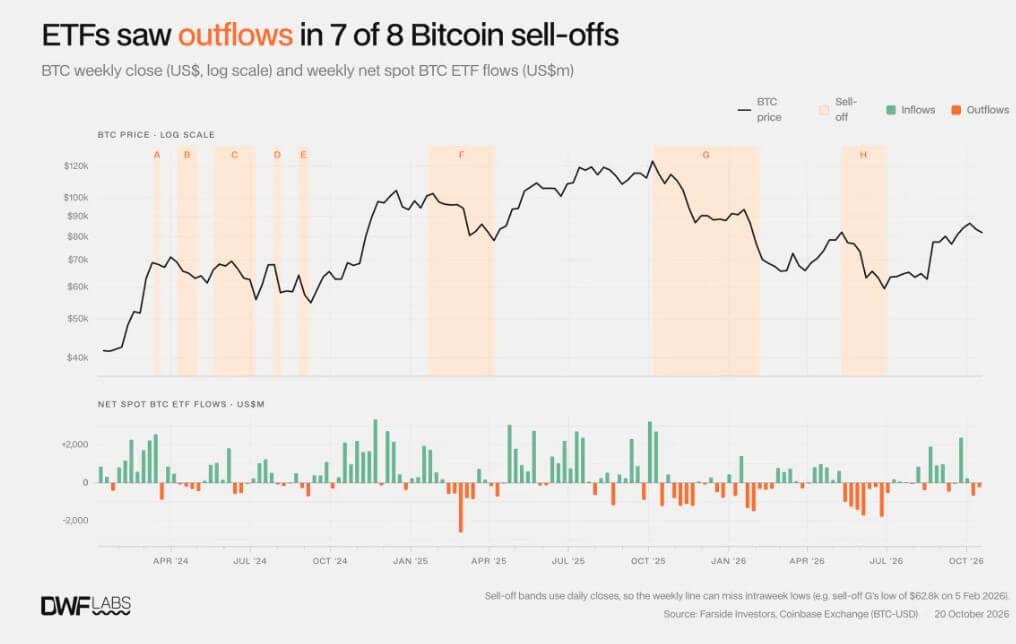
The selling frequently intensified as downturns progressed. In five of the eight corrections, the heaviest withdrawals occurred during the final five trading days before Bitcoin bottomed.
During the May-June 2026 decline, outflows averaged $412 million daily in the final week, while investors withdrew money on 88% of trading days throughout the correction.
The pattern reversed during recoveries, with all nine rallies of at least 15% attracting net inflows. Seven recorded their strongest buying during the final five sessions before the market peaked.
One notable exception emerged during the May-July 2024 correction, when ETFs attracted $2.2 billion despite Bitcoin falling 21.8%. That decline coincided with selling pressure from German government liquidations and Mt. Gox creditor repayments, allowing ETF demand to absorb some of the additional supply.
Otherwise, institutional investors have generally waited for recoveries to become established before returning.
During Bitcoin's April 2025 rebound, ETFs continued losing an average of $40 million daily even as the cryptocurrency gained 9.7%. Inflows subsequently accelerated to $436 million a day after prices had already recovered.
Conversely, one of the largest ETF inflow days, totaling approximately $1.2 billion, coincided with Bitcoin's October 2025 peak, shortly before a prolonged decline.
Bitcoin ETF flows follow prices instead of predicting them
The research found that ETF flows correlated 0.54 with Bitcoin's performance over the preceding five trading days, compared with just 0.03 for returns over the following five days.
Their correlation with same-day returns was 0.41, suggesting flows and prices often move together without indicating whether fund demand drove the move.
This weakens the usefulness of ETF inflows as a forward-looking market signal, despite their growing prominence in institutional Bitcoin analysis.
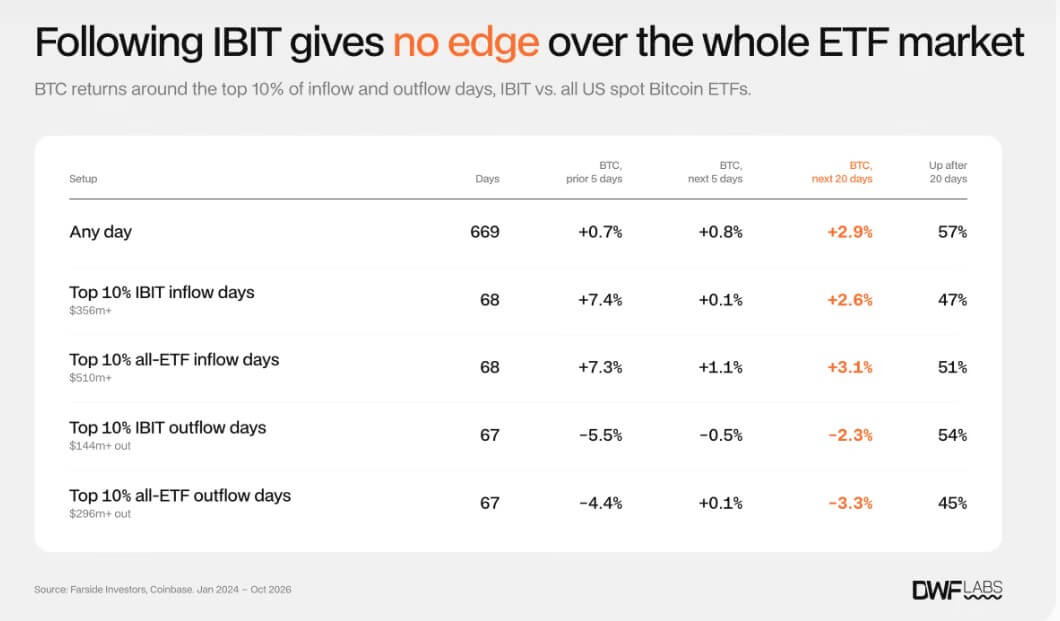
After the largest 10% of inflow sessions, Bitcoin appreciated over the following 20 days only 51% of the time, compared with 57% across all trading days.
BlackRock's iShares Bitcoin Trust (IBIT), the market's largest Bitcoin ETF product, offered little additional predictive advantage despite accumulating $65.6 billion in net inflows during the study period.
Its flows correlated only 0.04 with Bitcoin's subsequent five-day returns. Following its largest inflow sessions, Bitcoin advanced over the next 20 days in only 47% of cases.
The findings also complicate the assumption that large ETF purchases necessarily signal fresh bullish positioning.
Some activity reflects investors moving money between competing funds, while hedge funds can simultaneously buy ETF shares and short Bitcoin futures to capture pricing differences without betting on the cryptocurrency's direction.
DWF Labs nevertheless identified one unusual pattern worth attention.
When ETFs experienced unusually large withdrawals on days Bitcoin moved less than 1%, the cryptocurrency subsequently declined over 20 days in eight of 12 cases.
Returns following those sessions were 10.7% weaker than on days with comparable preceding price trends. However, the negative outcomes were concentrated around three major selloffs, limiting the pattern's reliability as a trading signal.
Bitcoin crashes have slowed despite persistent ETF selling
Although institutional investors have repeatedly withdrawn money during corrections, Bitcoin's broader market behavior has changed considerably since ETFs began trading.
The median selloff has unfolded at a daily pace of 0.69%, compared with 1% during 2022-2023 and 1.37% in 2021.
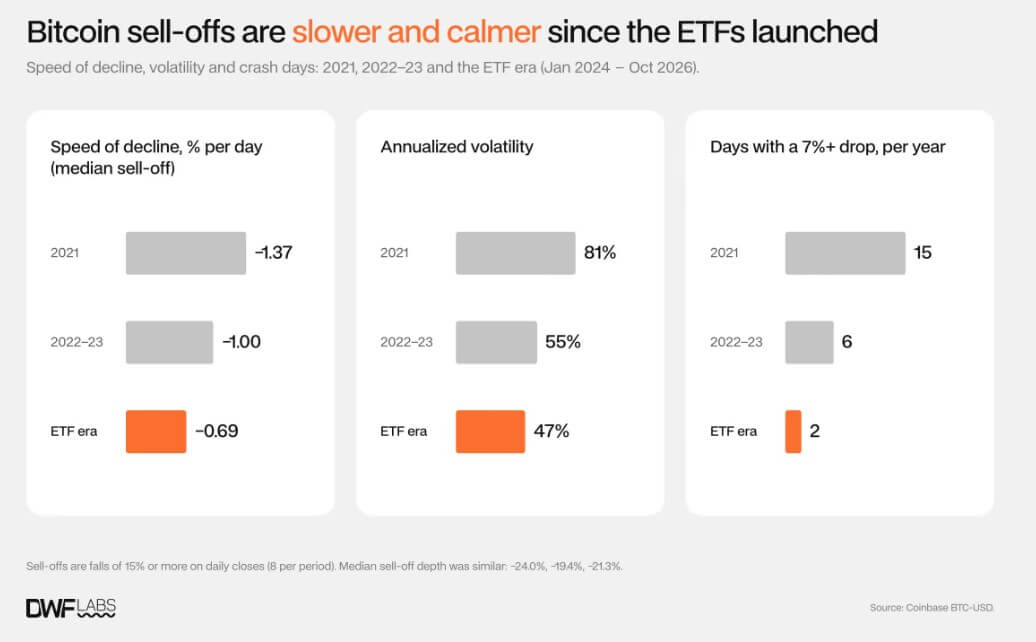
Major corrections of at least 15% have become less frequent, declining to about 2.9 annually from 4.4 in 2022-2023 and 8 in 2021.
Annualized volatility has also fallen to 47% from 55% in 2022-2023, while the annual frequency of roughly 7% daily crashes has dropped from six to two.
However, corrections have remained substantial. The median ETF-era downturn was 21.3%, compared with 19.4% during 2022-2023.
DWF Labs identified deeper liquidity, a broader investor base and greater access to regulated hedging instruments, including CME futures and ETF options, as potential contributors to the market's changing behavior. Bitcoin's volatility was already declining before the ETFs launched.
Hedge funds' positioning provides another indication of how the institutional market has evolved.
DWF Labs estimated that approximately one-fifth of ETF flows may have been hedged through CME futures basis trades. Leveraged funds' net short exposure has since declined from approximately 116,000 BTC in December 2024 to 29,000 BTC.
The firm estimated that unwinding those positions could explain much of the ETF selling during the January-April 2025 correction, but no more than roughly a quarter of withdrawals during the two largest subsequent declines.
That suggests a larger share of recent outflows reflected investors actively reducing Bitcoin exposure.
The report also identified a potential threshold for renewed selling. Once Bitcoin fell 7% below its 20-day high, average daily ETF flows shifted from $74 million in inflows to $72 million in outflows over the following five trading days.
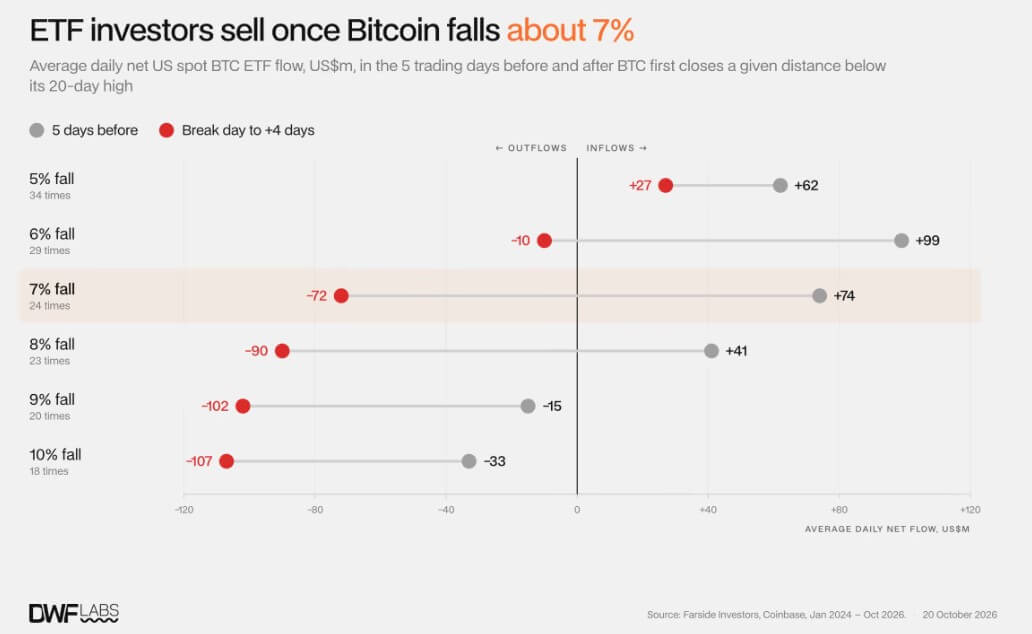
Selling intensified in 19 of the 24 episodes examined, though flows typically returned to neutral levels over the next two weeks.
The finding comes as Bitcoin ETFs have pulled in $57.96 billion in cumulative net inflows, with the 12 products managing around $110 billion in assets.
Bitcoin is -3.97% over the past 24 hours and currently sits at rank #1 by market cap.
Mentioned in this article

Editorial credits

Oluwapelumi values Bitcoin's potential. He imparts insights on a range of topics like DeFi, hacks, mining and culture, underlining transformative power.

Gino Matos is a law school graduate and a seasoned journalist with six years of experience in the crypto industry. His expertise primarily focuses on the Brazilian blockchain…