Banks Want More: Trade Groups Demand Stricter Stablecoin Limits in Clarity Act
In brief
- Eight banking trade groups asked Senate leaders to tighten restrictions on stablecoin rewards.
- They want to delete language allowing rewards tied to balances, duration or tenure.
- The groups say a proposed deposit-flight safeguard would take effect too late.
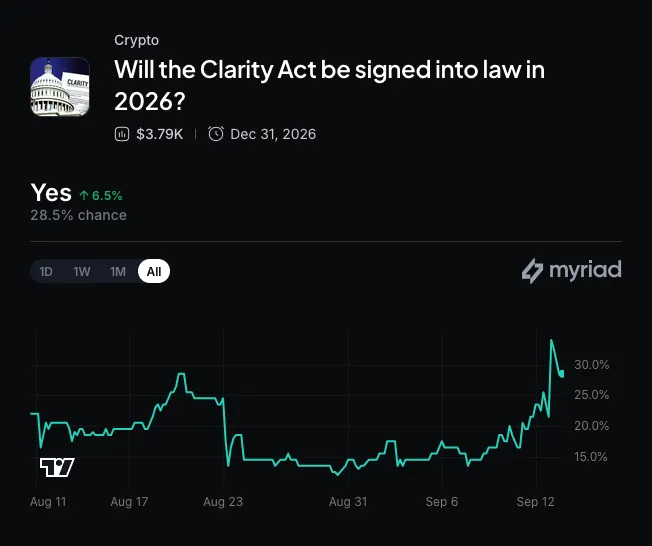
Eight banking trade groups urged Senate leaders Monday to tighten the Clarity Act’s stablecoin rewards restrictions, arguing that exceptions in the bill could allow interest-like payments that draw deposits away from banks.
In their letter to Senate leaders John Thune and Chuck Schumer, the group said it could not support the latest revisions in the Clarity Act regarding rewards for transactions involving stablecoins—tokens typically pegged to the dollar—and sought tighter restrictions on payments tied to how much customers hold or how long they hold them.
“We support this distinction in principle, although we believe that the way the current legislative text is drafted provides loopholes and avenues for the prohibition to be easily evaded that would still allow interest and interest-like payments to be made on stablecoin balances,” the group wrote.
Signatories include the American Bankers Association, Bank Policy Institute and Independent Community Bankers of America, representing large banks and community lenders. The letter comes ahead of a key Senate procedural vote scheduled for Tuesday, following the release of a revised Clarity Act.
While the bill would establish federal rules for digital assets and clarify regulators’ responsibilities, the group wants to remove “solely” from a restriction on payments connected with holding stablecoins. They also seek to replace an equivalence standard with a “substantially similar” test, broadening the restriction to capture incentives that resemble deposit interest.
A separate request would delete language allowing otherwise permissible rewards to depend on a customer’s balance, duration, or tenure.
“Given that interest payments are often calculated by reference to duration, balance and tenure, this subsection appears to contradict the initial prohibition,” the groups wrote.
Banks argue those incentives could attract money they otherwise use to fund mortgages, farms, and small businesses. The letter says community and mission-driven lenders could be particularly exposed, but provides no estimate of potential outflows or evidence that the predicted lending reductions have occurred.
The groups also rejected a proposed deposit-flight “circuit breaker,” which they described as allowing regulators to respond after substantial outflows.
“A circuit breaker that activates only after substantial deposit flight has already occurred is not a safeguard at all,” the group wrote. “Congress should address this risk upfront by ensuring the Clarity Act prohibits payment stablecoin rewards and incentives that function like deposit interest, rather than waiting for harm to banks, borrowers and communities before regulators are empowered to respond.”
The letter renewed demands made by six banking trade groups in May, including restrictions on rewards tied to account balances and adoption of a “substantially similar” standard.
The dispute has since spread to senators’ home states, where community bankers have pushed for tighter restrictions and crypto advocates have rallied support for the bill. Crypto firms argue that stablecoin rewards should remain available and that the industry needs clearer federal rules.