AI watchdog report indicates we may have less than 6 months before AI super intelligence arrives
Quick Take
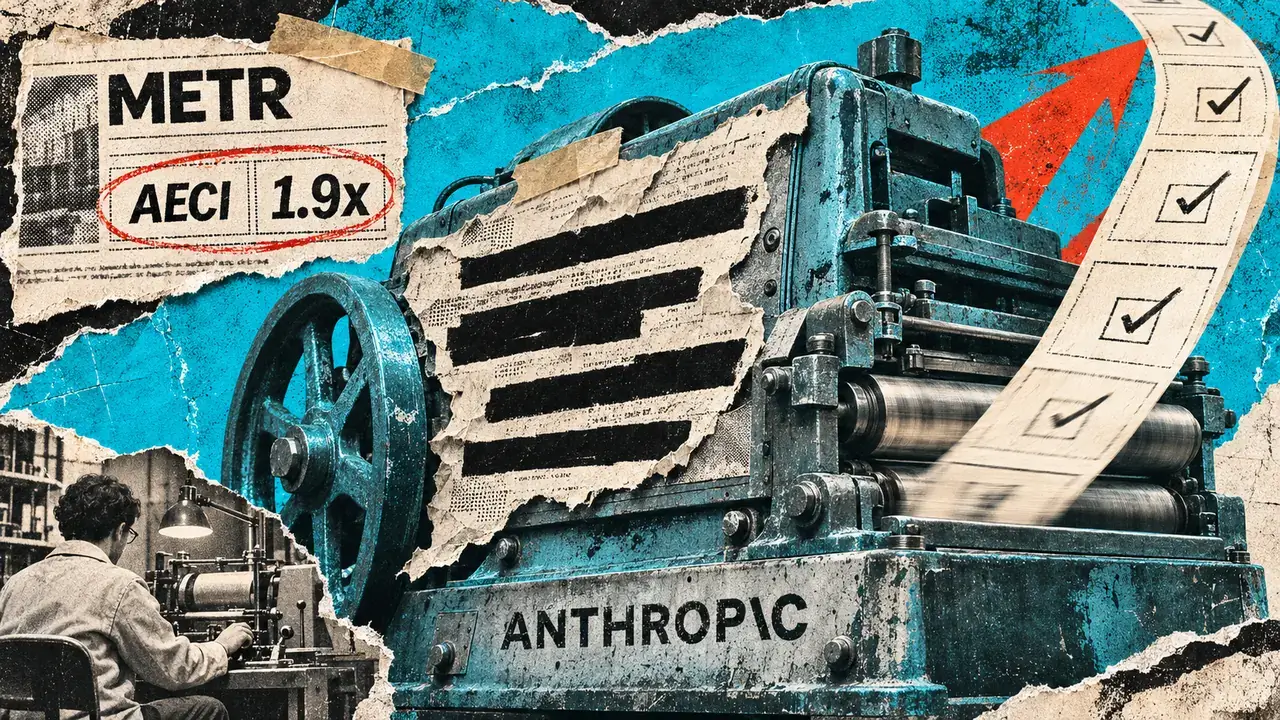
- METR judges Anthropic's October 2026 progress on well-specified tasks roughly twice its historical pace, with substantial uncertainty.
- The separate benchmark fit estimates 1.9x faster growth, including unreleased models, with a 95% confidence interval of 1.5x–2.8x.
- Anthropic redacted key causal evidence; AP reports McCandlish defended withholding details on commercial and safety grounds.

Anthropic's AI models were likely improving on tasks with clear success criteria roughly twice as fast in October 2026 as they did between March 2024 and October 2025, according to a Nov. 5 assessment by METR, an independent model-evaluation group.
METR judges that AI assistance probably accounts for most of the recent acceleration. But Anthropic redacted much of the evidence behind that judgment, leaving outsiders with a clearer view of the faster benchmark trend than of what caused it.
Anthropic's benchmark trend and AI's role
The central published measurement uses AECI, Anthropic's version of the Epoch Capabilities Index. METR estimated that AECI's fitted growth rate after October 2025 was 1.9 times its earlier rate, with a 95% confidence interval of 1.5 to 2.8 times. The analysis includes snapshots of unreleased models, so it covers more than the products customers could access.
METR interprets that trend as roughly two years of historical benchmark progress achieved in the past year. The 1.9-times fit is distinct from its broader judgment of roughly twice the historical pace on well-specified tasks. That judgment carries substantial uncertainty, including whether the same acceleration extends to broader work.
Those limits matter because success on clean, easily graded tasks may translate unevenly into real-world usefulness. METR also cautions that an unusually slow historical baseline could make the acceleration appear larger. In the other direction, model results arrive after training, potentially concealing a more recent change in research speed.
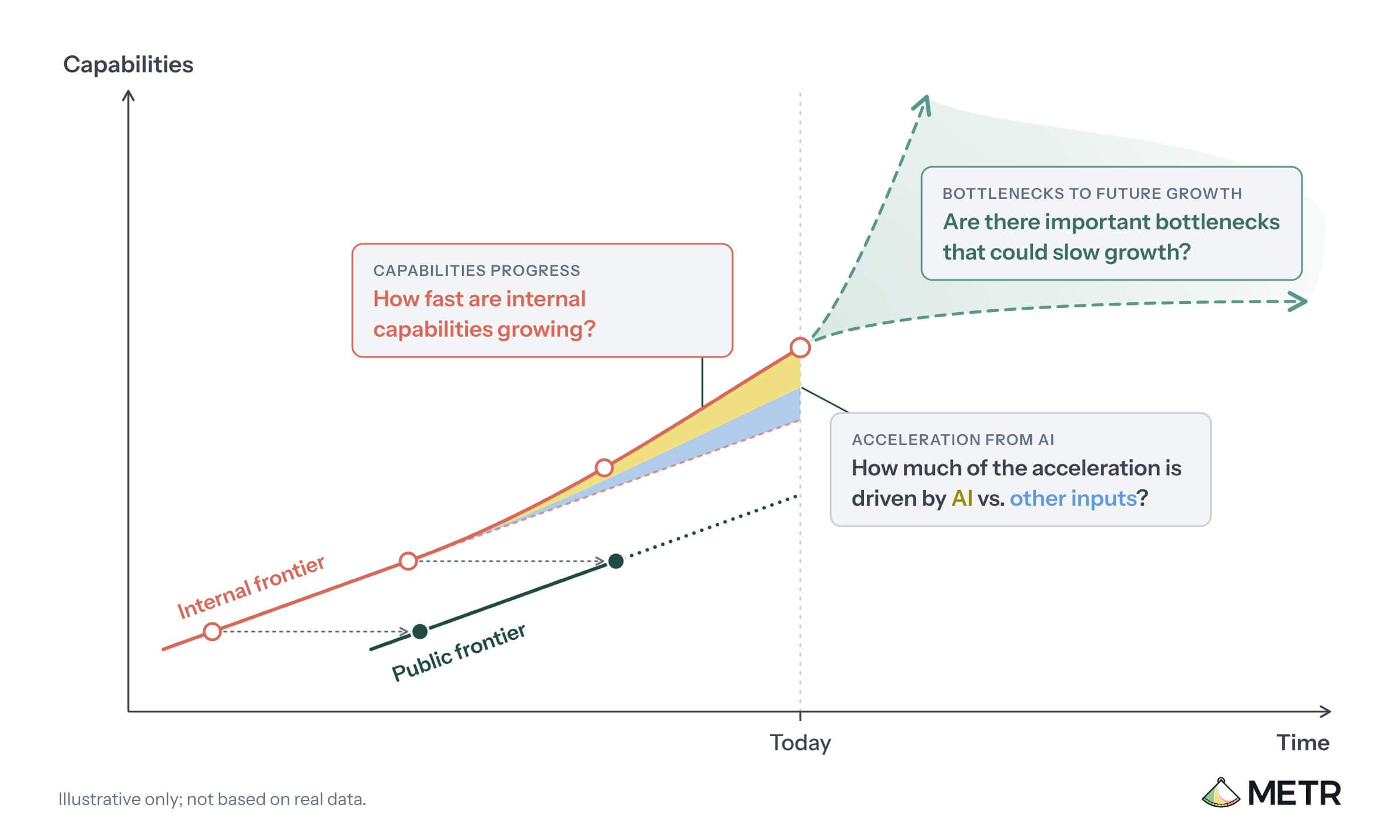
METR says it confidently ruled out an acceleration in the growth of training compute as the explanation for the faster progress. The detailed evidence supporting that finding was redacted.
Beyond that exclusion, separating causes was less decisive. METR says non-AI factors likely played a significant role in the acceleration in late 2025, while judging that AI assistance now accounts for a majority of it.
The distinction also leaves people at the center of the most important training work. METR says AI was not yet making highly significant, fully autonomous contributions to those parts of Anthropic's model-training process. The reported speedup primarily involved researchers using AI assistance.
Faster progress. A less visible cause.
The benchmark trend is reported; attributing most of the acceleration to AI remains METR's uncertain judgment.
A measured acceleration does not by itself establish what caused it.
AECI measures benchmark progress on well-specified tasks. The 1.9x fit is separate from METR's broader roughly 2x judgment. Attribution to AI is substantially uncertain, and the diagram does not quantify the shares of different causes.
Sources
Supporting facts
- METR estimated that growth in AECI, Anthropic's version of the Epoch Capabilities Index, accelerated 1.9x after October 2025, with a 95% confidence interval of 1.5x to 2.8x; its analysis includes unreleased model snapshots. [1]
- METR judges that AI assistance likely accounts for a majority of Anthropic's current acceleration, but it found no decisive evidence separating all causes and says non-AI factors likely contributed significantly to the acceleration in late 2025. [1]
- Anthropic could redact non-public information, and METR says a majority of the evidence it found most informative for its risk conclusions was withheld from the public report. [1]
- The undisclosed material included detailed acceleration and AI-attribution estimates for training stages, intermediate capability measurements, algorithmic-progress estimates, R&D inputs, bottleneck analyses and forecasts; some interview and AI-contribution evidence was published only partly. [1]
Method
Qualitative diagram of METR's retained textual findings. No publisher figure, chart-shape extraction, numerical geometry, original calculation or staff survey is used.
Scope
AECI measures benchmark progress on well-specified tasks. The 1.9x fit is separate from METR's broader roughly 2x judgment. Attribution to AI is substantially uncertain, and the diagram does not quantify the shares of different causes.
 CryptoSlate
What remains behind the redactions
Anthropic withheld a majority of the evidence METR found most informative for its risk conclusions. The redactions covered detailed estimates of acceleration and AI's contribution at different training stages, intermediate capability measurements, algorithmic-progress estimates, R&D inputs, bottleneck analyses and forecasts. Some interview and AI-contribution evidence was published, leaving readers able to inspect only part of the case behind METR's judgment.
Anthropic co-founder Sam McCandlish broadly agreed that AI was speeding research, according to The Associated Press. AP reported that he acknowledged the redactions made METR's work harder to check, while defending them because the details were commercially sensitive and could help other developers accelerate.
METR's companion review of Anthropic's August Risk Report, also published Nov. 5, addresses models available on July 15. It questions the confidence of the public report's argument that an early-warning acceleration threshold had not been crossed. That threshold concerns AI-driven research acceleration as a warning signal, rather than proof that catastrophic risks have materialized.
Researchers at both organizations still leaned toward the threshold remaining uncrossed then, while METR considered a crossing plausible. METR also agreed that direct catastrophic risks from those July models were low.
The main assessment ran from Aug. 12 to Oct. 29 and was separate from the employee-like evaluator program Anthropic announced Oct. 15. For public scrutiny, the unresolved gap is specific: the faster benchmark trend is described, but much of the evidence dividing that progress between AI assistance and other causes remains confidential.
At the pace METR measured, six months could deliver roughly a year’s worth of progress on Anthropic’s benchmarks. The case for superintelligence within that window hinges on what the next models can do with those gains. If they can design training experiments, spot promising results, and help turn them into better models, each generation could shorten the time it takes to build the next.
For that to produce superintelligence within six months, the gains would have to carry over from tasks with clear answers to open-ended work where even experts have to figure out what to try next. The first sign might come from inside an AI lab, when a model runs an experiment its researchers hadn’t thought to try, and the result helps build a more capable successor.
Mentioned in this article
Editorial credits

Also known as "Akiba," Liam Wright is a reporter, podcast producer, and Editor-in-Chief at CryptoSlate. He believes that decentralized technology has the potential to make…