Aave Horizon taps perpetual futures to price stock collateral on weekends, Chainlink says

Quick Take
- Chainlink says Aave Horizon uses its new weekend pricing feeds, starting with high-volume U.S. equities.
- Off-hours references draw on perpetual-futures venues, so weekend valuations do not represent trades on closed stock exchanges.
- Initial Horizon equity tokens and liquidation settings are undisclosed in the announcement; stablecoin lenders still depend on executable collateral exits.

Chainlink says Aave's institutional lending platform Horizon is using its new weekend pricing service, giving tokenized stock collateral a reference that keeps moving while traditional exchanges are closed. The service was announced Oct. 29 and starts with high-volume U.S. equities, according to Chainlink's announcement.
The off-hours price comes from derivatives markets. During regular, extended and overnight sessions, Chainlink 24/7 uses its existing weekday data. When the underlying market closes, it draws quotes from multiple perpetual-futures venues, where derivatives linked to the asset continue trading. That reference reflects those markets' prices, rather than transactions on a closed stock exchange.
Chainlink says it filters stale inputs, limits outlier influence and joins the different sessions into one continuous series. Lending protocols receive the prices through onchain Data Feeds.
What changes for borrowers and lenders
For a borrower, the consequence depends on how the feed enters collateral calculations. Where the moving reference is integrated into the market's risk rules, a weekend decline can reduce the value supporting a loan before the underlying exchange reopens. A position could cross its liquidation threshold during that window, rather than waiting for the reopening price update.
Horizon is a separate institutional instance of Aave. Only participants qualified and allowlisted by the collateral's issuer can supply its tokenized real-world assets and borrow against them. Its stablecoin pools, including USDC, RLUSD and GHO, accept liquidity from unrestricted suppliers. Collateral requirements and liquidation thresholds depend on the underlying asset.
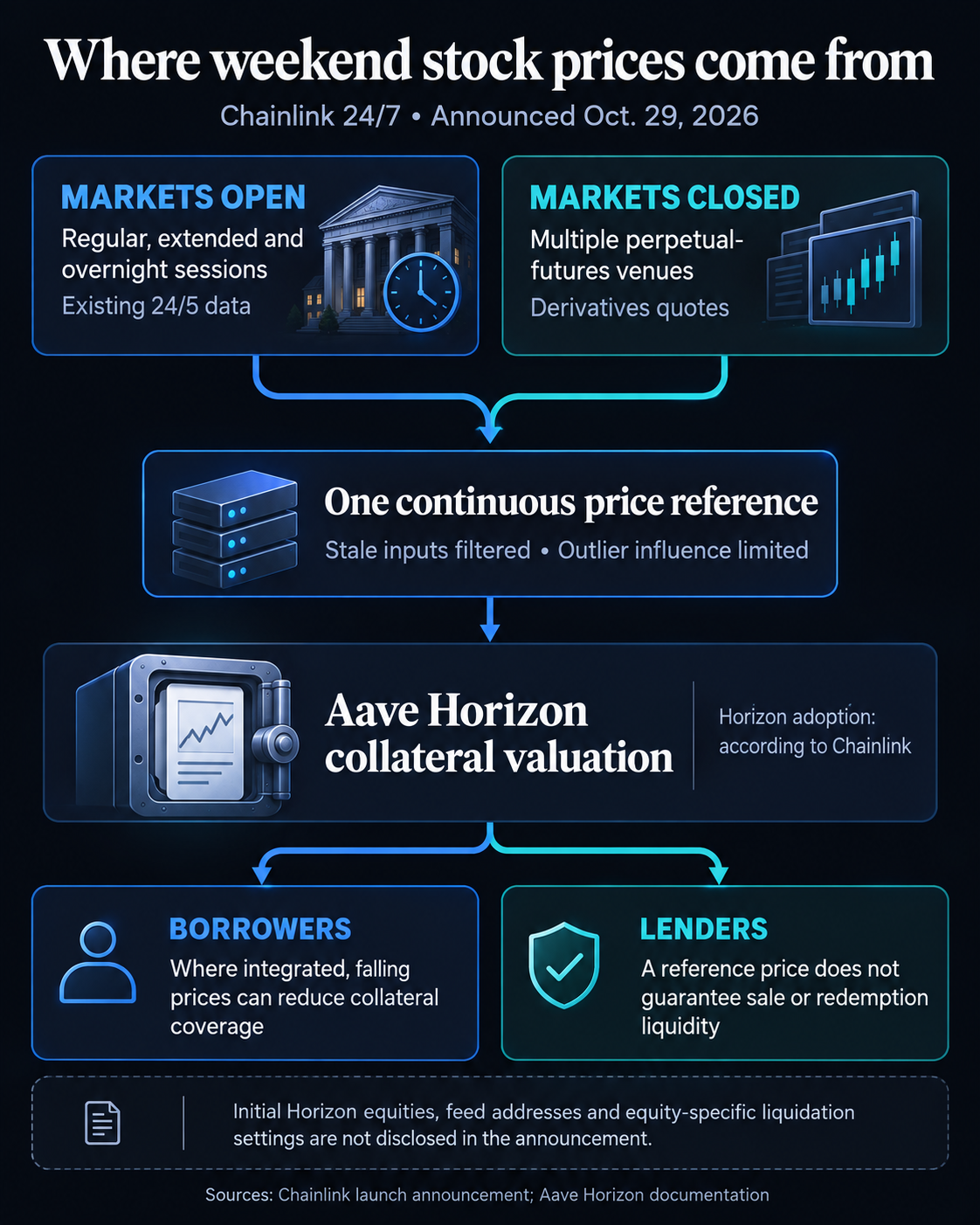
For those stablecoin lenders, a moving valuation can make deteriorating collateral visible sooner. Debt recovery still depends on what can be realized from the collateral; an oracle reference by itself supplies neither a buyer nor redemption access.
Chainlink's announcement and Aave's Horizon documentation do not disclose the initial equity tokens, their feed addresses or equity-specific liquidation settings. Horizon's documentation describes bounds on issuer-reported net asset values that reject out-of-range updates and retain the last valid price. How those safeguards apply to the newly announced equity feeds is not specified in those pages.
This is distinct from Aave's V4 Equities Hub on Base, the subject of CryptoSlate's September weekend-gap coverage. Aave's Sept. 25 description of that market listed seven Coinbase stock tokens and feeds that held their last value over weekends. The Horizon announcement does not establish that Base's configuration has changed.
Mentioned in this article
Editorial credits

Also known as "Akiba," Liam Wright is a reporter, podcast producer, and Editor-in-Chief at CryptoSlate. He believes that decentralized technology has the potential to make…