Aave and Lido lose $1.7B in massive DeFi capital drop after the Binance hack

Quick Take
- Stablecoin market capitalization fell about $10.8 billion over 30 days, with earlier data showing contraction before the Binance breach.
- Aave's emergency freeze blocked fresh deposits while withdrawals pushed some reserves toward full utilization and higher borrowing costs.
- LlamaRisk's Nov. 2 update retained zero collateral borrowing power for USDT, USDC and USDT0 in affected Aave configurations.

Binance's security breach hit a crypto market whose stablecoin market was already shrinking, as DeFiLlama's dashboard put stablecoin market capitalization at $293.8 billion by Nov. 3, down over $10 billion in 30 days.
Binance's Nov. 3 report estimated that approximately $6.34 billion in assets were impacted on October 29 and said the company would absorb the financial impact.
The exchange's Oct. 29 incident added a separate shock to decentralized lending when an exploiter-linked wallet supplied USDT to the Aave lending protocol.
Aave's risk service provider LlamaRisk reported that an exploiter-linked wallet supplied 60 million USDT and borrowed 19,762 units of Wrapped Ethereum (WETH), worth about $44.6 million at the time.
Its Oct. 30 assessment described the position as overcollateralized and subject to normal liquidation, and said it did not put suppliers at risk.
Guardians subsequently froze 175 Aave V3 reserves and 117 V4 reserves. New supply and borrowing stopped in frozen reserves, while repayments, withdrawals and liquidations remained enabled.
Suppliers could withdraw available tokens, but fresh deposits could not replace them. LlamaRisk said withdrawals pushed some large reserves to 92%-100% utilization, meaning almost all supplied funds were borrowed. Borrowing costs rose, and stewards temporarily reduced the upper part of the interest-rate curves.
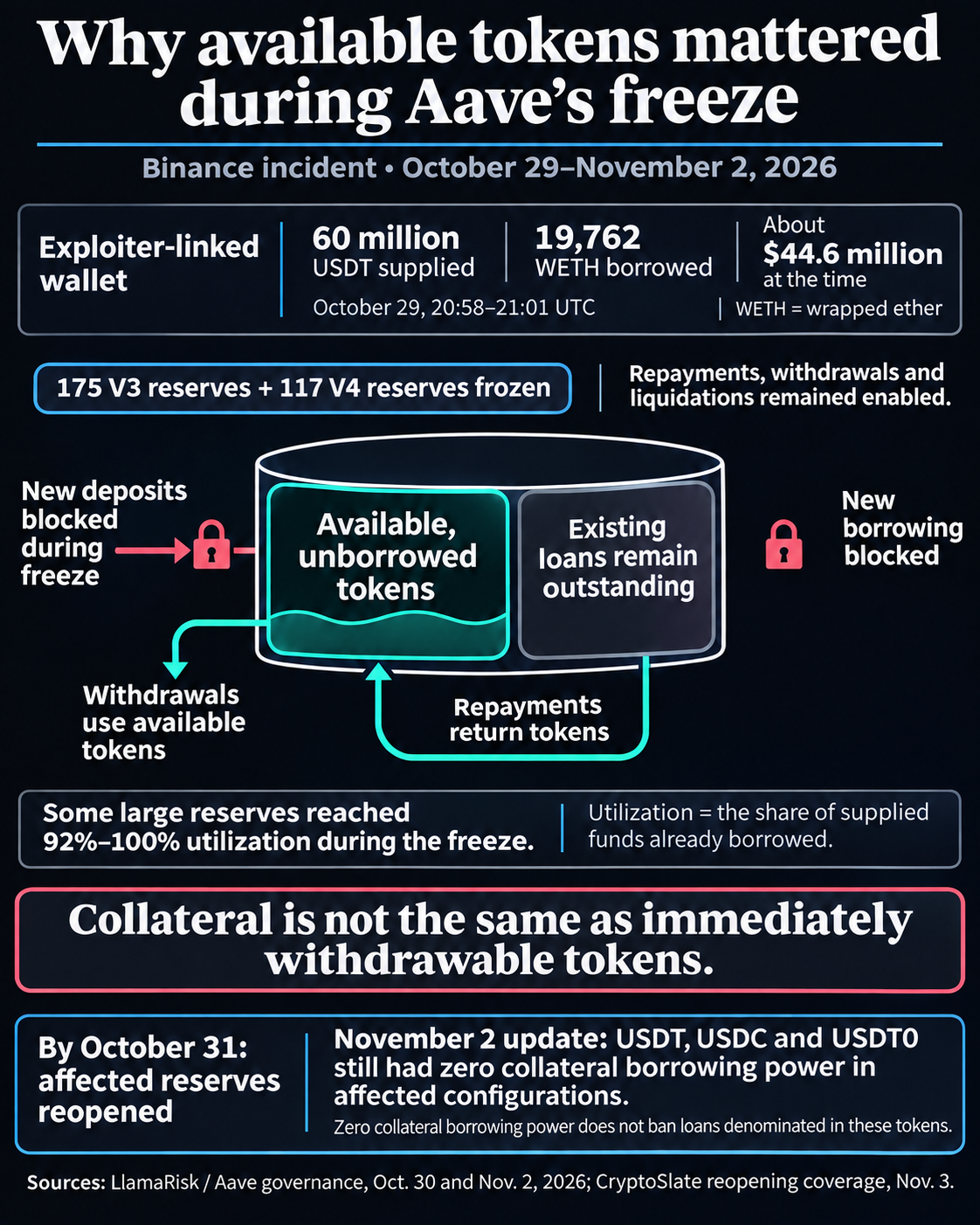
The affected reserves had reopened by Oct. 31, and LlamaRisk reported on its Nov. 2 update the restoration of specified non-stablecoin collateral settings and said affected reserves had returned to pre-incident rate curves on Nov. 1.
USDT, USDC, and USDT0 still had zero collateral borrowing power in affected configurations.
The wider contraction began before the Binance breach
Among the large protocols examined, Aave recorded the biggest dollar decline between Oct. 27 and Nov. 3. Its dated daily total value locked (TVL) fell by about $1 billion, and Lido followed with a $713 million decline.
| Protocol | Oct. 27 TVL | Nov. 3 TVL | Decline |
|---|---|---|---|
| Aave | $17.435 billion | $16.405 billion | $1.030 billion |
| Lido | $22.557 billion | $21.844 billion | $713 million |
| JustLend | $6.856 billion | $6.419 billion | $437 million |
| Morpho | $11.450 billion | $11.092 billion | $358 million |
| Sky | $5.469 billion | $5.157 billion | $312 million |
Falling token prices can reduce TVL without depositors moving assets, so a smaller TVL does not by itself establish either capital flight or insolvency.
USDT and USDC accounted for about $8.4 billion of the implied 30-day market-cap decline, based on DeFiLlama's rounded values and percentage changes.
DeFiLlama's separate historical series, which has different coverage from the dashboard, fell from $308.8 billion on Oct. 4 to $303.3 billion on Oct. 27.
Issuer redemptions exchange circulating stablecoins for fiat, differing from moving tokens off an exchange or between wallets. Freezing stolen tokens also does not automatically remove them from supply.
The practical risk is the amount of liquidity available where they need it. Thinner trading pools can produce more slippage for the same trade, lending withdrawals can raise borrowing costs, and falling collateral prices increase liquidation exposure.
Conditions would look healthier with renewed stablecoin net issuance, lending deposits returning, lower reserve utilization with more withdrawable tokens, and steadier collateral prices. A rebound in dollar TVL alone would not show that lending cash had returned.
Mentioned in this article

Editorial credits

Gino Matos is a law school graduate and a seasoned journalist with six years of experience in the crypto industry. His expertise primarily focuses on the Brazilian blockchain…

Oluwapelumi values Bitcoin's potential. He imparts insights on a range of topics like DeFi, hacks, mining and culture, underlining transformative power.