A forced Bitcoin Lightning exit can be cheap and still leave you waiting days
Quick Take
- The preprint's 2026 public force-close cohort paid median fees of 925 satoshis per channel across both parties.
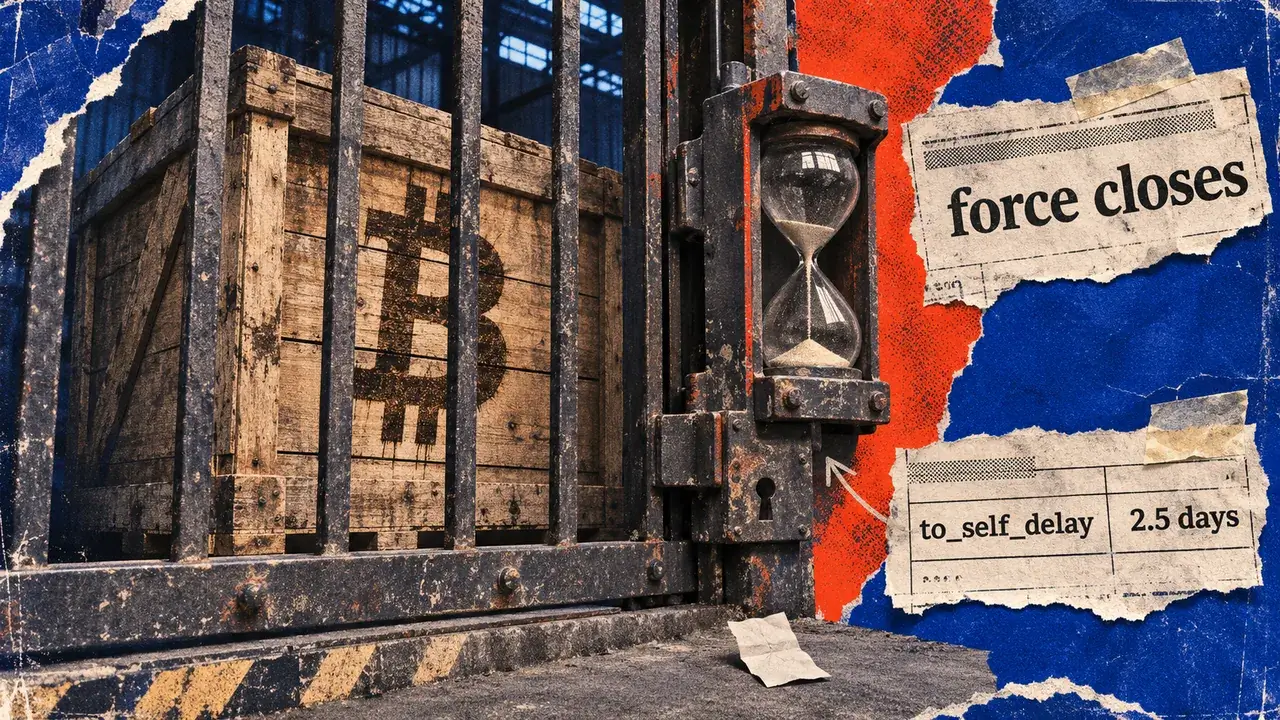
- The party initiating a forced closure waited a median 2.5 days before it could reclaim its own balance.
- Lightning’s zero-fee design changes how settlement fees are paid, but the waiting period remains.

When a Bitcoin Lightning channel closes without both parties agreeing, the fees can be small but the wait can stretch for days. In a 2026 sample of public channels, forced closures cost a median 925 satoshis per channel across both parties, while the party that initiated the closure waited a median 2.5 days before it could reclaim its own balance, according to Saurabh Kumar's November 12 preprint.
Kumar, of Bitcoin Data Labs, reports 973,581 channel closes from January 2018 through October 31, 2026, including 523,815 force closes. The detailed 2026 cost cohort covers 14,435 public force closes through October 4, leaving four weeks to follow their outputs.
For comparison, the paper reports a 2026 cooperative-close median of 197 satoshis. The ratio between the force-close and cooperative-close medians was 4.7 to one. Its force-close total includes the commitment transaction, required balance sweeps, pending-payment resolution, observed same-block owner fee bumps and later owner anchor cleanup, with batched spending fees divided among inputs.
Why the balance stays locked
A unilateral close uses a previously signed commitment transaction to settle a channel on Bitcoin. Under Lightning's BOLT 3 specification, the output returning the broadcaster's own balance carries a delay called to_self_delay. That gives the peer time to penalize a broadcaster that submits a revoked channel state.
The 2.5-day figure measures the wait before that balance becomes eligible to be swept. It does not promise receipt in a wallet at that moment, and it does not describe the speed of ordinary Lightning payments. Across the whole study period, the reported median wait was 1.7 days.
Low exit fees. Days before funds can move.
In the preprint's 2026 public force-close cohort, a small miner-fee bill came with a separate delay for the broadcaster's own balance.
Zero-fee design: where mining fees come from
A fee-paying child funds the commitment package. The broadcaster's balance delay remains.
Paying the settlement fee does not remove the broadcaster's contractual wait.
Fees aggregate both parties per channel. Delay ends at sweep eligibility, not wallet receipt. Excludes private cooperative closes and unclassified simple-taproot spending details. Zero-fee mechanism panel is protocol context, not cohort-specific evidence.
Sources
Supporting facts
- For 14,435 public force closes in its 2026 cost cohort through October 4, the preprint reports median total required fees of 925 satoshis and a median 2.5-day wait before the broadcaster's own balance could be swept. [1]
- BOLT 3 requires outputs returning funds to the commitment broadcaster to wait to_self_delay blocks, allowing the peer to penalize a revoked commitment; this delayed to_local output remains in the zero-fee commitment design. [2]
- Under BOLT 3's zero-fee commitments, commitment mining fees must be supplied through child-pays-for-parent, while HTLC transaction fees are supplied by adding inputs. [2]
- The combination of delayed broadcaster balances and fee-paying settlement means low observed exit fees alone do not establish how much immediately usable liquidity an operator retains after unilateral closure. [1] [2]
Method
Reported 2026 cohort medians, not a simulation: 14,435 public force closes through October 4. Timeline geometry is schematic and not a time scale. Fee-route diagrams separately explain the BOLT 3 zero-fee design, not outcomes measured for that design.
Scope
Fees aggregate both parties per channel. Delay ends at sweep eligibility, not wallet receipt. Excludes private cooperative closes and unclassified simple-taproot spending details. Zero-fee mechanism panel is protocol context, not cohort-specific evidence.
 CryptoSlate
This distinction matters for operators that need accessible funds while a channel is settling. A cheap exit can still leave capital unavailable for days; its fee alone does not reveal how much immediately usable liquidity remains.
Kumar compares those costs using a break-even annual return: the rate at which the broadcaster's locked-balance waiting cost would equal force-close fees. It was 1.2% in 2026, versus 16.7% over the full period. It compares per-channel fees across both parties with the broadcaster's locked balance, excluding pending-payment amounts. The calculation illustrates how the wait can outweigh fees in a low-fee environment; it does not assume that operators earned that return.
The same distinction between fees and accessible funds matters for BOLT 3's zero-fee commitment design, which changes how miners are paid. A child transaction supplies the commitment's mining fee through child-pays-for-parent. Transactions resolving conditional pending payments, known as HTLCs, obtain fees through added inputs.
The broadcaster's delayed balance remains part of that design. Removing a fee from the pre-signed transaction therefore leaves both a paid settlement path and a waiting period to account for.
The measurements also have boundaries. Private cooperative closes are absent, splices are excluded from the close counts, and simple-taproot delays, HTLC resolutions and fee bumps are unclassified in the cost analysis. Confirmed-chain records cannot show failed or replaced fee bumps.
The released repository contains code and aggregate outputs, while underlying scan tables, channel lists and gossip snapshots are available from the author on request. For operators, the findings make access to funds part of the exit bill, alongside the transactions needed to recover them. Readers comparing wallet support for everyday Lightning payments can consult CryptoSlate’s Bitcoin wallet guide.
Mentioned in this article

Editorial credits

Also known as "Akiba," Liam Wright is a reporter, podcast producer, and Editor-in-Chief at CryptoSlate. He believes that decentralized technology has the potential to make…